Heterogeneous Catalytic Synthesis of Deuterated Fine Chemicals: Catalyst Design Strategies and Future Perspectives

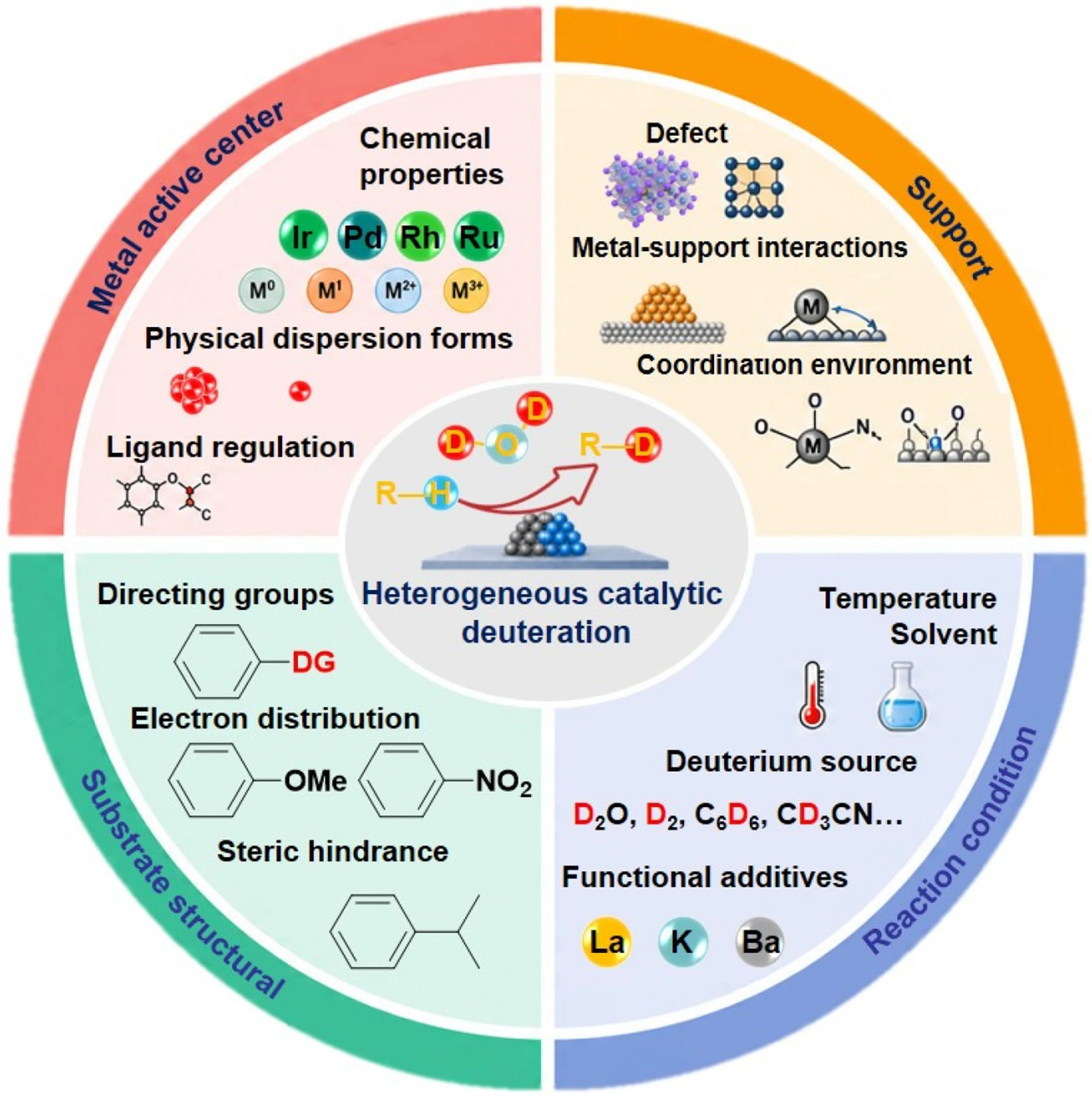
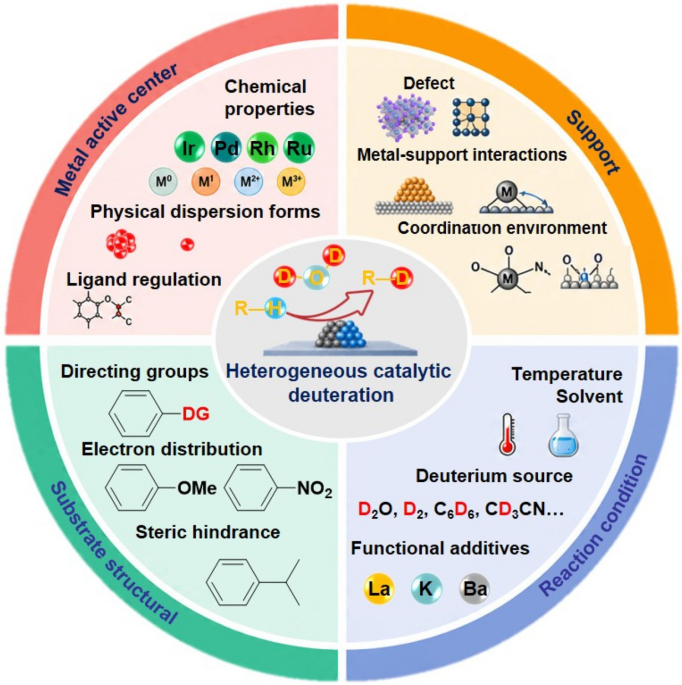

In this review, we provide an overview of recent advances in heterogeneous catalytic deuteration and discuss key catalyst design principles that enable efficient site-selective deuteration and perdeuteration. Particular attention is given to the roles of metal active centers, catalyst supports, substrate properties, and reaction conditions, as well as the growing use of deuterium oxide (D2O) as a practical deuterium source. We further highlight recent progress in catalyst development and outline future opportunities for sustainable and industrially relevant deuteration processes.
Key Insights
- Metal active centers, catalyst supports, substrate characteristics, and reaction conditions are identified as the four primary factors governing heterogeneous deuteration performance.
- Noble-metal catalysts, including Ir-, Rh-, Pd-, Ru-, and Pt-based systems, continue to demonstrate superior activity and selectivity for hydrogen-deuterium exchange and C-H bond activation.
- Single-atom catalysts have emerged as an effective strategy for maximizing metal utilization efficiency while enhancing catalytic performance compared with conventional nanoparticle catalysts.
- Non-noble-metal catalysts, including Fe-, Mn-, Ni-, and Cu-based systems, are gaining increasing attention as cost-effective and sustainable alternatives capable of achieving high deuterium incorporation.
- Deuterium oxide (D2O) is becoming an increasingly attractive deuterium source because of its low cost, wide availability, and compatibility with heterogeneous catalytic processes.
- Metal-free deuteration methods, particularly electrochemical and photochemical approaches, offer promising routes for deuterium incorporation under mild reaction conditions without the risk of metal contamination.
- Rational catalyst-support engineering can regulate electronic structures, adsorption behavior, and hydrogen spillover effects, leading to improved catalytic efficiency and isotope selectivity.
- Significant advances have been achieved in perdeuteration, where both monometallic and bimetallic catalyst systems provide high deuterium incorporation while minimizing undesirable side reactions.
- Continuous-flow deuteration technologies are progressing rapidly and offer advantages in safety, process control, scalability, and industrial implementation.
- The integration of advanced characterization techniques, mechanistic investigations, computational modeling, and machine-learning-assisted catalyst design is accelerating catalyst discovery and deepening understanding of deuteration mechanisms.
Why This Matters
Deuterium-labeled compounds play important roles in pharmaceutical development, mechanistic studies, analytical chemistry, and materials science. Advances in heterogeneous catalytic deuteration have transformed the field into a versatile platform for efficient isotope incorporation. The development of highly active catalyst systems, especially those capable of utilizing inexpensive D2O, has significantly improved the practicality, sustainability, and scalability of deuteration processes. Continued progress in catalyst design and process engineering is expected to support broader applications in drug discovery, isotope labeling, and industrial chemical production.
Looking Ahead
Future research opportunities include:
- Developing ultra-low-loading noble-metal catalysts with enhanced atom efficiency.
- Expanding the capabilities of non-noble-metal catalytic systems.
- Improving deuteration processes that rely on inexpensive D2O.
- Advancing mechanistic understanding through in situ characterization and theoretical studies.
- Applying machine learning and computational screening to catalyst discovery.
- Accelerating the adoption of continuous-flow manufacturing for large-scale deuterated compound production.
These directions are expected to contribute to more efficient, sustainable, and industrially viable deuteration technologies in the coming years.
Authors & Affiliations
Authors
Fu-Jia Gao, Xiang-Yi Liu, and Guang-Ping Hao.
Affiliation
State Key Laboratory of Fine Chemicals, Frontier Science Center for Smart Materials, Liaoning Key Laboratory for Catalytic Conversion of Carbon Resources, School of Chemical Engineering, Dalian University of Technology, Dalian 116024, People's Republic of China.
Corresponding Author
Guang-Ping Hao
guangpinghao@dlut.edu.cn
How to Cite This Article
Gao, F.-J., Liu, X.-Y. & Hao, G.-P. Catalyst design in heterogeneous deuteration: recent advances and perspectives. Catal 2, Article 20 (2026). https://doi.org/10.1007/s44422-026-00033-x
Follow the Topic
-
Catal
Catal is an open access journal covering full spectrum of catalysis critical advances. From biocatalysts to heterogeneous catalysts, it integrates fundamental and applied sciences. Catal offers a primary platform for researchers and practitioners in the field.

Related Collections
With Collections, you can get published faster and increase your visibility.
Porous Materials for Sustainable Green Catalysis
The advancement of our collective understanding in the field of porous materials for sustainable green catalysis is crucial as we face urgent environmental challenges and the need for sustainable energy solutions. The integration of porous materials into catalytic processes has opened new avenues for improving efficiency, selectivity and stability while minimizing waste. Significant advances have been made, including the development of zeolites, mesoporous materials, metal-organic frameworks (MOFs) and covalent organic frameworks (COFs), which have demonstrated remarkable catalytic performance in various reactions.
Future research holds immense potential, with speculations ranging from the design of novel porous materials with tailored properties to their application in industrial catalysis, biocatalysis, H2 production and carbon capture technologies. By continuing this research, we can drive progress toward achieving Sustainable Development Goals (SDGs), particularly in clean energy (SDG 7) and climate action (SDG 13), ultimately fostering a sustainable future for our planet.
We invite researchers to contribute to this special Collection by submitting research articles, brief communications, perspectives, reviews, and analyses.
Topics of interest include but are not limited to:
- Synthesis of porous materials
- Catalytic performance evaluation
- Green synthesis methods
- Application in environmental remediation
- CO2 conversion technologies
- Biocatalysis in porous matrices
- Design of multifunctional porous catalysts
- Mechanistic studies of catalysis
Publishing Model: Open Access
Deadline: Dec 31, 2026
National Catalysis Conference 2025
The 22nd National Catalysis Conference, held in December 2025 in Xiamen, China, stands as the largest national academic event in the field of catalysis, bringing together leading scientists from academia and industry to discuss frontier research and emerging technologies across catalytic science.
In collaboration with several internationally recognized researchers from Xiamen University - the main organizer of the conference - Catal will publish a Special Issue featuring selected contributions from the meeting. This joint effort ensures high academic standards and showcases the scientific breadth and excellence presented at the conference.
Potential topics include, but are not limited to:
• Catalytic materials
• Thermocatalysis
• Electrocatalysis
• Biomass and CO₂ conversion
• Industrial catalysis
• Theoretical and computational catalysis
Publishing Model: Open Access
Deadline: Dec 31, 2026