Metastable ferroelectricity driven by depolarization fields in ultrathin Hf0.5Zr0.5O2
Published in Physics
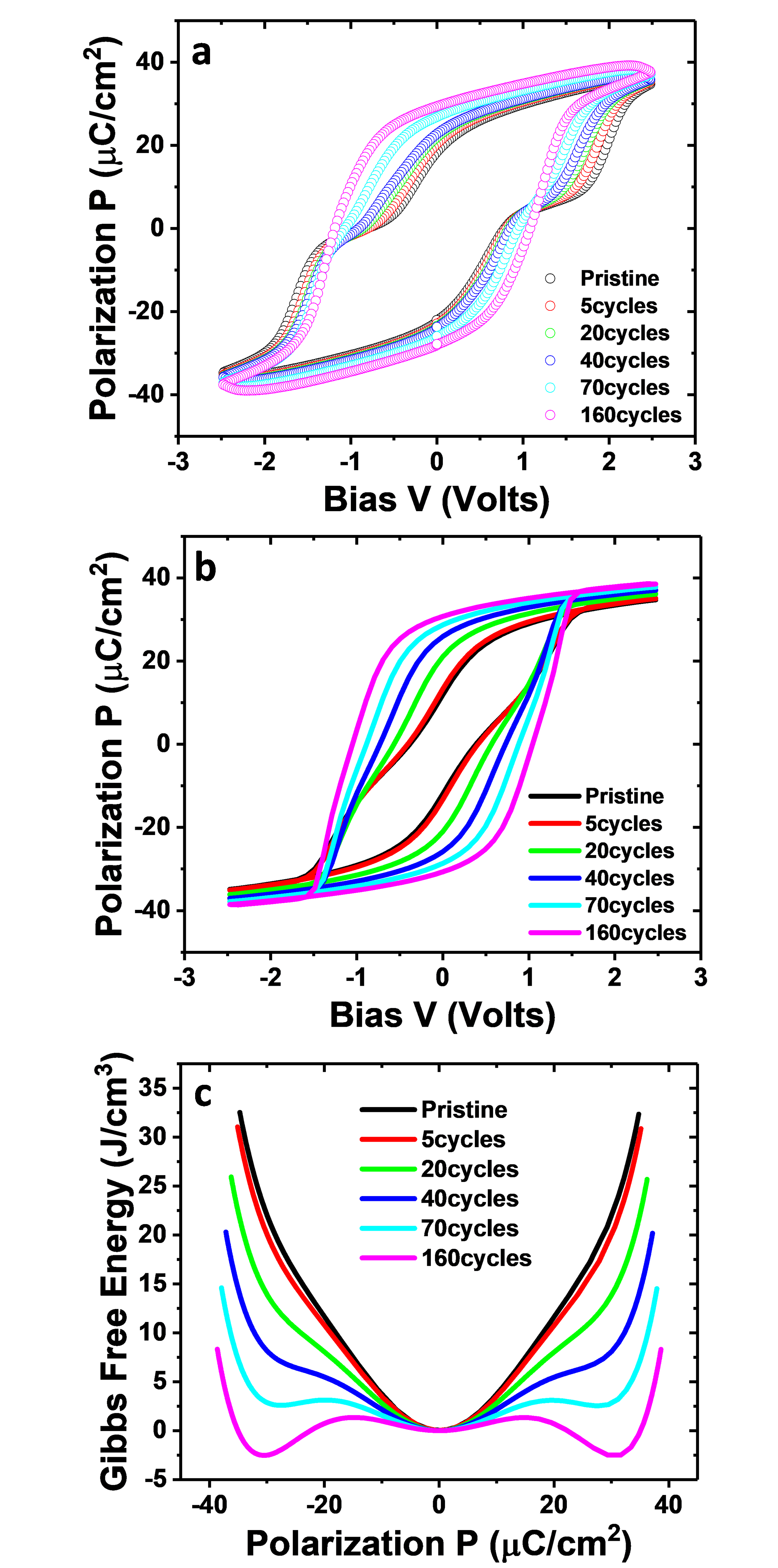

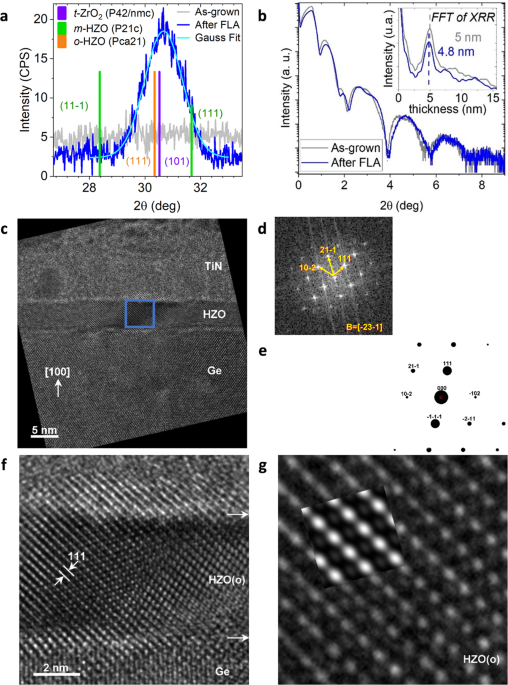

It is very often reported in the literature that the pristine ferroelectric hysteresis of Hf0.5Zr0.5O2 (HZO) is constricted or pinched with a reduced remanent polarization. The problem is more pronounced for films thinner than 10 nm which inhibits their use in applications, especially those relying on ultrathin barriers such as ferroelectric tunnel junction (FTJ) memory devices. There have been many proposals about the possible cause of this behavior. The most common explanation is that a dominant antiferroelectric (AFE) phase exists in HZO that causes the observed AFE-like hysteresis. However, pinched or double loops do not necessarily mean that AFE phases exist in the material. It is well known for example that 1storder ferroelectrics above the Curie temperature Tc show double loop hysteresis associated with a triple potential well in the Gibbs free energy.
In this work by Siannas et al. Commun Phys 5, 178 (2022) and in the framework of Landau Ginsburg Devonshire (LGD) theory, we propose that a similar situation can be realized in the presence of a depolarization field (quite strong in ultrathin ferroelectrics) due to uncompensated polarization charges. In short, the depolarization field adds a positive energy term, quadratic in polarization, which counteracts the negative terms in the Gibbs free energy resulting in a triple potential well (Fig.1).
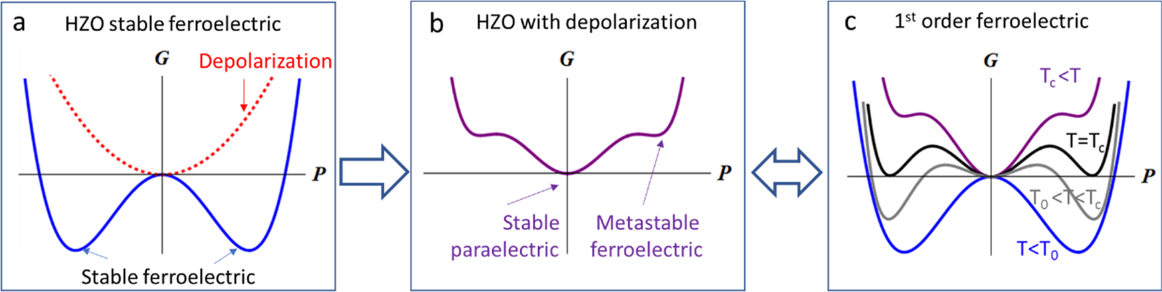
The latter describes a stable paraelectric phase coexisting with a metastable ferroelectric one that gives rise to pinched ferroelectric loops. In essence, the depolarization field drives the ferroelectric in a situation that resembles a 1st order ferroelectric above the Curie temperature Tc (Fig. 1). To rephrase it, the depolarization field lowers the effective Tc of HZO driving it to a metastable ferroelectric state with pinched loops.
From a different perspective, the system reacts against the building up of a depolarization field by minimizing the cause, that is the remanent polarization. This state with reduced remanent polarization is energetically favored since it minimizes the build in electrostatic energy. The interesting thing is that the reduction of remanent polarization (pinched hysteresis) is nicely described within the LGD theory framework.
Then, we showed that in the framework of LGD, we can also explain how we the full ferroelectric loops can be recovered by field cycling (“wake-up”). More specifically, we show that the polarization and an external bias, both can facilitate the injection of carriers from the metal electrodes into pre-existing defect traps at the interface which screen the depolarization field, leading to full ferroelectric loops (Fig. 2).
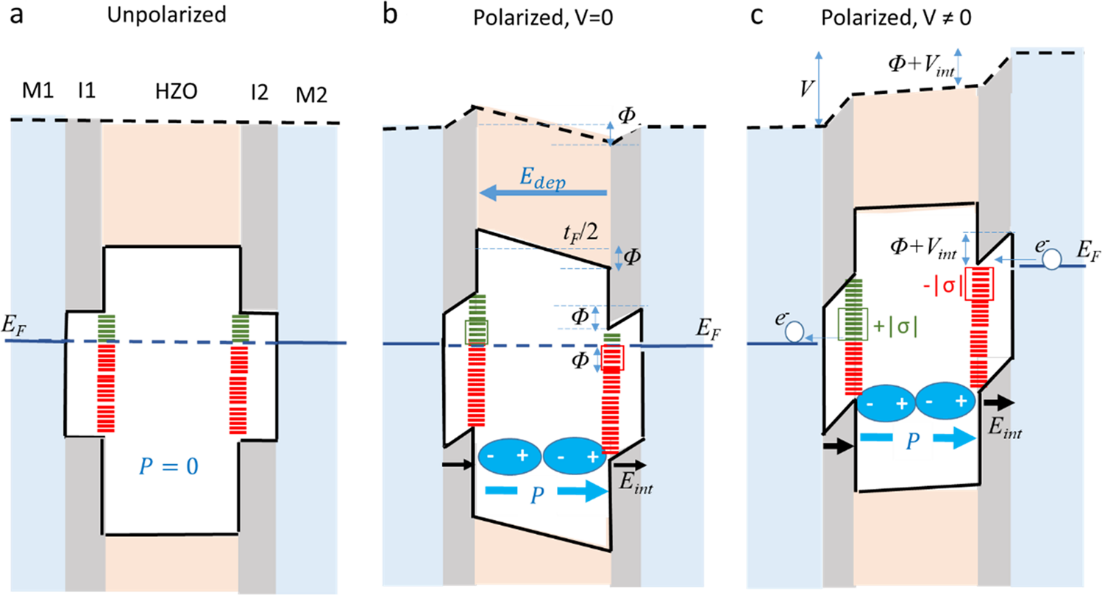
Our main contribution was that we correlated the density of trapped charge with the polarization and the external bias which permitted us to treat the charge filling and hysteresis evolution via the Landau-Khalatnikov equation. It turns out that the larger the interface trap density, the better is the recovery of the ferroelectric loop which is counterintuitive. While researchers and engineers use extensively field cycling as a means to obtain good ferroelectric characteristics, our work shows that this is not an innocent procedure. Indeed, the recovery of ferroelectric loops comes with a penalty: the interface is “flooded” with trapped charge which controls the electrostatics, mitigating or totally canceling out the effect of polarization. This is particularly problematic for the FTJ operation since the polarization normally controls the barrier height and the tunneling current but after cycling, the trapped charge takes over and FTJ may not be operational. One has to choose between good quality, defect free interfaces which allow polarization to do the job and defective interfaces which allow charge filling of traps during cycling. Unfortunately, both choices are problematic. At low thickness when high depolarization fields are present, pristine characteristics show small remanent polarization and perfect interfaces do not allow cancellation of depolarization field during cycling freezing out the pinched hysteresis, so devices are not functional due to small remanent polarization. On the other hand, defective interfaces allow charge filling of traps alleviating depolarization field, but the external charges take over the electrostatics cancelling the effect of the polarization and devices are still not functional. A careful interface defect engineering is required to keep the balance between external charges necessary to partially screen the depolarization field and polarization charges necessary to retain the functionality of devices.
There is a question to be answered: why HZO is so special regarding the switching characteristics as compared to conventional ferroelectrics which typically exhibit full ferroelectric loops in the pristine state and do not require cycling (wake up)? We believe that the main reason is the low dielectric permittivity of HZO. The depolarization field is inversely proportional to the dielectric permittivity ε so the low ε ~ 30-40 of HZO produces large depolarization fields as compared to the perovskite ferroelectrics which have ε typically more than an order of magnitude larger yielding negligibly small depolarization fields.

Follow the Topic
-
Communications Physics
An open access journal from Nature Portfolio publishing high-quality research, reviews and commentary in all areas of the physical sciences.

Related Collections
With Collections, you can get published faster and increase your visibility.
Nonlinear dynamics of living systems
Publishing Model: Open Access
Deadline: Nov 09, 2026
Active, Entangled or Confined: Polymer Physics Across Synthetic and Living Matter
Publishing Model: Open Access
Deadline: Dec 31, 2026