Microbial Ecology and Functional Landscape of Black Soldier Fly Larval Bioconversion of Orange Waste: A Metataxonomic Perspective
Published in Earth & Environment, Microbiology, and Agricultural & Food Science




How Black Soldier Fly Microbes Are Turning Orange Waste into Green Gold
(Based on the study “Microbial Ecology and Functional Landscape of Black Soldier Fly Larval Bioconversion of Orange Waste: A Metataxonomic Perspective” World Journal of Microbiology & Biotechnology Volume 41, article number 377, (2025) https://doi.org/10.1007/s11274-025-04622-1)
Breathing New Life into Citrus Waste
Every year, millions of tonnes of orange peels, pulp, and seeds pile up in markets, juice factories, and landfills around the world. In Nigeria alone, where citrus production thrives, the mounting waste from orange processing is both an environmental burden and a lost economic opportunity. High in moisture and rich in sugars, orange waste decomposes rapidly, releasing foul odours and methane — a greenhouse gas far more potent than carbon dioxide.
But what if this sticky mess could be transformed into something valuable?
That question drove a team of Nigerian scientists to explore an unusual partnership between insects and microbes — one that could revolutionize organic waste management across Africa.
Meet the Black Soldier Fly: Nature’s Tiny Recycler
The black soldier fly (Hermetia illucens) is no ordinary insect. Its larvae, voracious eaters with powerful digestive systems, can consume almost any kind of organic matter — from food scraps to farm residues — converting waste into nutrient-rich biomass and fertilizer. The larvae themselves are packed with protein and fat, making them a sustainable feed source for poultry and aquaculture. Their by-product, known as frass, is an excellent organic fertilizer.
“Black soldier flies represent one of nature’s most efficient recycling systems,” explains Professor Lateef Babatunde Salam, an environmental microbiologist at Elizade University and the corresponding author of the study. “But the real heroes are the microbes inside their guts — microscopic workers that break down complex waste into nutrients the larvae can use.”
While BSFL bioconversion has been studied around the world, little was known about how these microbial ecosystems function in African environments or with local waste types such as orange residues. This study, published in World Journal of Microbiology and Biotechnology, provides the first high-resolution look into the microbial world driving orange waste bioconversion in a West African context.
A First Look Inside the Insect–Microbe Partnership
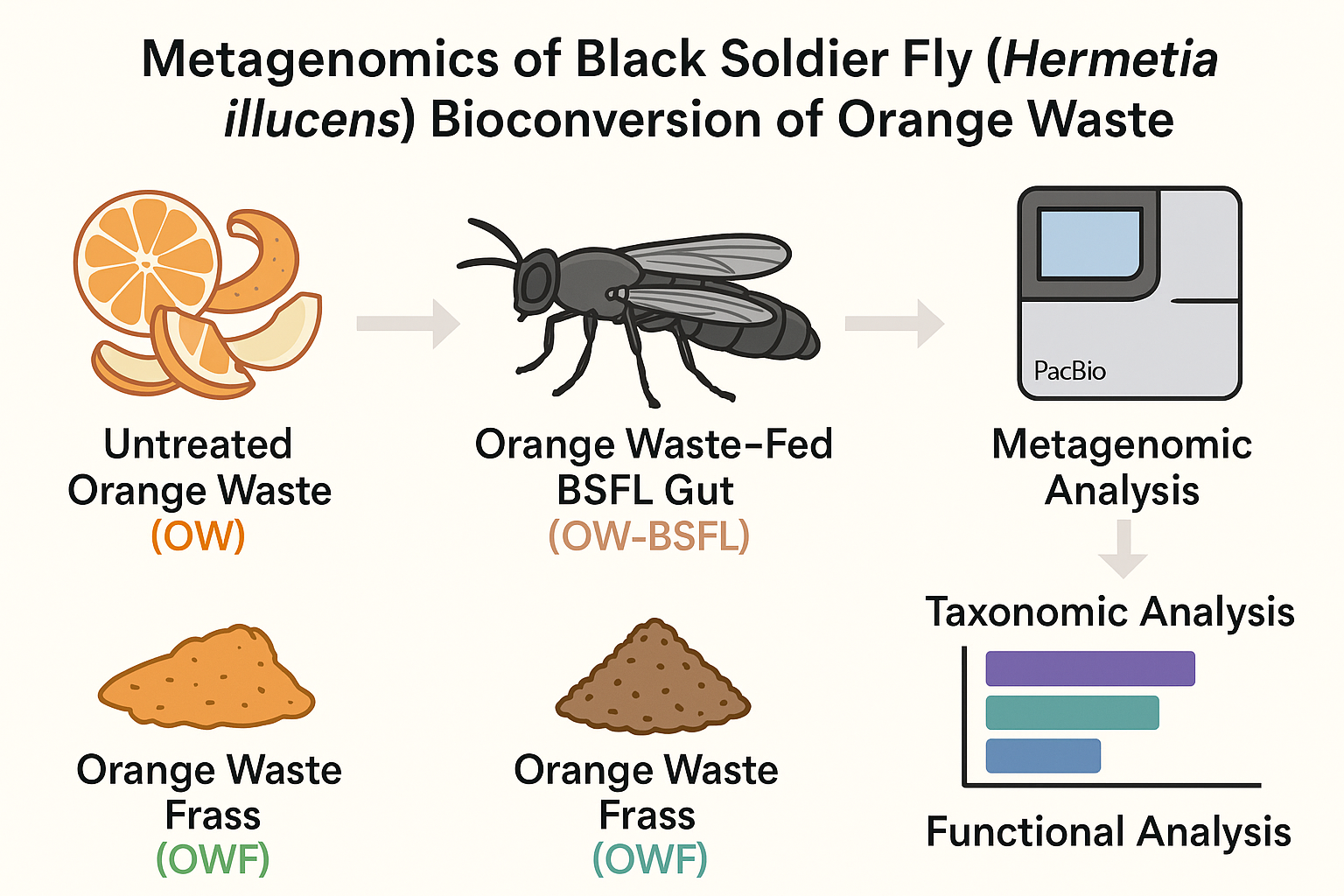
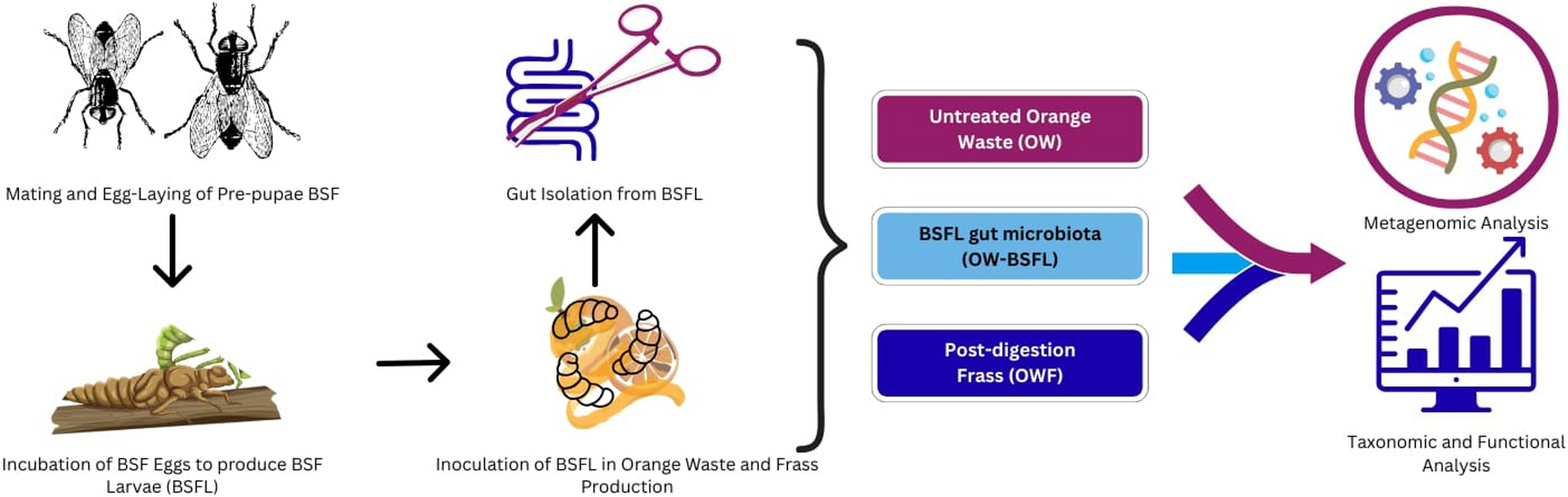
To unravel this hidden world, the research team used PacBio long-read 16S rRNA sequencing, an advanced DNA technology that can identify microbes down to the species level. They analyzed three stages of the bioconversion process:
- Untreated orange waste (OW) – the raw substrate full of natural citrus microbes.
- The gut of black soldier fly larvae fed on orange waste (OW-BSFL) – where digestion and microbial filtering occur.
- Orange waste frass (OWF) – the nutrient-rich by-product after digestion.
The goal was to see how microbial communities shift across these stages and to predict their metabolic roles, especially in carbohydrate and amino acid metabolism — the key biochemical engines of waste breakdown.
Microbial Succession: From Chaos to Coordination
The results revealed a dramatic transformation.
The raw orange waste hosted a moderately diverse mix of bacteria dominated by Lysinibacillus, Periweissella, and Gluconobacter — species known for fermenting sugars and producing organic acids. These microbes begin the breakdown of citrus carbohydrates but thrive mostly in acidic conditions.
Inside the larval gut, however, diversity dropped sharply. Here, the microbial population was almost completely reshaped — over 96% of the community was made up of just two genera: Lysinibacillus and Cytobacillus. This hyper-specialized microbiome suggests that the larval gut acts as a biological filter, selecting only microbes capable of surviving the fly’s alkaline digestive environment while contributing to rapid degradation.
Finally, in the frass, microbial diversity exploded again — with 263 bacterial species, including Mycolatisynbacter, Sphingobacterium, and Myroides cloacae. These communities are not just leftovers; they continue the decomposition process and help stabilize nutrients, making frass a powerful soil amendment.
“Think of it as a microbial relay race,” says Prof. Salam. “The first team starts breaking down sugars in the waste, the gut microbes sprint through the most complex transformations, and the frass microbes finish the race by recycling what’s left into the soil.”
The Science Behind the Transformation
The team used PICRUSt2 functional prediction — a bioinformatics tool that links microbial DNA to potential metabolic activities — to infer what these microbes were doing. The analysis revealed distinct patterns of metabolic specialization across the three stages.
In the larval gut, genes associated with carbohydrate transport and metabolism (like COG2814 and COG0726) were highly enriched, suggesting an intense breakdown of sugars, cellulose, and pectin — the main components of orange peels. Also abundant were genes linked to amino acid transport and catabolism (COG1173, COG0601, COG0444), reflecting the conversion of proteins and peptides into nutrients for larval growth.
In contrast, the frass retained genes related to secondary carbohydrate degradation — such as β-galactosidases and pectinases — which allow the continued breakdown of residual polysaccharides. This means that even after digestion, frass remains biologically active, promoting further organic matter turnover when applied to soil.
Key Findings at a Glance
- Extreme microbial filtering: The BSFL gut eliminates most external microbes, enriching for a small but highly efficient set of bacteria dominated by Lysinibacillus and Cytobacillus.
- Functional amplification: Gut microbes are hotspots for carbohydrate and amino acid metabolism, powering rapid waste digestion.
- Microbial revival in frass: Post-digestion frass supports a resurgence of microbial diversity, including soil-beneficial species.
- Lysinibacillus as a core microbiome member: Found in all stages, it plays a pivotal role in both waste degradation and microbial stability.
- Environmental potential: Frass microbial composition supports its use as an eco-friendly biofertilizer, improving soil health and reducing chemical fertilizer dependence.
Why It Matters: From Waste to Wealth
This study is not just a microbiological breakthrough — it’s an environmental and economic innovation.
Nigeria and many other tropical nations struggle with poor waste management infrastructure. Organic waste often ends up in dumps, contributing to pollution and greenhouse gas emissions. BSFL bioconversion offers a scalable, low-cost solution that turns these problems into opportunities:
- Cleaner cities: Reduced landfill waste and lower methane emissions.
- Green agriculture: Frass as a natural fertilizer improving soil fertility and structure.
- Circular economy: Conversion of food and agro-waste into valuable insect biomass — a sustainable feed for livestock and aquaculture.
- Job creation: Local BSFL farms can generate income from both larvae and frass production.
As Prof. Salam puts it, “Our goal is to turn what we throw away into what we grow with.”
A West African First — and a Model for Global Replication
Although BSFL research has gained global traction, most microbial studies have focused on temperate regions. This Nigerian study fills a crucial gap by mapping how locally adapted fly populations and waste types influence microbial dynamics.
The findings also demonstrate how African-led research can contribute to global sustainability science. The study not only establishes a baseline for regional microbial ecology but also provides a blueprint for scaling insect-based waste valorization in similar tropical contexts.
“Local waste streams have their own microbial stories,” notes the lead author Prof. Ademola Aderolu of the University of Lagos. “By understanding these interactions, we can design more efficient, context-specific bioconversion systems.”
The Microbes Behind the Magic
Among the microbial players identified, some stand out for their potential applications:
- Lysinibacillus capsici – versatile enzyme producer with antimicrobial and detoxification abilities, key to degrading orange waste rich in limonene (a citrus compound toxic to many microbes).
- Cytobacillus oceanisediminis – capable of breaking down polysaccharides and enhancing nutrient recycling.
- Sphingobacterium and Myroides species – known soil colonizers with roles in plant growth promotion and organic matter turnover.
Together, these microbes form a living toolkit for biotechnological innovation, from enzyme production to biofertilizer development.
Beyond Prediction: The Next Frontier
While the study used predictive metagenomics to infer microbial functions, the team emphasizes the need for deeper exploration through shotgun metagenomics, metatranscriptomics, and metabolomics. These approaches would capture real-time gene expression and biochemical activity, revealing how microbial metabolism changes as waste is transformed.
“PICRUSt2 gives us a map,” Prof. Salam explains, “but the next step is to walk the terrain — to see exactly how these microbes interact, what enzymes they produce, and how we can harness them for biotechnology.”
Future research will also test how different fruit wastes — mango, pineapple, papaya — influence microbial communities, potentially uncovering even more diverse enzymatic capacities suited to African agro-wastes.
From Lab to Land: Real-World Impact
The implications of this work stretch far beyond the laboratory. BSFL-based waste management systems are already being piloted in parts of Nigeria, Kenya, and Ghana, where insect farms process market and household waste into feed and fertilizer.
By integrating microbial insights like those from this study, such systems can become more efficient, hygienic, and sustainable. Frass enriched with beneficial microbes could enhance soil microbial diversity, improve nutrient cycling, and reduce dependency on chemical fertilizers.
The research also supports UN Sustainable Development Goals (SDGs) — particularly SDG 12 (Responsible Consumption and Production) and SDG 13 (Climate Action) — by promoting waste reduction and resource recovery.
A Microbial Blueprint for a Circular Africa
At its core, this study paints a hopeful vision for circular bioeconomies in developing regions. It shows that advanced molecular tools and local ingenuity can work hand in hand to address waste challenges while generating economic and environmental value.
Orange waste — once a symbol of post-harvest inefficiency — can now become a feedstock for sustainable production, a source of beneficial microbes, and a catalyst for green innovation.
“This is not just about flies and peels,” says Prof. Salam. “It’s about rethinking waste as a biological resource — one that, with the right science, can power livelihoods and restore ecosystems.”
Key Takeaways
- Novelty: First metataxonomic mapping of black soldier fly–mediated orange waste bioconversion in West Africa.
- Approach: PacBio long-read 16S sequencing with PICRUSt2 functional prediction.
- Discovery: Dominance of Lysinibacillus and Cytobacillus in the larval gut; high microbial diversity in frass.
- Impact: Insights for waste management, microbial enzyme discovery, and biofertilizer development.
- Vision: Transforming citrus waste into valuable bioresources through insect–microbe collaboration.
Toward a Sustainable Future
As cities and industries grapple with growing mountains of organic waste, the black soldier fly and its microbial allies offer a natural, scalable solution. Through their intricate symbiosis, they transform decay into renewal — embodying the principles of a truly circular economy.
In the vibrant markets of Lagos and beyond, the humble orange peel may soon find a new destiny — not as trash, but as the seed of a sustainable revolution.

Follow the Topic
-
World Journal of Microbiology and Biotechnology
The journal publishes original research papers and review articles on all aspects of applied microbiology and microbial biotechnology.

Related Collections
With Collections, you can get published faster and increase your visibility.
Article collection on SDG3 Good Health and Wellbeing
Publishing Model: Hybrid
Deadline: Ongoing
Article collection on SDG2 Zero Hunger
Publishing Model: Hybrid
Deadline: Ongoing




Please sign in or register for FREE
If you are a registered user on Research Communities by Springer Nature, please sign in