Modulating the thermal conductivity in hexagonal boron nitride via controlled boron isotope concentration
Published in Electrical & Electronic Engineering

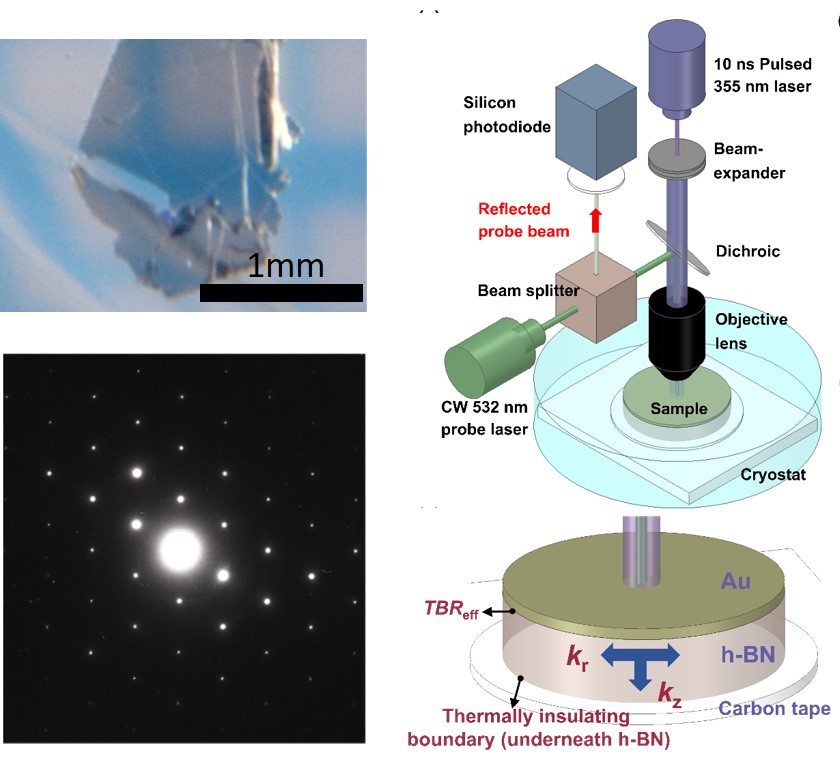
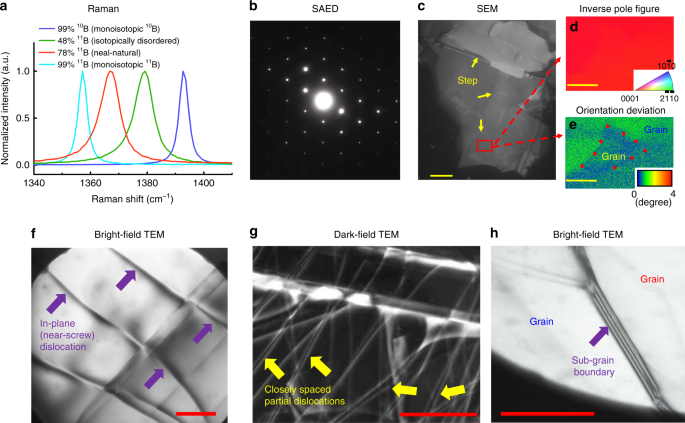

My group at the University of Bristol has great interest in developing and understanding heat transport in materials and devices. This is as most of today’s electronic and optoelectronic devices are limited by excessive device temperatures which degrade performance and reliability. When a good old friend of mine at Kansas State University, Jim Edgar, contacted me last year that his students managed to grow isotopically pure Boron Nitride we got very excited as this material to date never reached its expected high thermal conductivity; with the isotopically pure Boron Nitride we could demonstrate a thermal conductivity of 585 W/mK, twice that of copper, for the first time – pretty much in line with what theory predicted. We could also test and develop further a transient thermoreflectance technique we previous developed and pioneered for accurate thermal conductivity measurements. This is an easy to use technique to measure lateral and out-of-plane thermal conductivity of materials. Following this work, we now move forward to use the Boron Nitride to make high end electronic devices, but also by integrating it with other semiconductors. Boron Nitride should be able to conduct heat nicely away from many electronic materials when fully integrated. This will allow better performance devices and ultimately higher efficiency electronics which will save energy for a greener society.
Follow the Topic
-
Communications Physics
An open access journal from Nature Portfolio publishing high-quality research, reviews and commentary in all areas of the physical sciences.

Related Collections
With Collections, you can get published faster and increase your visibility.
Quantum machine learning: understanding capabilities, limitations, and perspectives for quantum advantage
Publishing Model: Open Access
Deadline: Dec 31, 2026
Advances in Quantum Networking: QKD and beyond
Publishing Model: Open Access
Deadline: Jan 31, 2027


