Monolithic Integration of Redox-Stable Sn–Pb Halide Perovskite Single-Crystalline Films for Durable Near-Infrared Photodetection

Published in Materials
Monolithic Integration of Redox-Stable Sn–Pb Halide Perovskite Single-Crystalline Films for Durable Near-Infrared Photodetection
Like

Share this post

Choose a social network to share with, or copy the URL to share elsewhere

This is a representation of how your post may appear on social media. The actual post will vary between social networks

Explore the Research

SpringerLink
SpringerLink SpringerLink

Monolithic Integration of Redox-Stable Sn–Pb Halide Perovskite Single-Crystalline Films for Durable Near-Infrared Photodetection - Nano-Micro Letters

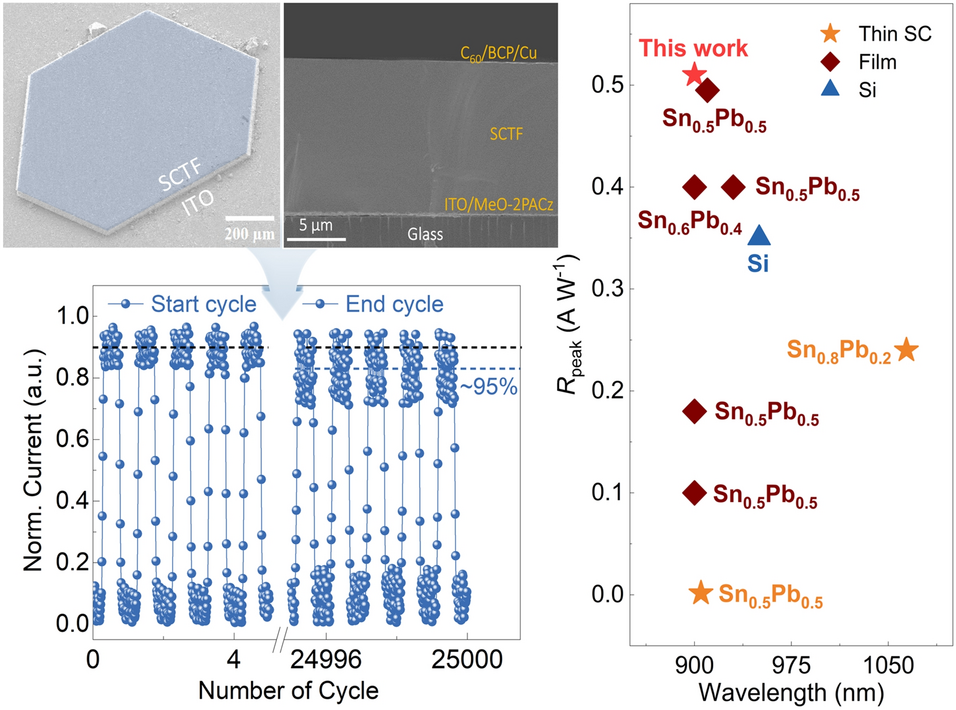
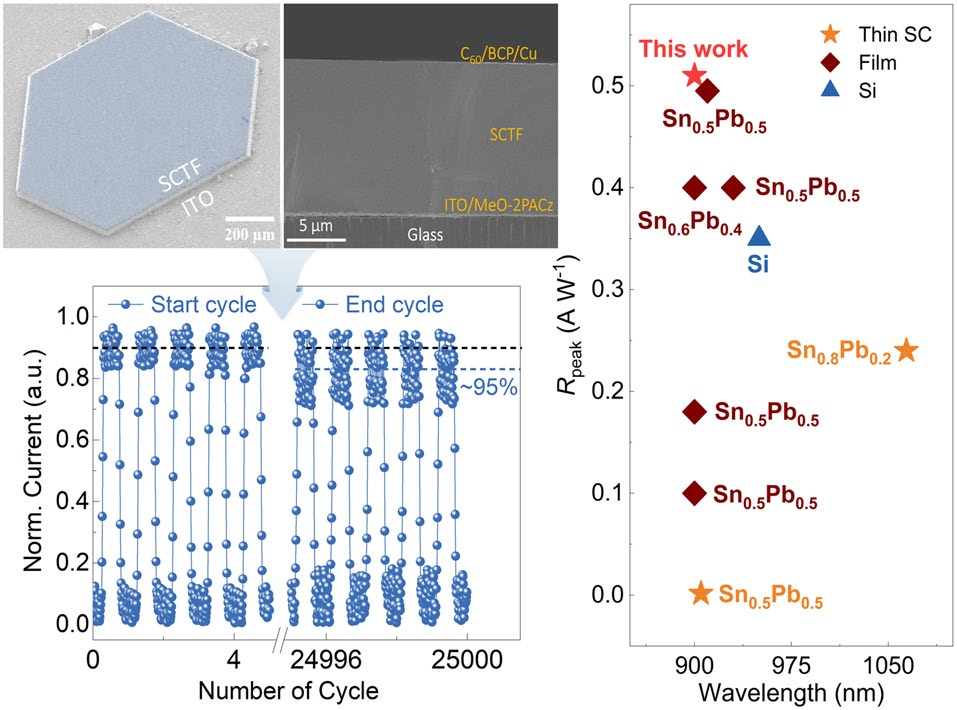
Tin–lead (Sn–Pb) halide perovskite single crystals combine narrow bandgaps, long carrier diffusion lengths, and low trap densities, positioning them as ideal candidates for near-infrared (NIR) optoelectronics. However, conventional growth strategies rely on bulk crystallization at elevated temperatures, leading to uncontrolled nucleation, Sn2+ oxidation, and poor compatibility with planar integration. Here, we develop a coordination-engineered crystallization strategy that enables direct, low-temperature growth of micrometer-thick Sn–Pb single-crystal thin films on device-compatible substrates. By modulating metal–solvent coordination strength using a low-donor number cosolvent system, we delineate a narrow processing window that stabilizes precursor speciation, lowers the nucleation barrier, and guides directional crystal growth under mild thermal conditions (< 40 °C). The resulting crystal films exhibit smooth morphology, high crystallinity, compositional uniformity, and ultralow trap densities (~ 3.98 × 1012 cm−3). When integrated into NIR photodetectors, these films deliver high responsivity (0.51 A W−1 at 900 nm), specific detectivity up to 3.6 × 1012 Jones, fast response (~ 188 μs), and > 25,000 cycles of ambient operational stability. This approach establishes a scalable platform for redox-stable, low-temperature growth of Sn–Pb perovskite crystal films and expands the processing–structure–function landscape for next-generation infrared optoelectronics.

Tin–lead (Sn–Pb) halide perovskite single crystals combine narrow bandgaps, long carrier diffusion lengths, and low trap densities, positioning them as ideal candidates for near-infrared (NIR) optoelectronics. However, conventional growth strategies rely on bulk crystallization at elevated temperatures, leading to uncontrolled nucleation, Sn2+ oxidation, and poor compatibility with planar integration. Here, we develop a coordination-engineered crystallization strategy that enables direct, low-temperature growth of micrometer-thick Sn–Pb single-crystal thin films on device-compatible substrates. By modulating metal–solvent coordination strength using a low-donor number cosolvent system, we delineate a narrow processing window that stabilizes precursor speciation, lowers the nucleation barrier, and guides directional crystal growth under mild thermal conditions (< 40 °C). The resulting crystal films exhibit smooth morphology, high crystallinity, compositional uniformity, and ultralow trap densities (~ 3.98 × 1012 cm−3). When integrated into NIR photodetectors, these films deliver high responsivity (0.51 A W−1 at 900 nm), specific detectivity up to 3.6 × 1012 Jones, fast response (~ 188 μs), and > 25,000 cycles of ambient operational stability. This approach establishes a scalable platform for redox-stable, low-temperature growth of Sn–Pb perovskite crystal films and expands the processing–structure–function landscape for next-generation infrared optoelectronics.

Please sign in or register for FREE

If you are a registered user on Research Communities by Springer Nature, please sign in

Follow the Topic

Perovskites
Physical Sciences > Chemistry > Materials Chemistry > Solid-State Chemistry > Perovskites
Materials for Devices
Physical Sciences > Materials Science > Materials for Devices
Surfaces, Interfaces and Thin Film
Physical Sciences > Materials Science > Surfaces, Interfaces and Thin Film
Nanoscale Design, Synthesis and Processing
Physical Sciences > Materials Science > Nanotechnology > Nanoscale Design, Synthesis and Processing
Photonic Crystals
Physical Sciences > Materials Science > Optical Materials > Photonic Crystals
  • Nano-Micro Letters Nano-Micro Letters

    Nano-Micro Letters is a peer-reviewed, international, interdisciplinary and open-access journal that focus on science, experiments, engineering, technologies and applications of nano- or microscale structure and system in physics, chemistry, biology, material science, and pharmacy.