Nanoreactor-Structured Defective MoS2: Suppressing Intercalation-Induced Phase Transitions and Enhancing Reversibility for Potassium-Ion Batteries
Published in Bioengineering & Biotechnology, Chemistry, and Materials



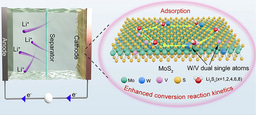
Conversion-type electrode materials hold significant promise for potassium-ion batteries (PIBs) due to their high theoretical capacities, yet their practical deployment is hindered by sluggish kinetics and irreversible structural degradation. To overcome these limitations, we propose a rationally engineered nanoreactor architecture that stabilizes defect-rich MoS2 via interlayer incorporation of a carbon monolayer, followed by encapsulation within a nitrogen-doped carbon shell, forming a MoSSe@NC heterostructure. This tailored structure synergistically accelerates both K+ diffusion kinetics and electron transfer, enabling unprecedented rate performance (107 mAh g−1 at 10 A g−1) and ultralong cyclability (86.5% capacity retention after 1200 cycles at 3 A g−1). Mechanistic insights reveal a distinctive “adsorption-conversion” pathway, where sulfur vacancies on exposed S–Mo–S basal planes act as preferential K+ adsorption sites, effectively suppressing parasitic phase transitions during intercalation. In situ X-ray diffraction and transmission electron microscopy corroborate the structural reversibility of the conversion reaction, with the carbon matrix dynamically accommodating strain while preserving electrode integrity. This work not only advances the understanding of defect-driven interfacial chemistry in conversion-type materials but also provides a versatile strategy for designing high-performance anodes in next-generation PIBs through heterostructure engineering.

Editor of Nano-Micro Letters, which is an Open-Access, peer-reviewed journal reported papers that have at least one dimension ranging from a few sub-nanometers to a few hundreds of micrometers. The journal is published by Springer Nature and indexed by SCI, EI, SCOPUS, Pubmed, etc. The 2024 JCR Impact Factor is 36.3. The 2024 CiteScore is 53.1.
Follow the Topic
-
Nano-Micro Letters

Nano-Micro Letters is a peer-reviewed, international, interdisciplinary and open-access journal that focus on science, experiments, engineering, technologies and applications of nano- or microscale structure and system in physics, chemistry, biology, material science, and pharmacy.
Please sign in or register for FREE
If you are a registered user on Research Communities by Springer Nature, please sign in