

For over two decades Transparent Conducting Oxides (TCOs) have been largely employed by manufacturers all over the globe for the fabrication of photovoltaic systems and touchscreen technology [1]. More recently, it has been discovered that these hybrid materials (in between metals and semiconductors) possess exceptional nonlinear properties in the frequency range where their refractive index approaches zero [2,3].
The reasons for such remarkable nonlinear enhancement are still at the centre of an intense debate within the photonic community, however it is understood that a slow-light effect, directly linked to the index-near-zero nature of these compounds and their peculiar dispersion properties, is mainly responsible for this unique optical behaviour [4].
Numerous nonlinear experiments have been recently conducted which are showing the huge potentials of zero-index systems for controlling light with light on ultra-short distances and ultra-fast time scales [5,6].
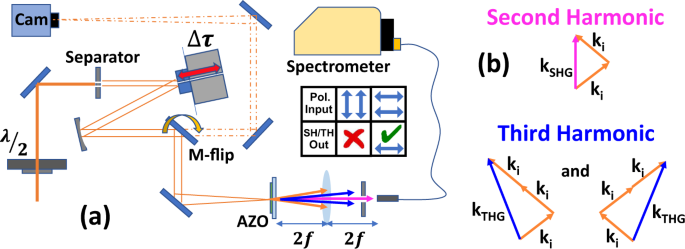
On the quest to figure the ideal framework of use for NZI materials, In Nature Communications 13, 3536 (2022) “Near-zero-index ultra-fast pulse characterization” my colleagues and I have focused our attention of the most important tool for the characterisation of ultra-fast optical pulses, a frequency resolved optical gating system (FROG in short).
By replacing the nonlinear core crystal of a standard FROG with an ultra-thin (270nm) film of near-zero-index aluminium zinc oxide (AZO), we recorded a remarkable improvement in all the fundamental metrics including bandwidth, energy efficiency, speed, manufacturability, and cost. These results, together with a direct comparison with other ultra-thin nonlinear systems, unequivocally demonstrate the fundamental advantage of employing NZI thin films for nonlinear flat-optic applications exploiting out-of-plane configurations.
In addition to this, due to the uniquely-large change of the material refractive index (in non-perturbative terms – n can go from 0.2 to 0.9 [7]), intense second and third harmonic signal can be produced and acquired simultaneously. This improves the robustness of the FROG retrieval algorithm, and opens up to the possibility of using both bulk and surface nonlinear effects which are critical for application in spectroscopy and sensing, respectively.
In order to underline the fundamental nature of NZI materials and their superior nonlinear optical performance, here we show a simple numerical comparison of an optical beam trespassing either a standard semiconductor or an NZI film. Two fundamental features should be highlighted: 1) the radiation profile inside the NZI materials shows the signature stretching of the effective wavelength; 2) the generation of nonlinear harmonics (SH, TH) is drastically augmented by the NZI film.
[1] Advances in Optics and Photonics Vol. 14, Issue 2, pp. 148-208 (2022) https://doi.org/10.1364/AOP.448391
[2] Optica Vol. 2, Issue 7, pp. 616-622 (2015) https://doi.org/10.1364/OPTICA.2.000616
[3] Optical Materials Express Vol. 8, Issue 11, pp. 3392-3400 (2018) https://doi.org/10.1364/OME.8.003392
[4] Optica Vol. 7, Issue 3, pp. 226-231 (2020) https://doi.org/10.1364/OPTICA.374788
[5] Nature Reviews Materials volume 4, pages535–551 (2019)
[6] Nature Reviews Materials volume 4, pages742–760 (2019)
[7] Phys. Rev. Lett. 116, 233901 (2016)

Follow the Topic
-
Nature Communications
An open access, multidisciplinary journal dedicated to publishing high-quality research in all areas of the biological, health, physical, chemical and Earth sciences.

Related Collections
With Collections, you can get published faster and increase your visibility.
Women's Health
Publishing Model: Hybrid
Deadline: Ongoing
Tumor Microenvironment Crosstalk and Therapeutic Implications
Publishing Model: Hybrid
Deadline: Nov 02, 2026