No to Inorganic Agriculture (NIA): How a Bengal-Born Innovation Is Addressing the World’s Most Severe Agricultural Crisis
Published in Agricultural & Food Science
Across the planet, scientists are racing to confront a monumental crisis: the widening gap between what modern agriculture demands and what our ecosystems can sustain. Decades of dependence on synthetic fertilisers and pesticides have depleted soils, destabilised ecosystems, and left farming communities vulnerable to the accelerating shocks of climate change. Several governments and global research institutions have invested billions of dollars to overcome these challenges—particularly the persistent gaps in biostimulant reliability, microbial technology, lab-to-field transition, and climate-resilient crop productivity. Yet the crisis persists, largely because scalable, farmer-friendly, sustainable and ecologically grounded solutions have remained out of their reach.
The Global Crisis: Why a Radical Shift Was Needed
The agricultural research community has long recognised several systemic gaps limiting sustainable crop production. Studies on microbial consortia highlight recurring problems:
- Poor lab-to-field transition of microbial inputs
- Lack of mechanistic understanding of plant–microbe interactions
- High variability of microbial product performance across soils, climates, and cultivars
- Absence of predictive biomarkers for field success
- Dependence on expensive agrochemicals despite their ecological costs
- Weak integration of beneficial microbes into real agricultural systems
- Limited farmer-level access to high-quality and viable microbial cultures
As a result, despite massive global funding, biostimulants and microbial-based solutions have struggled to deliver their full promise, especially at the scale required to safeguard global food security.
This is exactly where Professor Krishnendu Acharya’s ‘No to Inorganic Agriculture’ (NIA) innovation makes a historic departure. At the University of Calcutta, however, one scientist has transformed this narrative. Professor Krishnendu Acharya, a distinguished researcher in biodiversity and biotechnology, has developed a groundbreaking model—No to Inorganic Agriculture (NIA)—that is rapidly emerging as one of the most promising, scalable, and scientifically robust solutions to the global agricultural challenge. NIA does not merely address the long-standing research gaps identified worldwide; it solves them through a revolutionary, sustainable, homegrown, eco-friendly, community-empowering biotechnology ecosystem.
Today, thousands of farmers across Eastern India have adopted the NIA practices. Several government and non-government organisations have formally integrated this model into their climate-resilient agriculture frameworks, and increasingly, the scientific world is taking notice.
NIA: The First Scalable, Farmer-Led, Eco-friendly, Sustainable Microbial Biotechnology Revolution
At its core, NIA is a scientifically sophisticated yet socially grounded sustainable biotechnology framework that overcomes each of these global gaps. Instead of relying on industrial biostimulants—which often lose effectiveness due to contamination, transport delays, or strain instability—NIA shifts biotechnology into the hands of farmers themselves.
- Local Microbial Consortia Development
NIA begins with the creation of locally adapted microbial consortia, including beneficial fungi, rhizobacteria, and other important biocontrol organisms. These consortia are not imported or mass-fabricated; rather, they are developed by using regional ecosystem-specific microorganisms, ensuring biological compatibility, climatic resilience, and sustainability.
- Lab-to-Land Translation through Farmer-Level Labs
The most revolutionary component of NIA is its farmer-level biotechnology laboratory system. This system is well adopted by the local community of farmers, who are confident of preparing pure microbial cultures using traditional, low-cost, contamination-free technologies. Furthermore, through this system, farmers with their intricate community involvement are self-sufficient in their own sustainable agricultural practice.
- Ecosystem-Centric, Cost-effective Farming Model
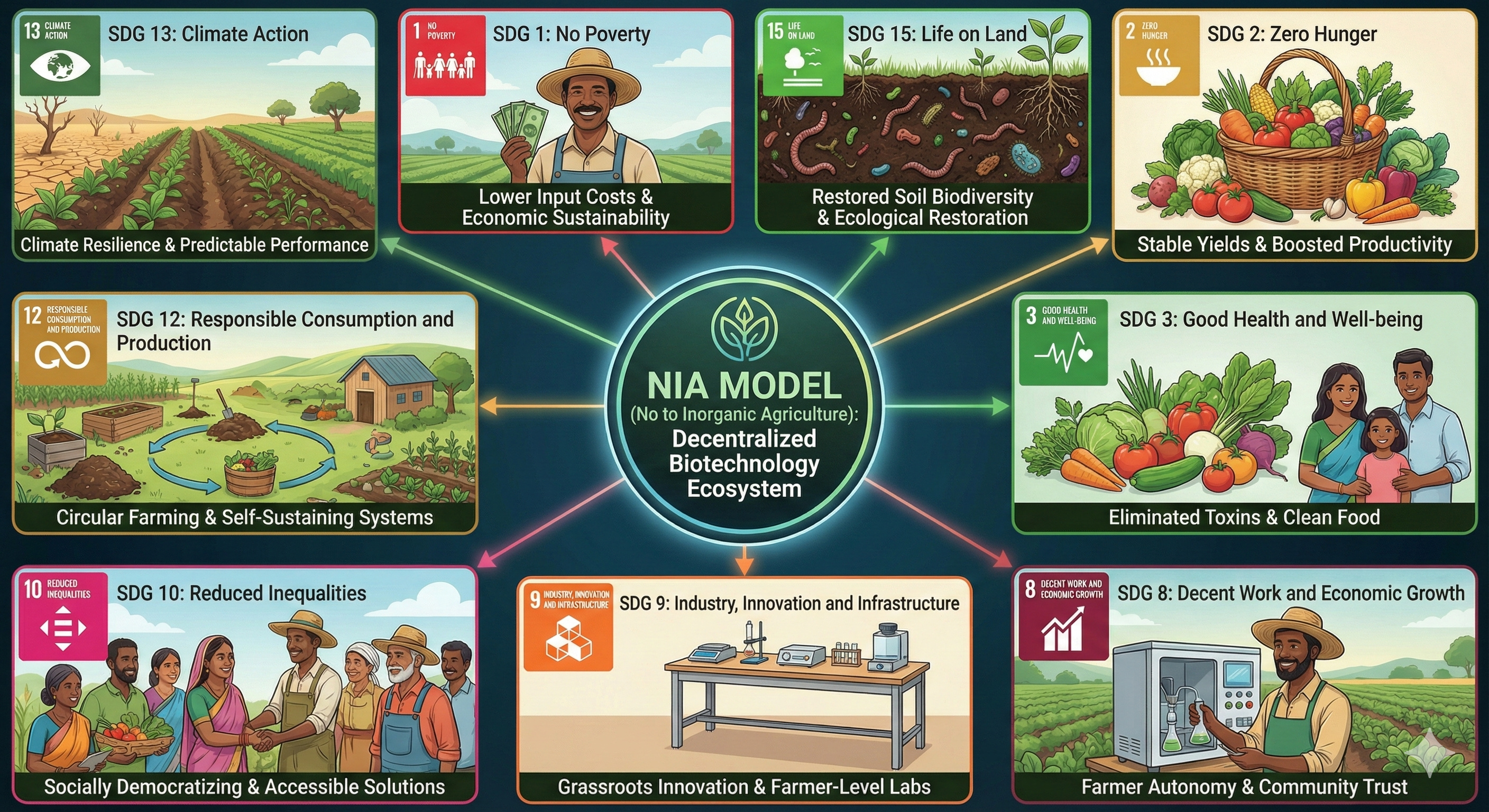
NIA significantly reduces farming costs, promotes crop productivity, enriches soil health, restores biodiversity, and empowers farmers to become sustainable. From field preparation to harvest, farmers are meeting all the necessary requirements to convert their farmlands from inorganic to organic cultivation.
This model significantly promotes:
- Restoration of soil biodiversity
- Toxin-free food production (without the use of inorganic chemicals).
- Creation of a composite, self-sustaining, eco-friendly farming ecosystem
- Circular use of available farm resources
This represents not only a technological shift but also a philosophical transformation—from input-intensive farming to biodiversity-driven farming.
A Response to Global Research Gaps
NIA addresses each of the scientific and technological barriers that global research has struggled with:
- Robustness across Climatic Conditions
Locally derived microbial consortia inherently withstand regional stresses, surpassing industrial strains that often fail outside controlled environments.
- Mechanistic Reliability
Long-term field use across thousands of farmers provides live, dynamic, real-world data on microbial–plant interactions—something that laboratory trials have rarely achieved at scale.
- Farmer-Led Adaptation
Unlike commercial microbial inputs, NIA empowers farmers to refine, adjust, and optimise microbial applications in real time.
- Economic and Soil Sustainability
The NIA model is not simply an agricultural approach, but it is a mechanism for achieving the United Nations Sustainable Development Goals (SDGs). By lowering input costs, improving soil biology, and ensuring food security, NIA directly supports several SDGs.
From Eastern India to the World: A Model for Global Replication
The scientific merit of NIA is profound, but its social impact is equally transformative. Farmer testimonies report:
- Comparable yields
- Reduced input costs
- Healthier soils
- Reduced ecosystem toxicity
- Revived traditional wisdom through modern biotechnology
A Global Call to Recognise Professor Acharya
In a time when agriculture faces its greatest crisis, Professor Krishnendu Acharya has delivered a solution that is scientifically rigorous, socio-economically empowering, and ecologically restorative. His dedicated research work deserves global recognition—not only for its innovation but also for its capacity to reshape the future of food systems worldwide.

Follow the Topic
-
Nature Sustainability
This journal publishes significant original research from a broad range of natural, social and engineering fields about sustainability, its policy dimensions and possible solutions.