Not all microbes play by the same rules
Published in Microbiology


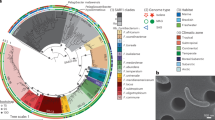

“Everything is everywhere, but the environment selects.” Microbiologists have quoted Baas Becking’s line for almost a century. Microbes are tiny, abundant, and seemingly capable of travelling just about anywhere. But is it really that simple? Imagine two lakes separated by thousands of kilometres. Would the same bacterial species living in both lakes necessarily belong to the same genetic population? And what happens when lakes have very different histories; one formed relatively recently, another has existed for millions of years?
These questions become particularly interesting for freshwater bacteria. Unlike the ocean, where water provides a vast, interconnected habitat, lakes can act like islands, separated by land, watersheds and geological barriers. Microbes may be transported between them, but getting somewhere does not necessarily mean establishing there.
Where this started
In our earlier work, we described Fontibacterium, the globally abundant freshwater SAR11-IIIb genus, and showed that it contains at least 16 species with different geographic ranges (1). Some species are found in only one region, and others turn up almost everywhere. That gave a natural experimental gradient of closely related bacteria that differ in how far they spread. Freshwater SAR11-IIIb bacteria are among the most abundant, genome-streamlined group found in lakes and are perfect model organisms to test our hypothesis. We focused on three of the species to explore how dispersal and geography help shape their populations.
Three species, three different stories
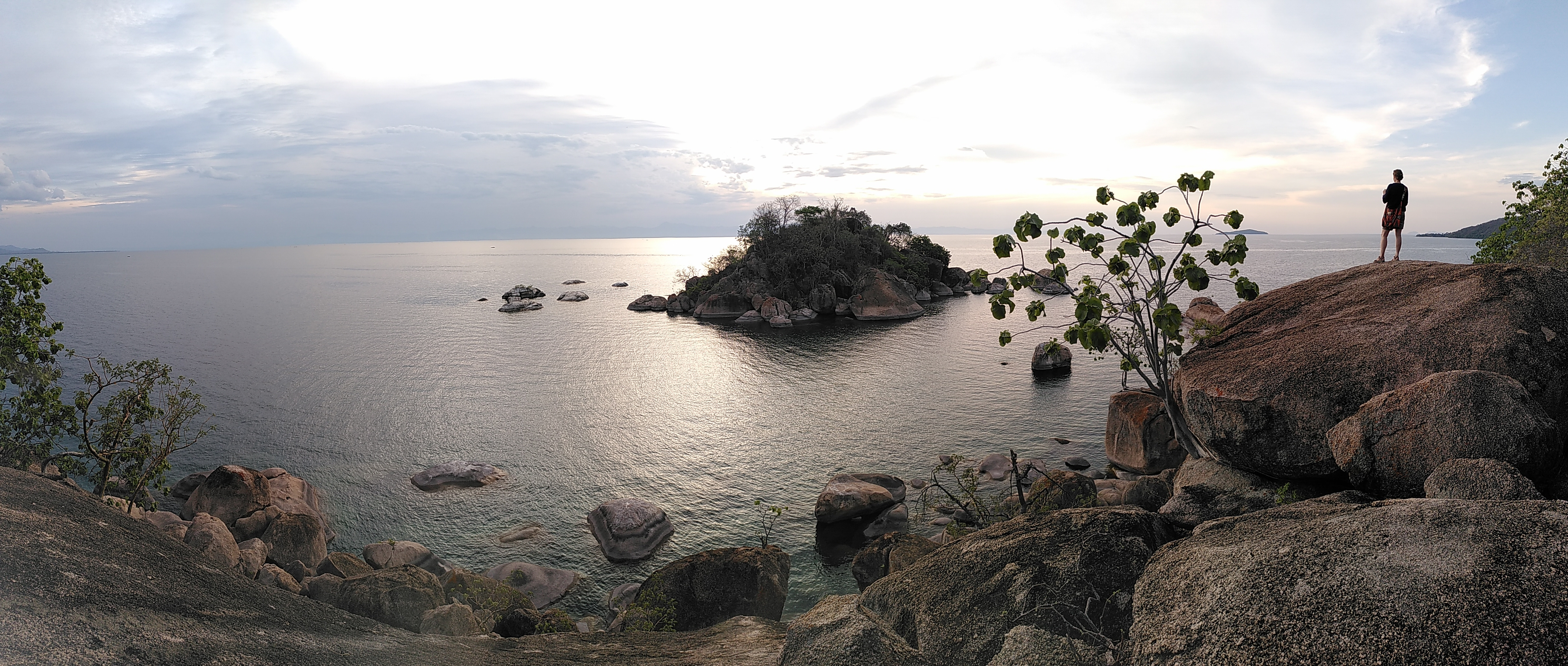
First, Fontibacterium africanum is restricted to the African Great Lakes, including Lakes Malawi (Fig. 1) and Tanganyika. This species inhabits some of the world’s oldest (5-12 million years), deepest (700-1470 m depth) and physically complex lakes with a permanently stratified and anoxic bottom water layer. Next, F. temperatum, which occurs in temperate regions of the Northern Hemisphere, and finally, F. commune, which, as its name suggests, has a much wider distribution, and co-occurs with F. temperatum in certain temperate lakes and with F. africanum in the African Great Lakes.
Finding the same bacterial species in two lakes tells us that it occurs in both places. It does not tell us whether the populations are genetically connected, how much they differ, or which evolutionary processes have shaped them. To investigate this, we used 118 metagenomic datasets from lakes across five continents. Rather than looking only at which microbes were present, we looked at single-nucleotide variants within the populations of our three target species. This allowed us to compare genetic diversity within lakes and differentiation between them. We could then ask whether populations became more different with geographic distance, whether certain lakes shared more similar populations than expected, and whether characteristics such as lake age, size and geological setting helped explain the patterns.
Distance matters, until it doesn’t
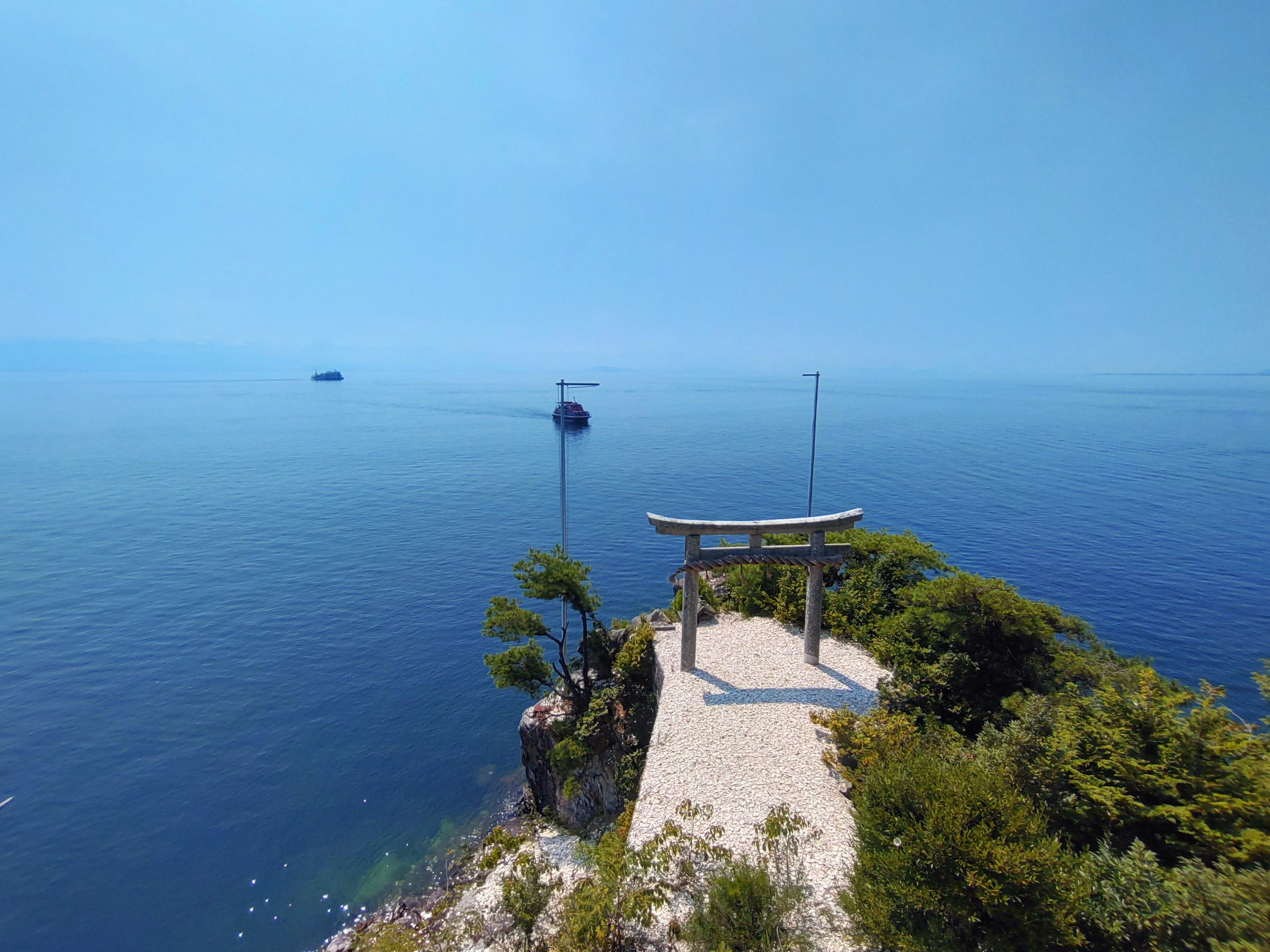
Distance did not affect every species in the same way. In F. temperatum, populations became more different with distance between lakes, but only up to roughly 100 km. Beyond that, the relationship disappeared. Instead, European and North American populations were clearly separated, and lakes on the Canadian Shield formed their own group. At the continental scale, geographic barriers and the species’ dispersal history explained population structure better than distance. F. commune surprised us more. Populations in lakes on opposite sides of the world could be nearly identical. Lake Biwa in Japan (Fig. 2) and a reservoir in Brazil were the clearest example. One explanation is occasional long-distance dispersal connecting populations that otherwise look isolated. Another is that some genetic variation has persisted from ancestral populations. Our data cannot yet separate the two. They do show that genetic differences do not simply increase with distance for every species. A species can be found worldwide without continuous gene flow among all its populations.
Ancient lakes have unique evolutionary signature?
Geography was only part of the story. Lake properties also shaped how populations evolved, and the African Great Lakes stood out. Some DNA changes alter the protein a gene encodes. Others are silent and leave the protein unchanged. Most protein-changing mutations are harmful, so natural selection usually removes them. In Lakes Malawi and Tanganyika, however, both the endemic F. africanum and the widespread F. commune carried more protein-changing variants than populations elsewhere. Lake Biwa did not show this pattern, even though it is also old (about 4 million years). It is much smaller and shallower than the African Great Lakes and mixes seasonally. So lake age alone does not explain what we saw. The size, permanent stratification and physical complexity of the African lakes may create a mosaic of conditions in which different variants persist. We cannot yet tell whether this reflects weaker removal of slightly harmful mutations or variants adapted to different niches within these lakes. Both remain possible.
A hierarchy of evolutionary processes
Putting this all together, we propose a hierarchical model of evolution in freshwater Fontibacterium (Fig. 3). At the broadest geographic scale, a species' dispersal capacity helps determine how far gene flow can extend. For a regionally restricted species, geographic barriers can separate populations; for a widely distributed species, occasional long-distance dispersal may maintain genetic similarity across continents.
At a finer scale, the history and physical properties of individual lakes help shape genetic diversity and the evolutionary processes acting within populations. This means that dispersal and local environmental conditions are not competing explanations for microbial biogeography. They operate at different scales, and their relative importance depends on the species and the ecosystem. It also reminds us that a widespread microorganism is not necessarily genetically uniform everywhere, just as a species restricted to a few lakes is not necessarily evolutionarily simple.
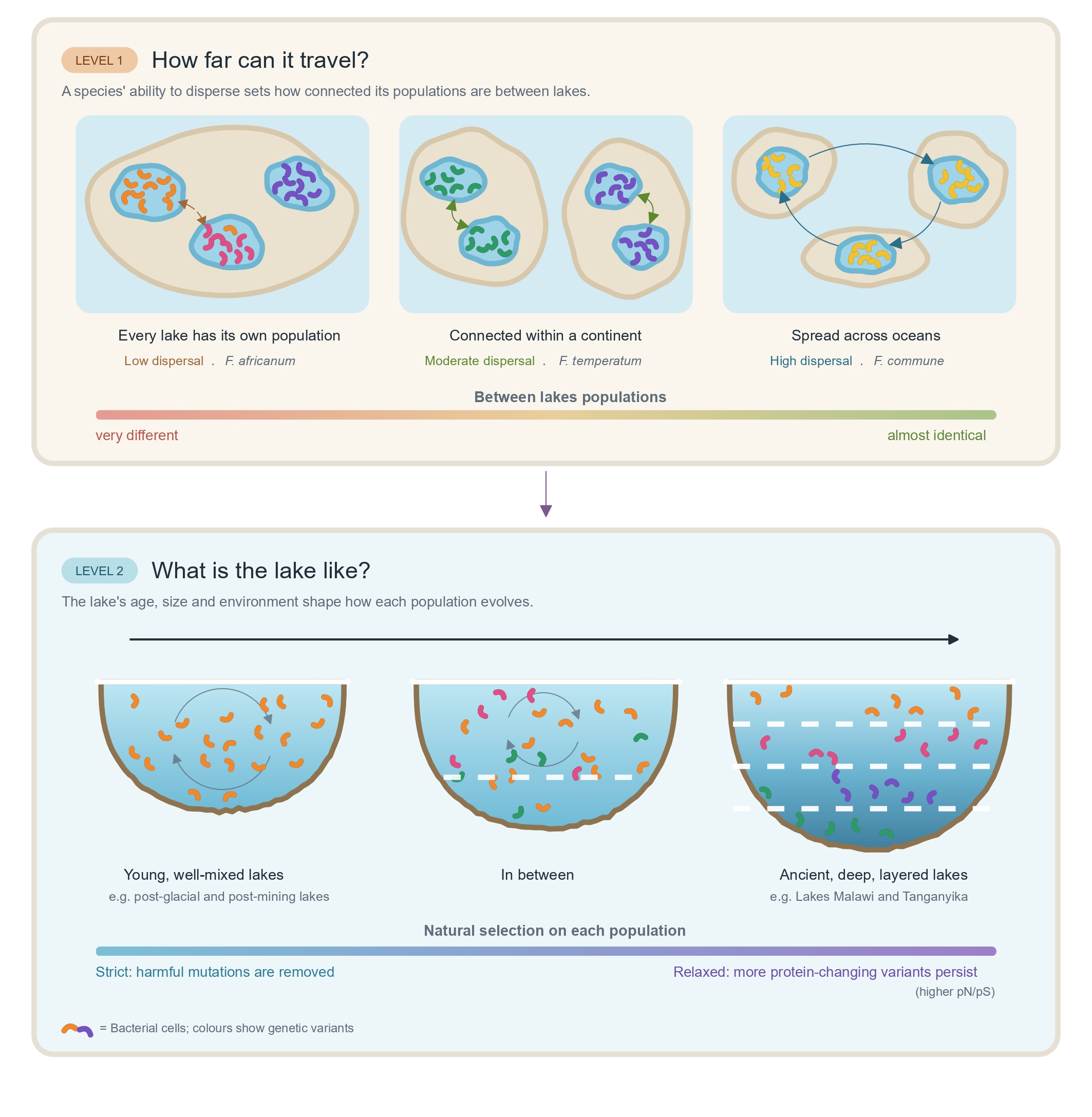
Figure 3. Our proposed model. How far a species can travel sets how connected its populations are between lakes (Level 1). Within each lake, its age, size and layering shape how the population evolves (Level 2).
What’s next?
For me, one of the most interesting aspects of this work is how much evolutionary information can be recovered from organisms that are invisible to us. By just looking beyond species presence, we are able to reconstruct how microbial populations are connected, how they diverge and how their environments influence their evolution.
There are still important questions to answer. How often do long-distance dispersal events occur? What maintains genetic diversity in enormous, permanently stratified lakes? And are these patterns specific to this one genus, or do other freshwater microbes follow similar trends? For now, our results suggest that there is no single evolutionary rule for freshwater bacteria. Lakes may be islands for microbes, but not every microbe experiences the same degree of isolation.
Follow the Topic
-
Nature Communications
An open access, multidisciplinary journal dedicated to publishing high-quality research in all areas of the biological, health, physical, chemical and Earth sciences.

Related Collections
With Collections, you can get published faster and increase your visibility.
Women's Health
A selection of recent articles that highlight issues relevant to the treatment of neurological and psychiatric disorders in women.
Publishing Model: Hybrid
Deadline: Ongoing
Healthy Aging
Publishing Model: Open Access
Deadline: Dec 31, 2026