One of these things is not like the others: How comparisons drive learning
Published in Behavioural Sciences & Psychology and Education



How many times a day do you make comparisons? Probably more than you think! At the grocery store, you might compare apples to pick the best one. Or you might compare prices to see which is the better deal. When you see a familiar face, you might compare it to your remembered faces to figure out how you know them. The more you tune into comparisons, the more you realize we are making comparisons constantly, in every conceivable context. In fact, without comparisons, making sense of daily life would be pretty difficult.
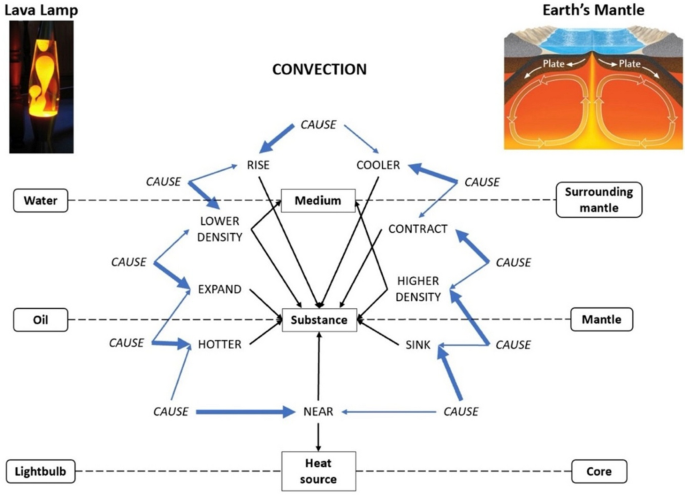
Teachers and psychologists have long recognized the importance of comparisons in children’s learning. Children are asked to recognize structurally similar mathematics problems so they can apply a known strategy, or to recognize that two stories share the same plotline. Teachers frequently use concrete objects to represent abstract concepts, like using an orange to stand for the parts of a cell, or using a lava lamp to show processes that cause volcanos (See Figure 1). Understanding these models requires comparison. School books are full of illustrations learners can use to understand new ideas, like what shapes are triangles or what animals are marsupials. Children are invited to compare all day long.
And for good reason—decades of research tells us that comparison is indeed, a very potent learning mechanism. Children are better at learning words, for example, if they are shown two objects with the same name than if they are shown just one. Comparisons like this give learners a way to make sense of the new word or concept, and also speeds up and consolidates learning. Practicing comparisons also leads to advanced cognitive skills, like reasoning by analogy. But how, exactly, does the comparison process work? And what can we do to help learners fully grasp the comparisons we ask them to make?
When learners make comparisons, they discover points of alignment between the items, and this alignment in turn, makes the underlying structures clear. If you’re asked to explain how time is like a river, the first step is trying to find any way we might be able to compare these two entities. Are they both water? No. Are they both visible? Not really. How are they alike?! Finally, one point of alignment jumps out—they are both moving. But they’re not moving around and around like a windmill. They’re moving forward. And unlike a car that’s moving forward, neither a river nor time can turn around and go back the same way. They are both moving inevitably forward. Now we can start to understand the analogy. This point-by-point comparison is what reveals its deep underlying meaning.
If point-by-point alignments are the engine that drives learning from comparisons, what can we do to help this engine run smoother? First and foremost, research has shown that it’s easier to make comparisons when there are two examples present at the same time. This may seem obvious, but examples are quite often shown individually, as an illustration, or shown sequentially, one by one. However, one example at a time does not invite comparison. And when examples are spread out over time, learners have to look for alignments using their memories for the first example, which is a lot harder and may not be as accurate. We get the most out of comparisons when there are at least two examples to examine at the same time. Maria Montessori understood this when she developed her curriculum over 100 years ago (see Figure 2).
We can also help learners by presenting examples in a way that draws their attention to the important points of alignment—by lining the examples up as shown in this place value lesson (see Figure 3), or using gestures to point back and forth between the examples, literally modeling for children what we want them to do mentally on their own. Even though comparison is a natural process everyone can do, but we can accelerate learning and help children become better comparers by directly showing them how it works. This is especially important when children are learning new material. Finally, when ideas or concepts are given the same name, this common label signals that there’s a commonality to be found. If I say, “Oh look at the swan!” while pointing to one bird, and then, “Hey, there’s another swan!” while pointing to another bird, the word, “swan” tells children these two birds are the same in some way, which will get them started looking for those points of alignment.
As you can see, supporting children’s comparisons takes time and intentionality. In today’s classrooms, some teachers understand how comparisons work but may not feel they can devote the amount of time needed to scaffold comparisons and let the alignment process unfold all the way. Other teachers may not be aware of the way people learn via comparisons, because these topics are not regularly taught in teacher preparation programs. We hope that by writing this article, we can get the word out to more teachers and school leaders, so all learners can have the support they need to make the most of learning from comparisons.
Kelly Mix and Dedre Gentner

Follow the Topic
-
Discover Education
An international, peer-reviewed open access journal that publishes original work in all areas of education, serving the community as a broad-scope journal for academic trends and future developments in the field.

Related Collections
With Collections, you can get published faster and increase your visibility.
Advancing Teaching & Learning: Integrating AI, Emerging Technologies, and Pedagogical Innovation
Collection "Advancing Teaching & Learning: AI, Emerging Technologies and Pedagogical Innovation" addresses a major challenge in education today. There is a lack of resources that bring advanced technologies and innovative teaching together. AI, digital tools and emerging technologies are transforming classrooms. Yet many teachers and education leaders struggle to use these tools effectively. This Collection fills that gap. It offers expert insights, practical strategies and real-world examples for modern teaching and learning.
The Collection is linked to the United Nations Sustainable Development Goal 4 on quality education. It shows how to make learning more accessible, inclusive and effective for all. AI, adaptive learning platforms and immersive technologies can personalise instruction. They can engage students and support diverse needs. At the same time, the human element of teaching remains central.
Readers will find practical guidance on curriculum design, digital literacy and evidence-based teaching methods. The approaches can be applied in classroom, blended and online learning. Beyond tools, the Collection inspires educators to rethink traditional methods. It encourages them to embrace innovation while keeping learning meaningful and student-focused.
By addressing the lack of comprehensive resources on advanced technologies, Advancing Teaching & Learning helps teachers, school leaders and instructional designers navigate the digital age. It equips them to create engaging, future-ready learning experiences. Students are prepared for a connected, digital world. Educators gain the confidence to unlock the full potential of every learner.
This Collection supports and amplifies research related to the United Nations Sustainable Development Goal 4 on quality education. It shows how to make learning more accessible, inclusive and effective for all. AI, adaptive learning platforms and immersive technologies can personalise instruction. They can engage students and support diverse needs. At the same time, the human element of teaching remains central.
Keywords: Teaching and Learning; AI in Education; Emerging Technologies; Digital Tools in Classrooms; Pedagogical Innovation; Adaptive Learning Platforms; Immersive Technologies; Quality Education (SDG 4); Classroom Innovation; Blended and Online Learning; Student Engagement; Teacher Professional Development; Future-Ready Learning; Instructional Design; Educational Technology Integration.
Publishing Model: Open Access
Deadline: Apr 15, 2027
Advancing Health Professions Education: Innovations, Strategies, and Global Perspectives
Health Professions Education (HPE) plays an important role in preparing competent, ethical, and compassionate healthcare professionals capable of responding to the complex demands of contemporary healthcare systems. In recent years, the field of HPE has witnessed a paradigm shift towards learner-centred, competency-based, and interprofessional education models that prioritize not only clinical expertise but also communication, professionalism, teamwork, and leadership skills.
This Collection invites original research, systematic or scoping reviews, case studies and brief reports and that critically examine the evolving landscape of HPE across medicine, dentistry, nursing, pharmacy, and other allied health disciplines. Key areas of interest include curriculum design and reform, innovative teaching and assessment methods, integration of digital and blended learning technologies, interprofessional education (IPE), faculty development, educational management, student support and well-being, and strategies to promote equity, diversity, and inclusivity in HPE.
We also welcome contributions that explore challenges and best practices in clinical training, rural and underserved community placements, global health education, policy development, accreditation, and institutional leadership in health education. Studies from low- and middle-income countries are strongly encouraged to enhance global representation and to promote scholarly exchange on scalable and contextually relevant innovations.
By consolidating scholarly work in this Collection, we aim to advance the discourse on high-quality, evidence-informed HPE that supports the achievement of Sustainable Development Goals (SDG 3 and SDG 4) and ultimately contributes to improved healthcare outcomes worldwide.
Publishing Model: Open Access
Deadline: Nov 30, 2026