Operational Visibility as a Governance Mechanism in Healthcare
Published in Healthcare & Nursing, Public Health, and Business & Management

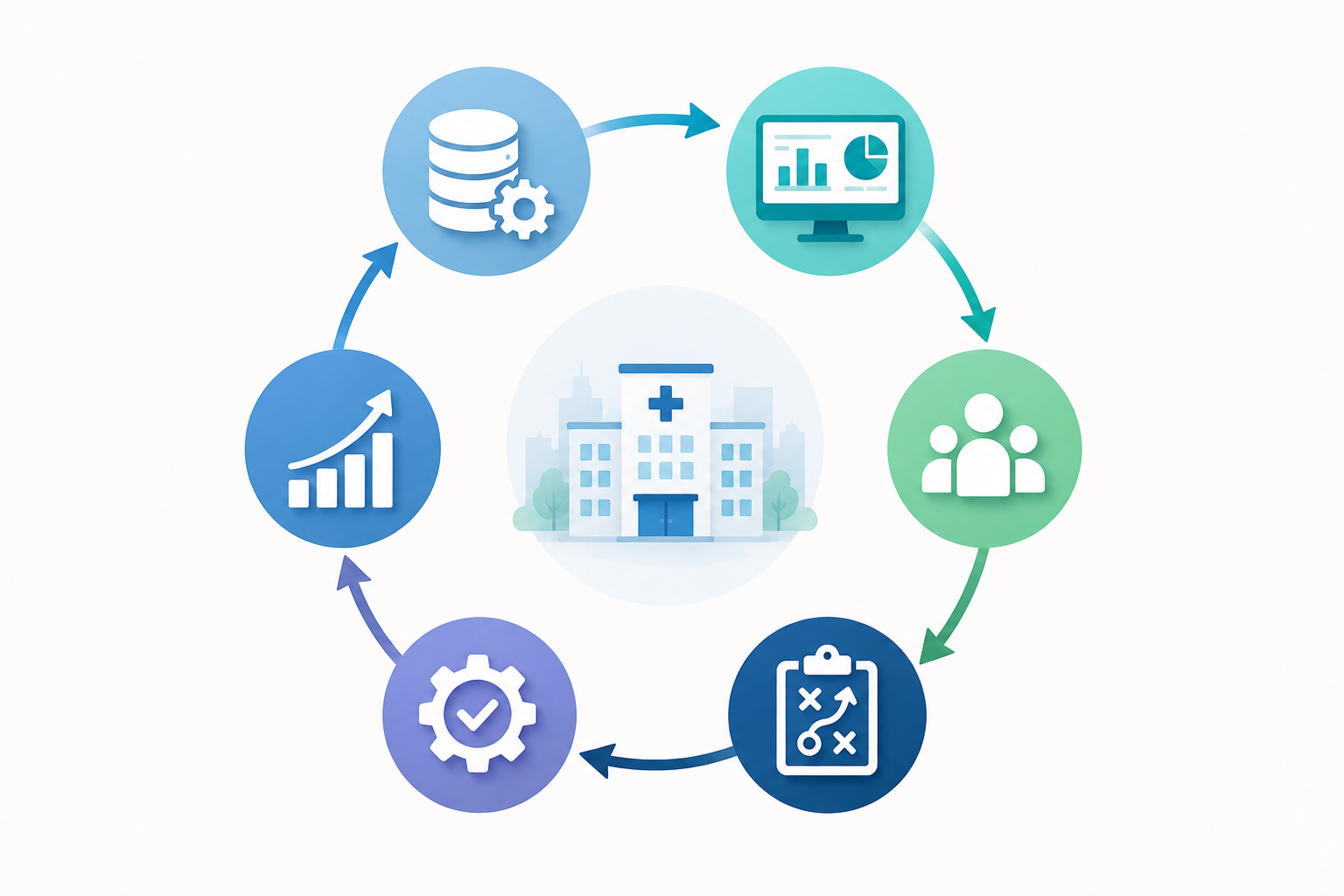


Healthcare organizations generate large amounts of data every day.
Bed occupancy.
Staffing levels.
Absenteeism.
Patient flow.
Clinical indicators.
Overtime coverage.
Costs.
Adverse events.
Yet data alone do not improve healthcare systems.
For data to influence quality, safety, and efficiency, they must become visible, interpretable, and connected to decision-making routines.
This is where operational visibility becomes a governance issue.
In many hospitals, leaders and frontline teams work with fragmented information. Different departments monitor different indicators, often using different systems, timeframes, definitions, and priorities.
The result is not simply informational inefficiency.
It is governance fragility.
When operational conditions are not visible in time, decisions become reactive.
When data are not shared, accountability becomes unclear.
When performance information is disconnected from leadership routines, indicators become reports rather than instruments for improvement.
When teams do not see the same reality, coordination becomes harder.
This is especially relevant in healthcare environments marked by workforce shortages, overcrowding, financial constraints, patient safety demands, and increasing operational complexity.
In these contexts, visibility is not a cosmetic improvement.
It is a structural condition for better governance.
This perspective connects directly with our recent research on organizational maturity and quality governance.
In our longitudinal study, Organizational Maturity as a Tool for Quality Governance: A Longitudinal Study in a Brazilian Hospital, published in International Journal for Quality in Health Care Communications, we examined how organizational maturity evolved over time in a Brazilian hospital.
The study suggested that sustainable quality improvement depends not only on formal standards or isolated interventions, but also on the organization’s ability to coordinate, monitor, standardize, and sustain change across multiple domains.
Operational visibility is one way this maturity becomes tangible.
A second example comes from our quality improvement preprint on visual management of nursing schedules and workforce balancing.
In that study, we described an intervention that integrated nursing schedules, absenteeism, hospital occupancy, internal staff redistribution, overtime coverage events, and related costs into a visual workforce management process.
After implementation, average monthly overtime coverage decreased from 143 events at baseline to 23.4 events, and average monthly overtime-related expenditure decreased from BRL 32,693.00 to BRL 6,071.42.
Because only one pre-intervention month was available, these findings should be interpreted as a temporal association rather than definitive causal evidence.
Even with this limitation, the operational lesson is important.
The intervention did not depend on reducing the workforce.
It depended on seeing the workforce differently.
By making staffing deficits and surpluses visible earlier, leaders could redistribute available professionals before overtime coverage became necessary.
Visibility changed the timing and quality of decisions.
This illustrates a broader principle in healthcare governance:
Operational visibility transforms data into coordination.
It allows leaders to identify variation earlier.
It helps teams align around the same problems.
It clarifies where action is needed.
It supports accountability.
It strengthens organizational learning.
In this sense, dashboards, visual boards, and management routines should not be understood only as operational tools.
They can function as governance mechanisms when they connect information to responsibility, decision-making, and follow-up.
However, visibility alone is not enough.
A dashboard without governance becomes decoration.
An indicator without accountability becomes noise.
A meeting without decision-making becomes ritual.
A visual board without learning becomes compliance.
The value of visibility depends on the organizational system around it.
For healthcare leaders, this raises practical questions:
Are the most important operational problems visible in real time?
Do frontline teams and executives see the same information?
Are indicators connected to decision-making routines?
Is there clear accountability for responding to variation?
Does the organization learn when expected performance is not achieved?
Can data trigger action before problems become crises?
These questions move operational management from passive monitoring to active governance.
They also help explain why similar tools may produce different results across hospitals.
The difference may not be the dashboard.
It may be the maturity of the governance system using it.
In complex healthcare systems, quality improvement depends not only on knowing what should be done.
It depends on seeing what is happening early enough to act.
Perhaps operational visibility is one of the bridges between organizational maturity and sustainable healthcare improvement.
Related research
Rodrigues Filho RND, Morais LG. Organizational Maturity as a Tool for Quality Governance: A Longitudinal Study in a Brazilian Hospital. International Journal for Quality in Health Care Communications. 2026. DOI: 10.1093/ijcoms/lyag022.
Rodrigues Filho RND, Barbosa MCP, Miranda GFS, Morais LG. Visual Management of Nursing Schedules for Workforce Balancing and Reduction of Overtime Coverage: A Longitudinal Quality Improvement Study. Research Square Preprint. DOI: 10.21203/rs.3.rs-10121229/v1.
Related literature: healthcare governance, operational visibility, visual management, Lean Healthcare, workforce management, organizational maturity, and sustainability of quality improvement interventions.




Please sign in or register for FREE
If you are a registered user on Research Communities by Springer Nature, please sign in