Palaeontology in a pandemic: remote research on dinosaur eggs and embryos
Published in Ecology & Evolution




Like many research scientists, the COVID-19 pandemic threw a wrench into the works of my research plans. My fieldwork has been greatly scaled back these last two years, I’ve been unable to sustain my usual museum research travel, and I have barely started some of the projects that I had originally planned to have finished by now. But the pandemic hasn’t been all-bad. It has also invited some new opportunities.
In May of last year, I was invited by my collaborator Dr. Xing Lida to help describe some dinosaur eggs and embryos, recently collected from Upper Cretaceous red beds (around 72–66 million years old) in southern China. This was not my first collaboration with Chinese colleagues, and I’ve been lucky enough to visit the country on a few occasions to work on some fantastic fossil material there. Unfortunately, the realities of the pandemic lockdowns meant that such travel was now impossible; I would have to work on the fossils from a distance. Not ideal, to say the least, but nonetheless possible, thanks to helpful colleagues, digital photography and videography.
The eggs and their embryonic contents were found as part of a larger clutch that turned up during a construction project in the Ganzhou area of Jiangxi Province. Two of the eggs were acquired by the Yingliang Stone Natural History Museum in Fujian Province, and made available to my colleagues and I for description. The eggs are nearly spherical, about 12 cm in diameter and 660 mL in volume, and thin-shelled (0.4 mm thick). Although not particularly well-preserved, they appear to belong to a fossil eggshell family called Spheroolithidae. These types of eggs are most associated with the duck-billed dinosaurs (or hadrosaurs), a group of large herbivores that lived near the end of the Age of Dinosaurs.
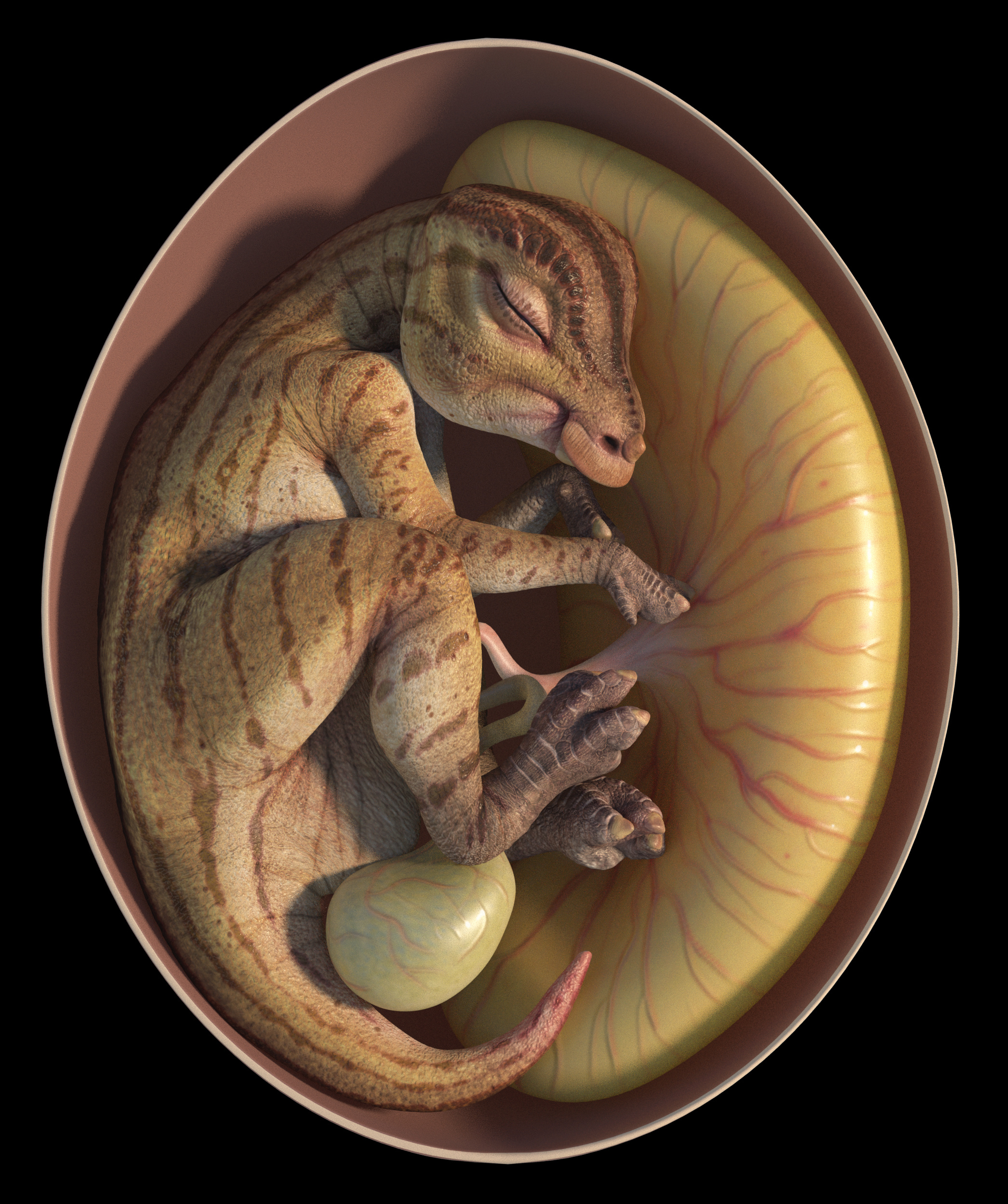
No surprise, then, that the fossil embryos (nicknamed the “Ying Babies”) contained within the eggs are those of a hadrosaur, based on the distinctive shapes of certain skull bones, vertebrae, and limb bones (Figure 1). Hadrosaur embryos had been identified before now, but these new embryos represent likely the best preserved of their kind to date. Unfortunately, it’s difficult to know precisely which species the embryos represent; species-specific diagnostic features often do not manifest until later in life. Still, the squamosal bone at the back of the skull has a distinctive shape reminiscent of only a handful of other hadrosaur species, and might prove helpful in narrowing the possibilities.
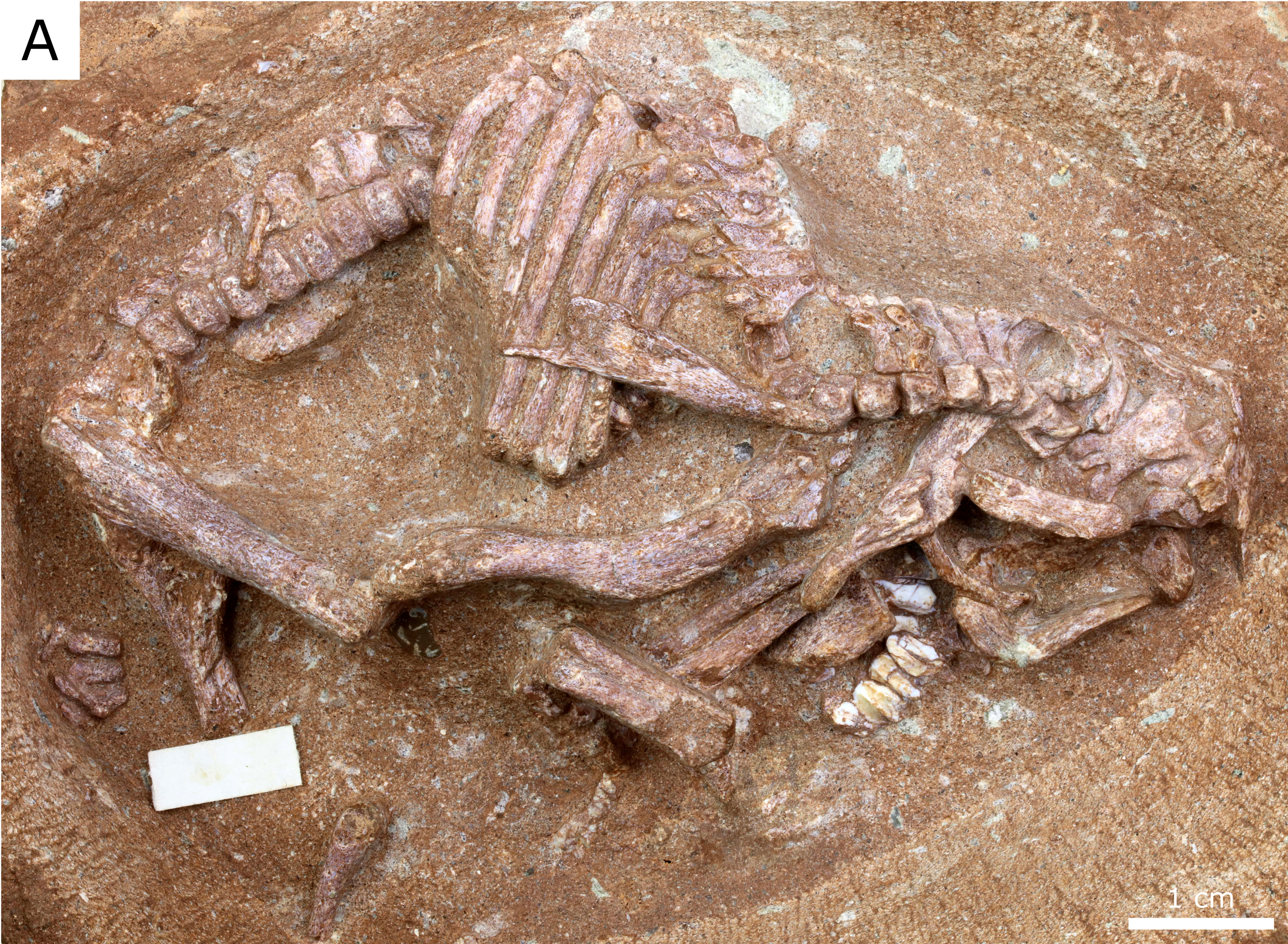
What’s most interesting about the eggs (and the embryos they contain) is their size relative to those of more specialized hadrosaurs (called hadrosaurids) from the Upper Cretaceous rocks of North America. Hadrosaurids come in two varieties: the lambeosaurines that bore elaborate, hollow crests on their skulls, and the hadrosaurines that lacked such crests. It is traditionally understood that hadrosaurines laid smaller eggs than lambeosaurines (900 mL vs. 4,000 mL, respectively), and consequently produced smaller hatchlings. More than that, hadrosaurine hatchlings are thought to have been less developed, particularly in the formation of the limb bones, compared to lambeosaurines. Thus, hadrosaurine hatchlings are thought to have been altricial, having spent a long time in the nest post-hatching while their limb bones finished forming; the larger lambeosaurine hatchlings were, by contrast, precocial and ready to join the herd at once. The question that naturally arises for the evolutionary biologist concerns the ancestral condition: Were hadrosaurids ancestrally altricial or precocial as hatchlings? The eggs and embryos my coauthors and I describe are both small and from a more primitive lineage of hadrosaurs, suggesting that altriciality was the original condition for hadrosaurids.
Throughout the pandemic, I have frequently joined the chorus in complaining about the move to online work. The endless Zoom meetings, the IT issues that go neglected, and the eye strain from staring at a screen all day have all taken their toll. Still, I wonder how much more my research might have suffered had this pandemic hit 15 or 20 years ago. Certainly, I wouldn’t have been able to collaborate with my colleagues from the other side of the world on such marvelous fossils. I’ll try to bear it in mind the next time I feel sorry for myself because I can’t have any genuine crispy duck.

Follow the Topic
-
BMC Ecology and Evolution
An open access, peer-reviewed journal interested in all aspects of ecological and evolutionary biology.

Related Collections
With Collections, you can get published faster and increase your visibility.
Nighttime ecology and evolutionary adaptations to low-light environments
BMC Ecology and Evolution welcomes submissions of research exploring the remarkable adaptations and ecological dynamics that enable life to flourish in the dark and low light environments. Contributions will explore evolutionary adaptations such as sensory specialization (e.g., night vision, echolocation, bioluminescence, heat-sensitive pits, and specialized hairs) that allow organisms to navigate, forage, and communicate in low-light conditions from caves to the deep sea. The collection will also investigate behavioral and physiological mechanisms, including circadian rhythm adjustments and predator-prey interactions, that are essential for survival in nocturnal niches.
Submissions on the impact of anthropogenic influences, such as light pollution, on nocturnal ecosystems and biodiversity are encouraged. The Collection also welcomes research on nighttime bioacoustics and soundscapes, examining how sound is used to adapt to and shape nocturnal environments. Contributions discussing the role of citizen science in advancing our understanding of nighttime ecology are also encouraged.
Publishing Model: Open Access
Deadline: Nov 20, 2026
Evolution of disease: From pathogens to proliferating cells
Evolution of disease: From pathogens to proliferating cells is a special Collection that explores how evolutionary processes shape health and disease—from infectious microbes to cancerous cells. We invite research within the discipline of evolutionary medicine that examine how forces such as natural selection, genetic drift, host-pathogen coevolution, and environmental change contribute to disease susceptibility, resistance, and progression. We welcome submissions that deepen our understanding of disease as a dynamic outcome of evolutionary interactions.
Topics of research may include but are not limited to research which uses evolutionary principles to understand:
1. Pathogen evolution, resistance, and host interactions
•
The evolution of antibiotic, antiviral, antifungal, and antiparasitic resistance
•
Mechanisms of immune evasion, persistence, and transmission
•
Experimental evolution and molecular insights into pathogen adaptation
•
Host-pathogen coevolution and the impacts of medical or environmental interventions
•
Comparative host-pathogen dynamics across species
2. Evolutionary mismatch and modern disease
•
Evolutionary insights into metabolic disorders, autoimmune conditions and cancer
•
When a previously advantageous trait becomes maladaptive due to change in the environment
3. Evolution of cancer
•
Evolutionary and ecological models of cancer progression and resistance
•
Comparative oncology: insights from cancer-resistant and long-lived species
•
Somatic evolution, immune escape, and tumor heterogeneity
4. Genetic variation, adaptation, and disease susceptibility
•
Adaptive and maladaptive genetic variants in human and animal populations
•
Pleiotropy and trade-offs in immune function, metabolism, and reproduction
•
Population genetics, admixture, and the evolutionary roots of health inequality
5. Microbiome evolution and host symbiosis
•
Coevolution and community ecology of host-associated microbiota
•
Functional evolution in microbial genomes and implications for host health
•
Microbiome shifts due to modern environments, drugs, or host genetic factors
6. Viral evolution and endogenous elements
•
Evolutionary arms races between hosts and viruses
•
Evolution and function of endogenous viral elements in animal genomes
•
Phylogenomic approaches to uncover ancient viral influences on host evolution
7. Experimental and computational approaches
•
Experimental evolution in microbial or model systems
•
Genomics, phylogenomics, and systems biology in disease evolution
•
Machine learning and AI in evolutionary medicine research
Publishing Model: Open Access
Deadline: Dec 04, 2026