Patchwork plans for carbon dioxide geological storage in national long term climate strategies
Published in Earth & Environment and Economics

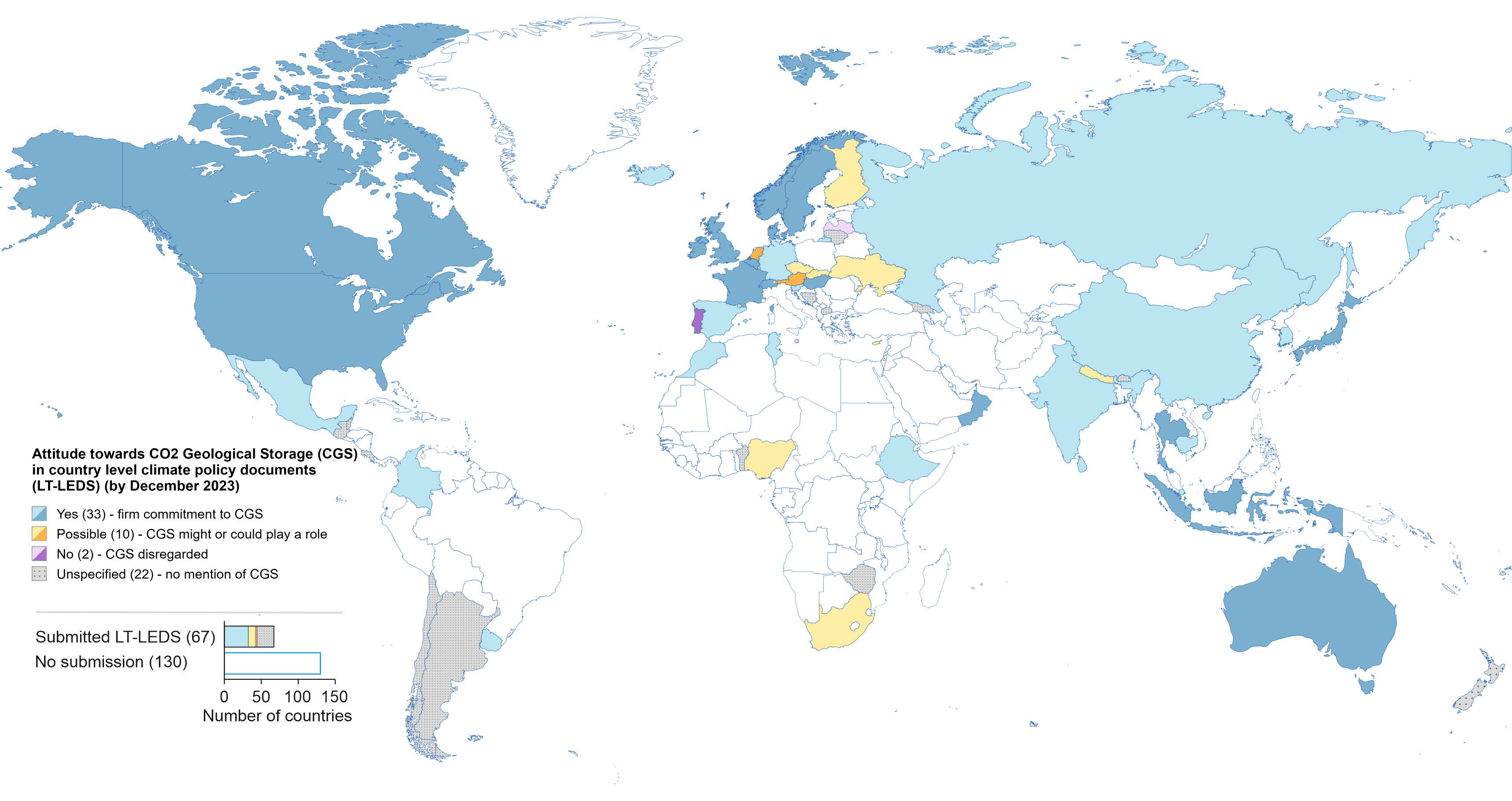
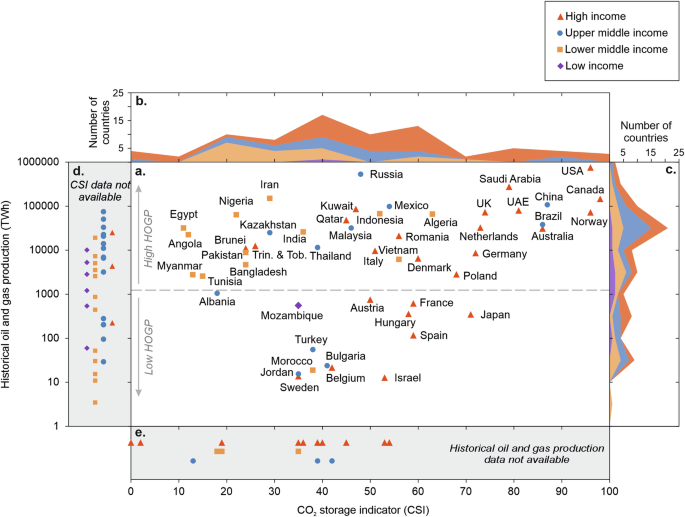

Carbon dioxide geological storage (CGS) is considered critical for limiting global average temperature rise to below 1.5 °C by mitigating fossil industrial emissions and delivering permanent Carbon Dioxide Removals (CDR). Depending on which climate models and mitigation pathways are used, the scale up of CGS required to curb dangerous climate change ranges between 7.5 - 10 GtCO2 per year. Should emissions not be mitigated significantly this decade, even greater quantities of CGS will be needed to balance emissions and reverse temperature overshoot.
Despite this, it is widely acknowledged that CGS buildout is currently not on track to deliver gigatonne scales in the necessary timeframe. This is largely due to policy and economics. Supportive policy and finance mechanisms will be important for supporting CGS development in terms of capacity building and project funding. There is need to accelerate policies that will establish a business case for CGS, such as establishing a revenue stream for CGS and facilitating private sector investment, potentially through novel financing approaches. This could mean that countries best suited for CGS that create a supportive policy environment for the sector could financially benefit, not only from cost effective delivery on their national climate goals, but also through the carbon management industry offtaking emissions from countries without CGS – either due to physical reasons such as geology and infrastructure, economic constraints, or policy context.
So, how will CGS be developed around the globe? Which countries are planning on developing CGS for emissions mitigation and/or removals? Previous published work had already shown that high income countries and those with high historic production of oil and gas have contributed the most to climate breakdown. At the same time, CGS knowledge economy is largely based in the Global North and higher income countries, and regions with historic oil and gas industries are advantaged for CGS development, including in terms of technical data and experience, physical infrastructure, skills and supply chain, legislative frameworks, and economic wealth from resource production. These factors raise questions around which countries are set to benefit most from carbon management business. This is what motivated us to do this research.
One way to assess future climate action is to analyse country level decarbonisation pathways as laid out in long-term low greenhouse gas emissions development strategies (LT-LEDS) which are submitted to the UNFCCC under the Paris Agreement. We performed a stocktake on CGS inclusion in the 67 LT-LEDS submitted prior to January 2024. Specifically, we examined the presence and prevalence of CGS in the LT-LEDS, differentiating types of carbon capture and storage (CCS), including for decarbonising industrial processes (“fossil CCS”), or for negative emissions (“subsurface CDR”) via bioenergy with CCS (BECCS) or direct air capture with CCS (DACCS). We considered the results in the context of historic oil and gas production, current economic circumstance and the presence and performance of CGS assessments. We then explored the justice dimensions that emerge from the global distribution of CGS ambitions.
Our findings highlight inequalities and sensitivities that must be carefully considered when designing carbon market and climate finance policies and frameworks for CGS development. The potential financial benefit from developing CGS infrastructure for carbon management raises questions around the potential future wealth distribution in terms of who pays and who gains - particularly where public sector funding is required to drive private investment in CGS. Climate finance mechanisms will be important for supporting CGS development in terms of capacity building and project funding particularly in lower income countries.
Overall, we find that national climate policies are not commensurate with the science. That said, we found it difficult to obtain a perspective of the expected international scale up of CGS due to quality and detail variation across the LT-LEDS. In several cases, lack of detail and/or ambiguity made it difficult to determine consideration of or commitment to CGS. It is therefore not currently possible to use LT-LEDS to identify spatial or temporal pinch points or discrepancies between capture rates, subsurface storage capacity, and other enabling factors such as transboundary policies or infrastructure, and supply chain maturity. Rapid improvement in standardising and harmonising this information will be critical for an integrated and coordinated effort to deliver on climate goals and to design carbon management policies that do not bake in inequalities.