Philosophical Foundations of Critical Reflection in the Teaching-Learning Process
Published in Education
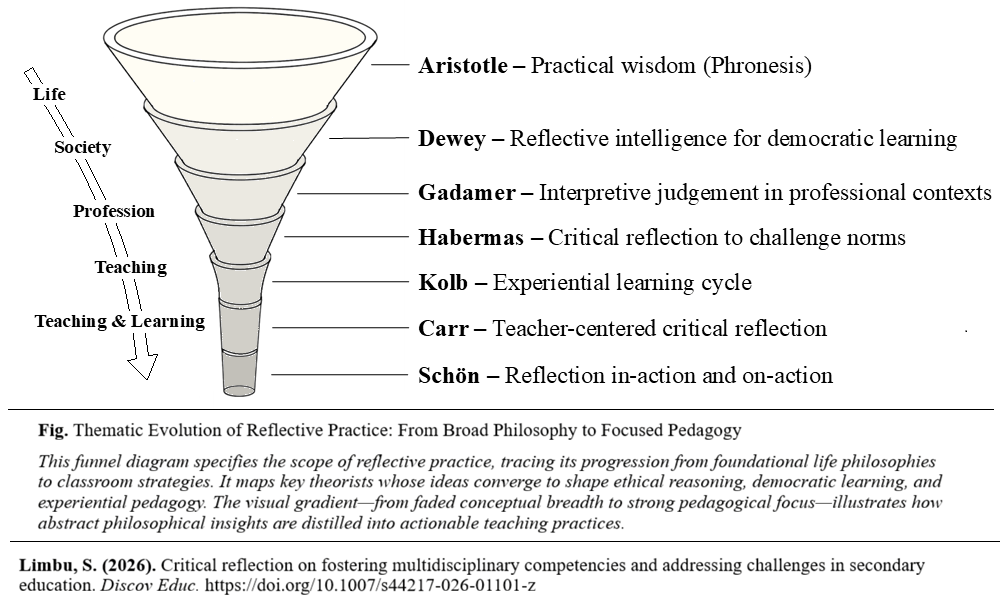


Critical reflection in education is not just a classroom technique—it is the culmination of centuries of philosophical thought. The journey from broad life philosophies to focused teaching strategies reveals how ideas about wisdom, democracy, and interpretation have gradually shaped the way teachers and learners engage with knowledge.
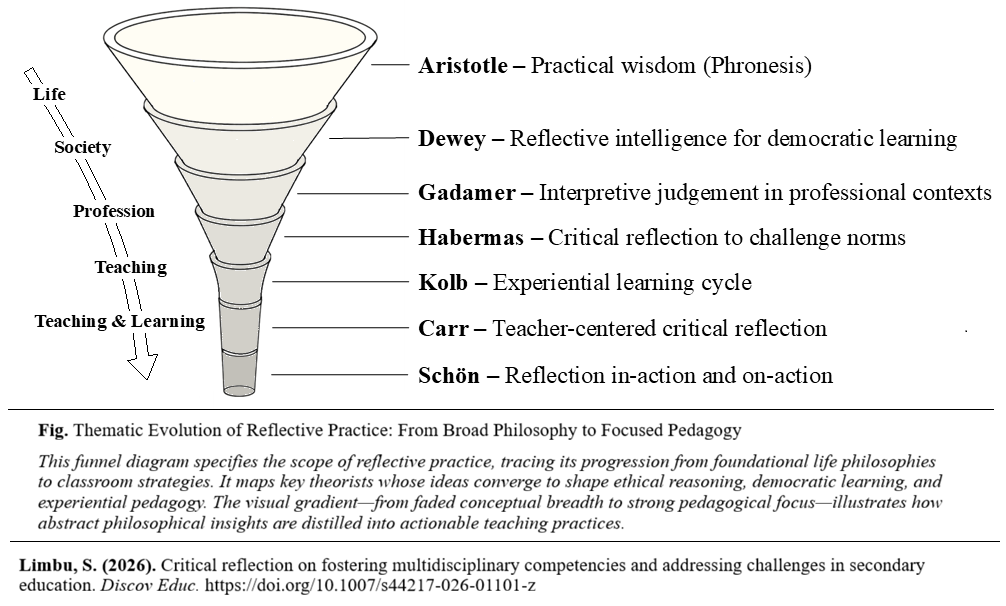 Imagine reflective practice as a funnel. At the wide opening, we find philosophers who explored reflection as a way of living wisely and ethically. As the funnel narrows, their insights are distilled into educational theories. Finally, at the narrow end, reflection becomes a practical tool for teachers in the classroom.
Broad Philosophical Foundations
- Aristotle – Practical Wisdom (Phronesis): Reflection begins as ethical judgment in action, helping us balance theory with lived experience.
- Dewey – Reflective Intelligence for Democratic Learning: Reflection becomes inquiry, encouraging learners to think critically and participate in democratic problem-solving.
- Gadamer – Interpretive Judgement: Reflection is dialogue, emphasizing interpretation and meaning-making in professional contexts.
- Habermas – Critical Reflection: Reflection challenges norms and power structures, making learning emancipatory and socially aware.
These thinkers remind us that reflection is not limited to teaching—it is a way of engaging with life itself.
Transition Toward Education
As reflection moves closer to the classroom, it takes on a more pedagogical focus:
- Kolb – Experiential Learning Cycle: Reflection becomes part of a cycle—experience, observation, conceptualization, and experimentation.
- Carr – Teacher-Centered Critical Reflection: Reflection empowers teachers to critique their own practices and the systems they work within.
Here, reflection shifts from philosophy to applied educational theory, guiding how teachers and learners interact with knowledge.
Focused Pedagogical Strategies
At the narrowest end of the funnel, reflection becomes directly actionable in teaching practice:
-
Schön – Reflection-in-Action and On-Action: Teachers reflect during teaching (in-action) and after teaching (on-action), continuously refining their methods.
This is where reflection becomes a critical tool for professional growth, allowing teachers to adapt, critique, and transform their practice in real time. The funnel metaphor shows us that critical reflection in teaching is deeply rooted in philosophy. It is not an isolated skill, but a practice shaped by centuries of thought: From wisdom and ethics (Aristotle) to democracy and inquiry (Dewey), to interpret and critique (Gadamer, Habermas), to learning cycles and professional practice (Kolb, Carr, Schön).
By tracing this lineage, we see that reflection in education is both a philosophical stance and a pedagogical necessity.
Critical reflection in the teaching-learning process is more than looking back on what worked or didn’t. It is about carrying forward the wisdom of philosophers, the insights of educational theorists, and the practical strategies of reflective practitioners. In doing so, teachers not only refine their methods but also honor a tradition that connects life philosophy with classroom pedagogy.
Reference:
Limbu, S. Critical reflection on fostering multidisciplinary competencies and addressing challenges in secondary education. Discov Educ (2026). https://doi.org/10.1007/s44217-026-01101-z

Follow the Topic
-
Discover Education
An international, peer-reviewed open access journal that publishes original work in all areas of education, serving the community as a broad-scope journal for academic trends and future developments in the field.

Related Collections
With Collections, you can get published faster and increase your visibility.
Empowering Education: Interdisciplinary Convergence and Skill Ecosystem Reconstruction for a Sustainable Future
In an era of unprecedented environmental and societal challenges, education systems must transform to empower students as catalysts for sustainable futures. This Collection advances sustainability education beyond environmental awareness, focusing on developing critical competencies—systems thinking, ethical decision-making, and innovative problem-solving—essential for building resilient societies.
We call for systemic reimagining of education across all levels and disciplines, particularly highlighting:
• Cross-curricular integration of sustainability principles in STEM and vocational training
• Pedagogical innovations that bridge theory-practice gaps
• Industry-education synergies for green skills development
• Digital transformation of sustainability learning
Key Research Domains
Contributions should address critical intersections of sustainability and education, including but not limited to:
• Curriculum innovation for actionable sustainability knowledge
• Evidence-based pedagogical strategies fostering sustainability literacy
• Vocational education redesign for green economy readiness
• Industry partnerships enhancing real-world learning
• Digital technologies (AI, data analytics) in sustainability education
• Assessment frameworks for sustainability competencies
• Teacher professional development models
• Global citizenship and ethical responsibility cultivation
Transformative Objectives
By examining how curricula, teaching strategies, and learning environments can embed sustainability principles, this Special Issue aims to:
• Equip learners with values-driven leadership capabilities
• Develop scalable solutions for environmental, social, and economic challenges
• Catalyze education’s role in achieving global sustainability goals
We invite submissions offering actionable insights and transformative frameworks to prepare students for thriving in a rapidly evolving world.
Publishing Model: Open Access
Deadline: Nov 30, 2026
Advancing Teaching & Learning: Integrating AI, Emerging Technologies, and Pedagogical Innovation
Collection "Advancing Teaching & Learning: AI, Emerging Technologies and Pedagogical Innovation" addresses a major challenge in education today. There is a lack of resources that bring advanced technologies and innovative teaching together. AI, digital tools and emerging technologies are transforming classrooms. Yet many teachers and education leaders struggle to use these tools effectively. This Collection fills that gap. It offers expert insights, practical strategies and real-world examples for modern teaching and learning.
The Collection is linked to the United Nations Sustainable Development Goal 4 on quality education. It shows how to make learning more accessible, inclusive and effective for all. AI, adaptive learning platforms and immersive technologies can personalise instruction. They can engage students and support diverse needs. At the same time, the human element of teaching remains central.
Readers will find practical guidance on curriculum design, digital literacy and evidence-based teaching methods. The approaches can be applied in classroom, blended and online learning. Beyond tools, the Collection inspires educators to rethink traditional methods. It encourages them to embrace innovation while keeping learning meaningful and student-focused.
By addressing the lack of comprehensive resources on advanced technologies, Advancing Teaching & Learning helps teachers, school leaders and instructional designers navigate the digital age. It equips them to create engaging, future-ready learning experiences. Students are prepared for a connected, digital world. Educators gain the confidence to unlock the full potential of every learner.
This Collection supports and amplifies research related to the United Nations Sustainable Development Goal 4 on quality education. It shows how to make learning more accessible, inclusive and effective for all. AI, adaptive learning platforms and immersive technologies can personalise instruction. They can engage students and support diverse needs. At the same time, the human element of teaching remains central.
Keywords: Teaching and Learning; AI in Education; Emerging Technologies; Digital Tools in Classrooms; Pedagogical Innovation; Adaptive Learning Platforms; Immersive Technologies; Quality Education (SDG 4); Classroom Innovation; Blended and Online Learning; Student Engagement; Teacher Professional Development; Future-Ready Learning; Instructional Design; Educational Technology Integration.
Publishing Model: Open Access
Deadline: Apr 15, 2027