Phosphorus: the forgotten element that quietly runs the world
Published in Earth & Environment, Sustainability, and Agricultural & Food Science




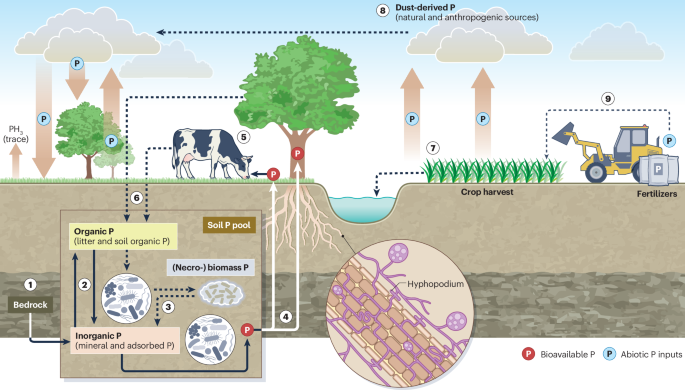

We live in an era obsessed with carbon. Net-zero targets, carbon footprints, carbon markets — the word appears in nearly every conversation about the future of our planet. Nitrogen gets its share of attention too, with decades of research on atmospheric deposition and the cascade of ecological consequences that follow. But phosphorus? Phosphorus tends to get left out of the room.
This has always struck me as a profound injustice, not just scientifically, but practically. Carbon and nitrogen cycle through the atmosphere; they have a way of coming back. Phosphorus does not. It moves in one direction: mined from finite rock deposits, spread across agricultural fields, washed into rivers, and eventually lost to ocean sediments. There is no gaseous return trip. No industrial fixation process to conjure more from thin air. What we have is what we have, and we are burning through it.
This tension between phosphorus's fundamental importance and its chronic neglect has shaped my entire research career.
From Chinese paddies to Spanish shrublands
I first encountered the phosphorus problem not as a global abstraction, but as a very concrete agricultural puzzle. During my PhD (2014–2018) at the Institute of Soil Science, Chinese Academy of Sciences, working under Academician Yongguan Zhu as part of a major CAS Strategic Priority Research Program, I was studying phosphorus mobilisation in Chinese farmland soils. China is the world's largest consumer of phosphate fertilisers, yet a frustrating paradox sits at the heart of its agriculture: farmers apply enormous amounts of phosphorus, but crops capture only a fraction of it. The rest gets locked up — bound tightly to soil minerals, sequestered in organic forms that roots simply cannot access. The microorganisms living in that soil, it turned out, held many of the keys.
Then came an opportunity that changed the scope of everything. I joined Josep Peñuelas at CREAF in Barcelona as a joint PhD student, entering the world of IMBALANCE-P, a landmark ERC Synergy Grant project worth 13.6 million euros that brought together leading researchers across ecosystem ecology, biogeochemistry, Earth system modelling, and global agricultural economics. The central premise of IMBALANCE-P was both simple and alarming: while carbon and nitrogen availability is increasing across most of the planet, phosphorus availability is not — and the resulting elemental imbalance will have consequences for biodiversity, food security, and the climate system that we are only beginning to understand.
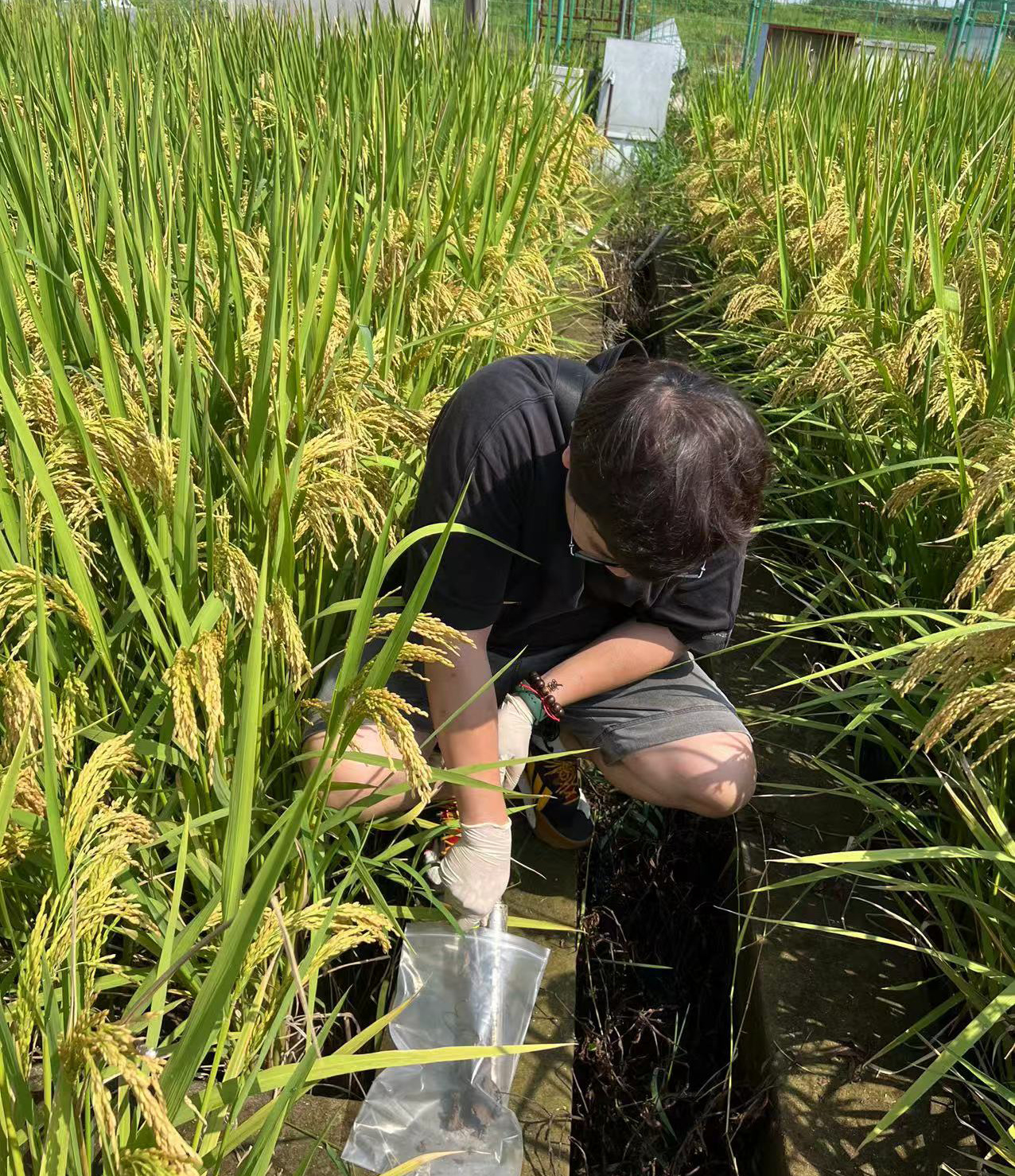
That transition from the intensively managed paddies of eastern China to the phosphorus-impoverished Mediterranean shrublands of Catalonia, and conceptually from farm-scale efficiency to planetary-scale biogeochemistry gave me a perspective I could not have gained any other way. The phosphorus problem looks very different depending on where you stand. In China, the question is: why can't we get more of this phosphorus we've already added into the food system? From a global ecology standpoint, the question is starker: how long can ecosystems and civilisations function as phosphorus keeps draining away?
Why we wrote this review
In the decade since IMBALANCE-P launched, the literature on microbial phosphorus cycling has grown explosively. New genomic tools have revealed extraordinary diversity in how bacteria, fungi, and archaea acquire, store, and share phosphorus. Technologies like nanoscale secondary ion mass spectrometry (NanoSIMS) now let us watch phosphorus move in and out of individual microbial cells. Global metagenomic surveys are mapping phosphorus-acquisition genes across every biome on Earth.
But this knowledge was scattered across microbiology, soil science, ecology, and biogeochemistry journals, rarely speaking to one another. What was missing was a unifying framework: something that could connect the molecular machinery inside a single bacterial cell to the phosphorus dynamics of an entire ecosystem, and ultimately to the global challenge of sustainable phosphorus use.
That is the gap this review tries to fill. Together with Josep Peñuelas, Akash Tariq, and Jordi Sardans, we set out to synthesise what is known about microbial phosphorus cycling in terrestrial ecosystems, and in doing so, we found ourselves articulating something we are calling the Microbial Phosphorus Adaptive Evolution Theory, or MPAET.
The core idea is this: chronic phosphorus scarcity is not just a stress that microorganisms endure, yet it is an evolutionary engine. Over geological timescales, persistent phosphorus limitation has driven microbial communities toward increasingly sophisticated scavenging strategies: amplifying the genes that produce phosphate-releasing enzymes, swapping phosphorus-rich membrane lipids for phosphorus-free alternatives, accumulating internal polyphosphate reserves for lean times ahead, and even building nano-scale tubes to share phosphorus between neighbouring cells. What looks like individual survival behaviour is, at the community level, a collectively tuned phosphorus recycling machine, one that has been refined over billions of years.
One of the findings that genuinely surprised me during this process was the role of viruses. Bacteriophages, it turns out, are not passive bystanders in the phosphorus cycle. They carry phosphorus-acquisition genes, co-opt their host's nutrient uptake machinery during infection, and then release a pulse of bioavailable phosphorus when the cell lyses. The soil is not a quiet library of chemical reactions, it is a dynamic, almost violent arena of competition, cooperation, and viral warfare, all playing out around the question of who gets the phosphorus.
The road ahead
Writing this review reinforced something I have believed since my PhD days in Xiamen: the phosphorus crisis is slow, quiet, and deeply underestimated. It will not announce itself with the drama of a wildfire or a flood. It will arrive as gradually declining soil fertility, as crops that need ever more fertiliser to produce the same yield, as ecosystems quietly tipping toward nutrient limitation with no easy way back.
Microorganisms offer a kind of hope. They have already evolved the solutions we are trying to engineer, i.e., efficient phosphorus recycling, minimal waste, adaptive response to scarcity. The challenge now is to understand those solutions well enough to learn from them, to integrate microbial phosphorus cycling into Earth system models, into agricultural management, and into the global conversation about resource security that phosphorus so urgently deserves.
Phosphorus has been running the world quietly for billions of years. It is time we started paying attention.

Follow the Topic
-
Nature Reviews Microbiology
This journal publishes the highest-quality reviews and perspectives highlighting important developments in our understanding of bacteria, archaea, viruses, fungi and protozoa, their environmental interactions, how they are harnessed in human endeavour and their societal impact.

What are SDG Topics?
An introduction to Sustainable Development Goals (SDGs) Topics and their role in highlighting sustainable development research.
Continue reading announcement