Quantum Annealer Unlocks New Insights into Many-Body Quantum Systems
Published in Physics



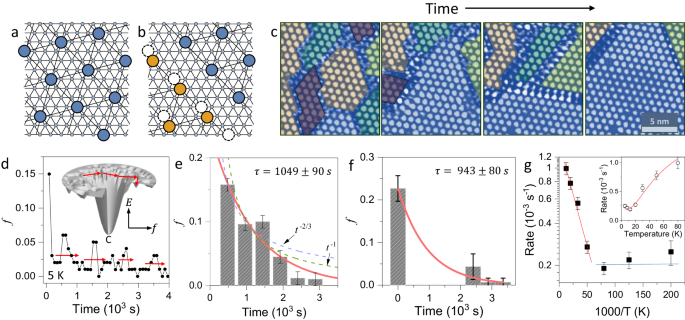

The Challenge: Understanding Quantum Domain Dynamics
Many-body quantum systems exhibit fascinating yet challenging behaviors, particularly in non-equilibrium settings. One such example is the domain wall dynamics in quantum materials, where microscopic interactions between electrons lead to large-scale reconfigurations. A central question in condensed matter physics is how these domain walls evolve under the influence of competing thermal and quantum fluctuations.
Traditionally, capturing these effects requires sophisticated experimental techniques and computational methods. However, conventional simulations often struggle to account for the full range of quantum effects. This is where quantum computing—in particular, quantum annealing—offers a unique advantage.
A Quantum Leap in Simulation
To explore this problem, we turned to a programmable superconducting quantum annealer. Quantum annealers are designed to find low-energy states of complex optimization problems and simulate certain quantum many-body systems. In our study, we encoded the microscopic electron interactions within the qubit connectivity of the quantum annealer.
Through careful tuning of a single parameter, we observed a transition in the simulated dynamics that closely mirrored the experimental behavior seen in time-resolved scanning tunneling microscopy (STM) measurements. This striking agreement between experiment and quantum simulation demonstrates that quantum annealers can provide valuable insights into real material properties—bridging the gap between theoretical models and physical observations.
Why This Matters
Beyond fundamental physics, our findings have direct implications for technology. One of the key applications of our research is in next-generation memory devices based on 1T-TaS2, a quantum material with promising storage capabilities. Understanding how electronic domain walls evolve helps optimize the material’s performance, potentially leading to more energy-efficient and longer-lasting memory elements.
This work also touches on broader themes in quantum science, including macroscopic quantum tunneling and non-equilibrium superconductivity. By showcasing a concrete example where a quantum annealer successfully models a real material, we provide a proof of concept for the future role of quantum computing in material discovery and device engineering.
Looking Ahead
This study is just the beginning. As quantum hardware continues to improve, we anticipate even more powerful simulations that can tackle increasingly complex quantum phenomena. Our research highlights the potential of quantum computing to go beyond abstract problems and contribute directly to understanding and designing new materials.
We invite the scientific community to explore these exciting possibilities further and look forward to the next breakthroughs at the intersection of quantum simulation, materials science, and technology.
For more details, check out our full paper here: https://www.nature.com/articles/s41467-024-49179-z

Follow the Topic
-
Nature Communications
An open access, multidisciplinary journal dedicated to publishing high-quality research in all areas of the biological, health, physical, chemical and Earth sciences.

Related Collections
With Collections, you can get published faster and increase your visibility.
Women's Health
Publishing Model: Hybrid
Deadline: Ongoing
Tumor Microenvironment Crosstalk and Therapeutic Implications
Publishing Model: Hybrid
Deadline: Nov 02, 2026