Quantum differential holography: A quantum-enhanced computational holographic scheme driven by metasurfaces





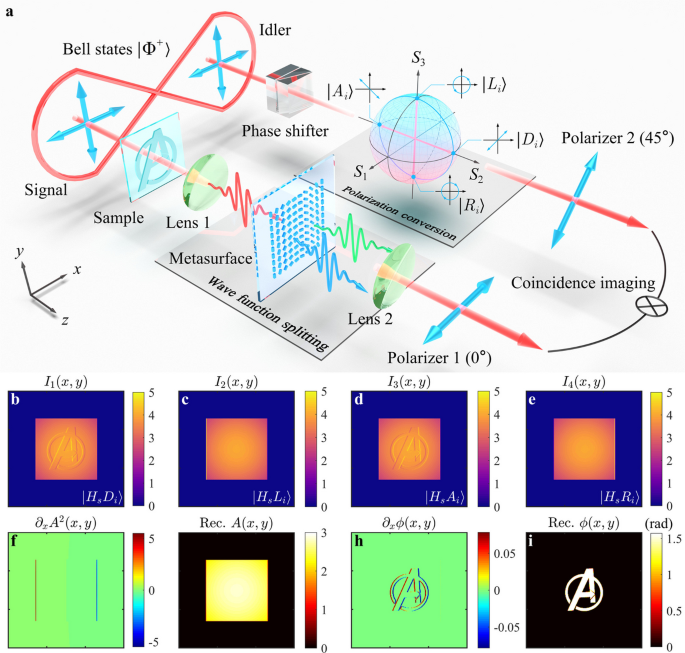

In the long process of exploring scientific questions, we can easily see that “The most elegant ideas often hide behind seemingly simple questions.” For us, the question was: “Why does a holographic microscope still need a bulky interferometric system?” Every time we imaged a transparent cell with a Mach-Zehnder interferometer, the unsynchronized phase jitter between the two arms would inevitably corrupt the result. Even when the fringes were perfect, we still had to wrestle with phase-unwrapping algorithms—finicky algorithms that try to guess where to remove those 2π jumps. It struck us as absurd that in the era of chip-scale quantum photonics, we were still doing holography much as people did in the 1960s. That frustration planted the seed for what eventually became quantum differential holography.
The idea itself was born from a collision of two worlds. Our team has been dedicated to developing optical differentiators based on metasurfaces, which are two-dimensional platforms constructed at the nanoscale. When used in conjunction with polarization selectors, metasurfaces can perform differential operations on incident light fields within a single plane. On the other hand, entangled photon pairs and the nonlocal correlations they provide had been quietly revolutionizing quantum information processing. One afternoon, we sketched out an intriguing thought: what if we let a single photon’s own polarization state carry both the original wave function and its derivative, and then used its entangled twin to read them out separately? If we could do that, we could eliminate the interferometer entirely and avoid any local modulation in the imaging path. More importantly, because we would measure the phase gradient directly, there would be no more need for the uncertain business of phase unwrapping.
As always, the first major challenge was crosstalk. A conventional optical differentiator, with its hardwired functionality, mixes amplitude and phase variations into a single intensity signal. To separate them, we turned to quantum mechanics. By encoding the signal photon’s wave function and its derivative into polarization states, and performing a nonlocal four-step phase shift with the entangled partner, we could effectively extract two independent pieces of information. Realizing this experimentally was, however, far from easy. It demanded a polarization-entangled photon source with extremely high fidelity, and we had to fight against degradation of entanglement caused by temperature fluctuations, wavelength drift, and other real-world nuisances. On the other hand, continuously adjusting the differential modes of the metasurface under extremely low photon flux was an extremely time-consuming task. It took us several months to overcome these challenges. But when we finally achieved it, the images obtained with the nonlocal four-step phase shift were nothing short of exhilarating.
Now, as we set about reconstructing the information, we were met head-on with yet another rather formidable challenge. We found ourselves in possession of these exquisite one-dimensional gradient data sets, but the question remained: how on earth does one transform them back into a two-dimensional complex field? After ploughing through a mountain of papers, we tumbled to the realisation that the problem could be recast as solving Poisson’s equation to recover the field — an idea that seemed, quite frankly, almost too good to be true. You see, this superpower for tackling the inverse problem dovetailed splendidly with our non-local imaging scheme. Ordinarily, one would need to rotate the metasurface to capture gradient information along the other dimension in order to achieve a full two-dimensional light-field reconstruction. But the Poisson solver completely sidesteps any fiddling about with the metasurface orientation, and in doing so, it utterly eliminates the need to realign the imaging optical path. To our amazement, the first reconstructed phase map of a phase target showed crisp, unwrapped fringes that matched the theoretical surface profile perfectly. No 2π jumps, no branch cuts, no iterative refinement. It was one of those rare instances where the mathematics and the physics simply clicked into place.
What does this mean for the future? I believe we have cracked open a door towards genuinely compact, chip-scale holographic imaging systems. Because the whole interference takes place inside the polarization degree of freedom of a photon interacting with a metasurface, one can imagine a future in which the light source, the metasurface, and the detectors are all integrated on a silicon photonic chip. Picture a quantum holographic microscope small enough to sit inside an incubator, imaging live cells label-free and without phototoxicity for days on end, delivering not just pictures but quantitative phase maps of cell growth and division. Beyond biology, the ability to detect surface curvature with quantum-enhanced precision could influence optical manufacturing and quantum metrology. Since we operate at the single-photon level, this technique may become a powerful tool for characterizing precision quantum materials, or even serve as a novel readout for quantum information protocols.
Our paper, “Quantum differential holography,” has now been published in PhotoniX (On the Cover), and we are currently working on follow-up research. The dream of a “compact quantum holographic camera” remains a distant goal, but it feels closer than ever before.
Follow the Topic
-
PhotoniX
PhotoniX aims to present brave endeavors in promoting X-disciplinary research, latest progress of engineering applications and breakthroughs in scientific discoveries, all enabled by photonics. Original scientific letters, articles, reviews, and technology progress reports are equally welcome.

Related Collections
With Collections, you can get published faster and increase your visibility.
Photonics X Metaverse
Metaverse is a comprehensive concept because it is not a single technology, but an expansive, interconnected framework composed of multiple disciplines. Therefore, to fully realize the metaverse, it is necessary to integrate expertise from traditionally siloed fields. Photonics, among them, is acting as a powerful catalyst, driving waves of innovation across all layers of the metaverse hardware ecosystem. This special Issue aims to highlight the latest breakthroughs and insights at the intersection of metaverse and photonics and to foster continuous, cross-disciplinary dialogue and collaboration.
Scope:
Topic 1: Photonics-powered near-eye displays (magnifiers, birdbaths, waveguides, etc.)
Topic 2: Photonics-powered microdisplays (Micro LED, Micro OLED, LCoS, DMD, laser, etc.)
Topic 3: Photonics-powered three-dimensional displays (holography, light field, etc.)
Topic 4: Nanophotonics-powered lenses (freeform lenses, Fresnel lenses, pancake lenses, metalenses, contact lenses, etc.)
Topic 5: Biophotonics-powered bionics (bionic eyes, retinal implants, etc.)
Publishing Model: Open Access
Deadline: Dec 31, 2026
Solar Light-Matter Interactions: Energy Regulation, Conversion and Its Interdisciplinary Applications
The interaction between Solar Light and Matter constitutes a core foundational topic, covering interdisciplinary fields such as optics, energy science, materials science, environmental engineering, and biomedicine science. More critically, it serves as a pivotal technological breakthrough to address the pressing global energy crisis and mitigate climate change. Spanning from large-scale solar energy utilization (such as photovoltaic and photothermal conversion) to micro/nano-scale photon manipulation and interfacial energy transfer, research in this field has steadfastly embraced the multiple mission of "decoding the inherent laws governing natural energy exchange and empowering human sustainable development and health security." Driven by the rapid advancement of micro/nanofabrication technologies, metamaterial design, photonics theories, and biosensing technology, human understanding of solar light-matter interactions has evolved beyond traditional macro-phenomenon observation to the precise regulation of mechanisms at the atomic, quantum and biomolecular levels. This paradigm shift has spawned a series of transformative advances, including plasmonic enhancement effects, metamaterial-based spectral selective control, directional interfacial energy transfer and cross-scale photobio regulation—innovations that have opened up entirely new technical pathways for high-efficiency solar energy utilization, radiative cooling, environmental remediation, and related fields. Nevertheless, the field still grapples with numerous critical scientific challenges and technical bottlenecks: the multi-physics coupling mechanisms governing underlying solar radiation and energy transfer at the micro/nano scale remain incompletely elucidated; the large-scale fabrication, long-term stability and biocompatibility of high-efficiency energy conversion devices are insufficient to meet practical application demands; and the depth and breadth of interdisciplinary technological integration require further enhancement. This Special Issue aims to systematically synthesize cutting-edge theoretical achievements and technological breakthroughs in this domain, construct a robust bridge between basic research and engineering applications, and assemble top-tier global researchers to collectively tackle core challenges. By providing academic support for technological innovation in key areas such as high-efficiency solar energy utilization, radiative cooling, environmental governance and life and health, it will contribute to green and low-carbon development under the "dual carbon" goals, which holds significant academic value and profound practical implications.
Scope:
Topic 1: Fundamental physical and chemical mechanisms underlying solar light-matter interactions
Topic 2: Design, fabrication, and solar radiation regulation performance of micro/nanostructures (e.g., metamaterials, plasmonic materials, porous materials)
Topic 3: High-efficiency solar photothermal/photovoltaic conversion devices and systems
Topic 4: Daytime radiative cooling materials, devices, and their engineering applications
Topic 5: Applications of solar energy conversion technologies in water treatment, environmental remediation, building energy efficiency, and other related fields
Topic 6: Research on the photothermal dynamic regulation mechanisms between solar light and organisms (including humans and other mammals, etc.)
Publishing Model: Open Access
Deadline: Ongoing

