Resolving Meson Hyperfine Structure with a Smeared Cornell Potential Across Heavy–Light and Heavy–Heavy Systems
Published in Physics

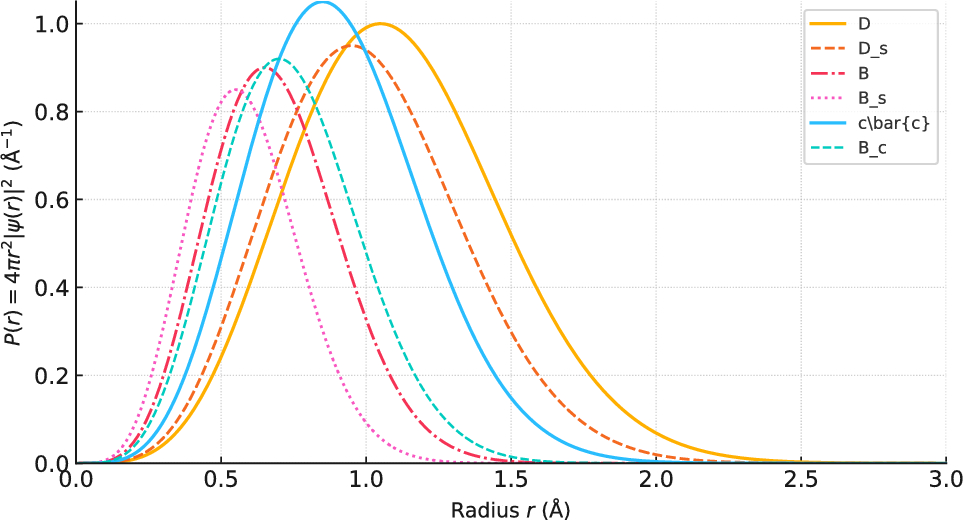

Understanding how quarks bind to form mesons remains one of the central challenges in non-perturbative Quantum Chromodynamics (QCD). While QCD is the fundamental theory of the strong interaction, extracting precise predictions in the low-energy regime requires effective modeling approaches.
In this work, I revisit meson hyperfine structure—the mass splitting between vector and pseudoscalar states—using a QCD-inspired Cornell potential framework. The study is based on my published article: https://doi.org/10.1140/epjp/s13360-025-07031-3
A key issue in conventional potential models is the divergence of the spin–spin contact interaction at short distances. To address this, I introduce a Gaussian smearing of the contact term, which regularizes the interaction and provides a physically meaningful description of short-range quark dynamics.
The framework further employs analytic wavefunctions derived using the Dalgarno–Lewis perturbative method, treating the Coulombic term as the parent potential and the linear confinement as a perturbation. This yields compact expressions that retain both analytical clarity and predictive power.
Using this approach, a unified analysis is performed across:
- Heavy–light mesons (D, Ds, B, Bs)
- Heavy quarkonium systems (charmonium, bottomonium)
- The Bc system
- Radial excitations (2S states)
The results show excellent agreement with experimental data for ground states, typically within a few MeV. The model also predicts systematic reduction of hyperfine splitting for excited states, consistent with reduced wavefunction density at the origin.
Importantly, the model demonstrates parameter stability: variations in the effective strong coupling lead to only minor changes in predictions, while the smearing parameter provides a controlled and physically interpretable regularization.
Overall, this work shows that a smearing-regularized Cornell potential combined with analytic methods can provide a unified and predictive description of meson hyperfine structure across different mass regimes. The results offer useful benchmarks for ongoing and future experiments at LHCb and Belle II.

I work in high energy physics, QCD-inspired models, and quantum tunneling, focusing on universal scaling laws and analytical frameworks for complex quantum systems. My research connects fundamental theory with applications in molecular tunneling and meson spectroscopy. I also contribute to innovation with three design patents and six utility patents, particularly in quantum control and applied physics.
Follow the Topic
-
The European Physical Journal Plus
This journal encompasses all aspects of fundamental and applied physics, including energy, environment, cultural heritage, research infrastructures and citizen science, and welcomes in particular interdisciplinary topics.