Rethinking Laundry toward Ecological Hygiene
Published in Ecology & Evolution and Materials

Every time we wash a shirt, we rarely think about what happens after the water drains away.
The cycle feels simple: detergent in, dirt out. Clean clothes signal hygiene, comfort, and normal life. Yet hidden behind this familiar ritual is an invisible trade-off. For thousands of years, cleanliness has meant removing dirt by washing it away with water. Modern washing machines are more efficient, and detergents more sophisticated, but one fundamental reality remains unchanged: clean clothes almost always come at the cost of wastewater.
From a molecular perspective, laundry is not merely rinsing stains away. Detergents are carefully engineered to intervene at the interface between stain and fabric. They weaken the adhesion of contaminants to textile fibers while simultaneously trapping oily residues inside microscopic assemblies known as micelles. These micelles keep dirt suspended in water so it can be carried away.
But the chemistry that makes detergents effective also makes them persistent. Once they have disrupted adhesion and captured contaminants, they do not deactivate. Surfactant molecules remain adsorbed on fibers and lodged within textile pores, while micelles continue to stabilize residual substances in water. If not thoroughly rinsed out, these residues may irritate skin or cause discomfort in sensitive individuals. Repeated rinsing is therefore not optional — it is physically necessary. Only by diluting and replacing wash water with large volumes of clean water can detergents and their associated residues be removed.
The consequence is structural: conventional laundry inevitably generates substantial quantities of detergent-containing wastewater. Alongside dissolved surfactants, this effluent carries microfiber debris and microplastics shed from textiles, increasing the burden on aquatic ecosystems. The process of cleaning, paradoxically, leaves behind its own environmental footprint.
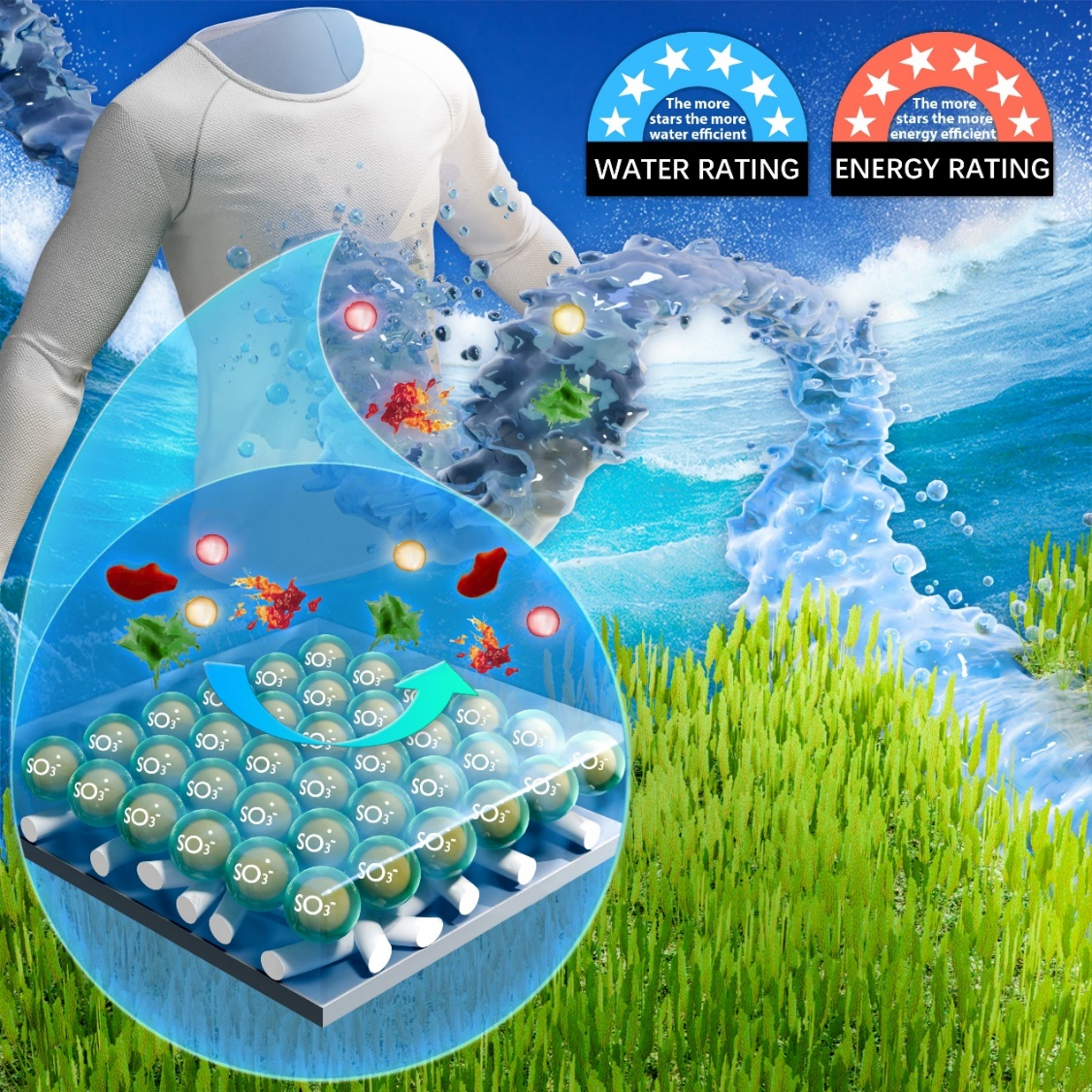
Our work did not begin with laundry in mind. It emerged from fundamental studies of surface chemistry. In earlier research, we examined surfaces bearing densely packed sulfonate groups — highly hydrophilic chemical moieties. We found that when these groups are arranged at high density, they sustain a stable and continuous hydration layer in water: a nanoscopic sheath of tightly bound water molecules that effectively shields the solid surface from direct contact with external contaminants.
This discovery prompted a simple but provocative question: what if textiles could be designed to clean themselves instead of relying on detergents? Cleanliness, we realized, may not require stronger chemistry or harsher mechanical agitation. If a textile surface can maintain a persistent hydration layer upon contact with water, that layer acts as a physical barrier. Contaminants encounter structured water first — not the fiber itself — dramatically reducing their ability to adhere. Under such conditions, stains can be removed by water alone.
Guided by this concept, we introduced interfacial chemistry into real textile systems. After surface modification, the treated fabrics maintained stable hydration layers when immersed in water. When exposed to common contaminants – including oily stains, grease, bacteria, and fungi – they could be effectively cleaned by simple water rinsing. Because detergents were no longer required to weaken adhesion or stabilize contaminants, the otherwise unavoidable rinsing steps of conventional laundry could be eliminated. At the system level, this detergent-free, self-cleaning textile approach reduced water, energy, and time consumption by up to 82%. (A versatile self-cleaning fabric coating as a detergent-free laundry product. DOI: 10.1038/s42004-026-01942-7)
The broader implications extend beyond fabric care. This work illustrates how rethinking interfacial physics can reshape everyday practices. Rather than optimizing detergent formulations or machine efficiency alone, we explored a different dimension: redesigning the surface itself. In doing so, we expand the space of possible solutions. Cleanliness need not depend solely on chemical removal. It can arise from controlled surface interactions at the nanoscale. When adhesion is fundamentally weakened through hydration-layer engineering, the logic of washing changes.
In a world facing increasing water scarcity and mounting environmental pressure, incremental improvements are valuable. But sometimes a deeper conceptual shift becomes possible. By questioning assumptions embedded in routine human activities, science can uncover alternative pathways — ones that reduce environmental burden while preserving functionality.
Laundry may seem mundane. Yet within this ordinary act lies a rich interplay of chemistry, physics, and environmental consequence. By rethinking how surfaces interact with water and contaminants, we suggest that sustainability does not always demand sacrifice. Sometimes it begins with asking whether the problem itself has been framed correctly. Ecological hygiene, in this sense, is not simply about cleaner water. It is about redesigning cleanliness from the interface outward.



Please sign in or register for FREE
If you are a registered user on Research Communities by Springer Nature, please sign in