Rethinking Shame: Five New Frameworks for Understanding South Asian Psychology
Published in Social Sciences and Behavioural Sciences & Psychology

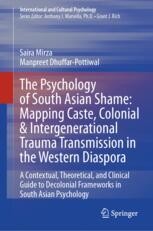

This question became the driving force behind our new book: The Psychology of South Asian Shame: Mapping Caste, Colonial & Intergenerational Trauma Transmission in the Western Diaspora. A Contextual, Theoretical, and Clinical Guide to Decolonial Frameworks in South Asian Psychology
As a researcher working at the intersection of psychology, migration, and decolonisation, I found that existing theories could explain pieces of the puzzle but rarely the whole picture. Clinical models often focused on the individual, while sociological accounts examined structures such as capitalism or patriarchy without fully considering their intersecting psychological consequences; what was missing was a framework that brought these perspectives together. The book therefore proposes that shame should be understood as more than an individual emotion and rather as a social technology that organises identities, regulates behaviour, and reproduces inequality across generations. Thus, throughout the book, shame is conceptualised as being simultaneously:
- Polarising – creating rigid divisions between those considered worthy and unworthy.
- Hierarchical – reinforcing systems of superiority and inferiority.
- Intersectional – interacting with caste, gender, religion, class, migration, and other identities.
- Weaponised – functioning as a mechanism of social control that maintains conformity and silence.
- Neurotic – becoming deeply internalised and shaping mental health, relationships, and self-concept.
These principles underpin five original theoretical frameworks that seek to explain different dimensions of South Asian psychological experience.
Framework 1: The Caste–Trauma Transmission Cycle
The first framework introduces what we term the Caste–Trauma Transmission Cycle, a model that conceptualises caste as a psychological system sustained through shame, structural violence, and intergenerational transmission. Although caste has been widely examined through sociological, historical, and political perspectives, its underlying emotional and psychological mechanisms have received far less attention. This framework proposes that shame functions as the central mechanism through which caste-based inequalities become internalised, reproduced, and passed from one generation to the next, embedding historical oppression within identities, relationships, and everyday lived experiences.
For individuals from disadvantaged castes, repeated experiences of exclusion, stigma, and dehumanisation can become internalised as feelings of defectiveness and unworthiness. Over time, these experiences shape identity, relationships, mental health, and expectations of what is possible. Meanwhile, privileged castes are also shaped by shame, albeit conversely; the pressure to preserve status, maintain purity, achieve perfection, and protect family honour can create anxiety, perfectionism, and a superiority complex. Thus, both superiority and inferiority become different expressions of the same underlying emotional system.
Importantly, the model situates caste within broader structures of colonialism, patriarchy, capitalism, and supremacist ideologies. These systems reinforce one another, legitimising inequality while producing violence, exploitation, and invisible labour. At the centre lies a colonial mindset that normalises domination and embeds beliefs about who is worthy and who is not. The consequences extend beyond individuals as shame becomes woven into parenting practices, community expectations, religious narratives, and cultural norms, creating intergenerational cycles in which trauma is repeatedly transmitted and reinforced. Psychological wounds strengthen the very ideologies that created them, making the system self-perpetuating.
At its core, the Caste–Shame Cycle offers a different way of thinking about oppression. It suggests that caste survives both through laws and institutions, and it is carried in people's identities, emotions, relationships, and behaviours. By recognising shame as the psychological engine of caste, the framework provides a new lens for understanding how historical inequalities continue to shape contemporary mental health, both in South Asia and across the diaspora.
Framework 2: The South Asian Acculturation Theory
The second framework reimagines acculturation as a relational, emotional, and political process, moving beyond traditional models that portray adaptation as an individual choice. While Berry’s acculturation framework has been highly influential, it often assumes that host societies are neutral spaces and overlooks the ways in which racism, caste, religion, colonial legacies, and migration policies actively shape opportunities for belonging.
Our framework suggests that South Asian acculturation is deeply embedded within family systems, intergenerational trauma, and collective histories. Decisions about whether to assimilate, integrate, separate, or marginalise are influenced by inherited expectations, shame, honour, transnational economic obligations, and community surveillance. Identity is therefore negotiated both between heritage and host cultures and also the competing demands of family loyalty, personal autonomy, and social acceptance. The framework proposes that many South Asians adopt hybrid forms of adaptation, including diasporic reconstruction (creating transnational identities that span multiple cultures), strategic passing (selectively modifying behaviour to avoid discrimination while preserving cultural practices in private), and fragmented solidarities (where caste, religion, or national identities complicate collective belonging). These strategies reflect adaptation as an ongoing process of resilience, negotiation, and survival.
The framework also highlights the role of transnational obligations and digital diasporas in shaping psychological wellbeing. Financial responsibilities to relatives abroad, expectations of sacrifice, and online community networks can foster belonging and solidarity while simultaneously reinforcing shame, surveillance, and moral pressure. Migration, therefore, often intensifies the emotional labour required to maintain family dynamics and relationships.
Ultimately, South Asian Acculturation Theory positions adaptation as both a psychological process and a political act, demonstrating that belonging is continuously negotiated within systems of racism, caste, patriarchy, and migration, while being mediated by shame, resilience, and intergenerational memory.
Framework 3: The South Asian Attachment Theory
The third framework proposes a new culturally grounded theory of attachment that reimagines traditional attachment theory through the lived realities of South Asian families. Although Bowlby’s model emphasises the infant–caregiver relationship as the foundation of emotional development, it does not fully account for the ways in which caste, colonialism, Partition, migration, patriarchy, and intergenerational shame shape attachment long before a child is born.
This framework conceptualises attachment as a transgenerational and shame-embedded process, where children inherit not only love and care but also ancestral grief, unfulfilled aspirations, survival strategies, and cultural expectations. Family bonds become intertwined with honour, duty, sacrifice, and collective identity, shaping how safety, belonging, and self-worth are experienced.
To capture these unique experiences, the framework introduces four original South Asian attachment styles:
- Inherited-Loss Attachment – where unresolved ancestral grief and sacrifice are transmitted through expectations of achievement and obligation.
- Shame-Bonded Attachment – where relationships are organised around trauma, honour, silence, and fear of social judgement.
- Survivalist Attachment – where caregiving is driven by protection against racism, displacement, poverty, or systemic oppression, prioritising endurance over emotional expression.
- Transcendent Attachment – where families consciously or organically break cycles of shame and trauma through emotional openness, integration, and compassionate caregiving.
By situating attachment within historical and structural contexts, this framework challenges universal assumptions about parenting and child development, suggesting that South Asian attachment extends beyond caregiver responsiveness into the ongoing negotiation of shame, belonging, survival, and intergenerational healing, offering a decolonial perspective on how relationships are formed and transformed across generations.
Framework 4: South Asian Ecological Systems
The fourth framework reimagines Bronfenbrenner’s Ecological Systems theory through a decolonial lens, demonstrating that trauma and shame are produced and reproduced across interconnected social, cultural, historical, and political systems, positioning wellbeing within nested ecological layers that continuously shape and are shaped by one another.
At the centre is the individual in the microsystem, whose identity, self-worth, and emotional wellbeing are influenced by inherited histories, family relationships, and lived experiences of belonging or exclusion. Surrounding this are the mesosystem of family and caregivers, where parenting practices, sibling relationships, and expectations around honour, obedience, and achievement become key mechanisms through which shame and resilience are transmitted. The mesosystem captures interactions between families and institutions such as schools, religious spaces, and community organisations, illustrating how engagement or withdrawal can reinforce or challenge inherited narratives of inferiority.
Beyond these immediate environments, the exosystem highlights the indirect influence of workplaces, healthcare systems, migration policies, community structures, and digital diasporas, all of which shape how individuals experience opportunity, recognition, and exclusion. At the broadest level, the macrosystem locates these experiences within the enduring legacies of colonialism, caste, patriarchy, migration, and dominant cultural narratives, demonstrating how historical and structural forces filter into family relationships, identity formation, and psychological wellbeing across generations.
Crucially, the framework incorporates the chronosystem, emphasising that trauma, shame, and resilience evolve across time. Historical events such as colonialism, Partition, migration, and discrimination continue to shape parenting practices, aspirations, relationships, and psychological wellbeing long into the future. Equally, resistance, healing, and social change can interrupt these cycles, allowing younger generations to reinterpret inherited narratives and construct new identities.
Unlike traditional ecological models, this framework positions shame as the emotional thread connecting every ecological layer. Family interactions, institutional practices, community expectations, and historical injustices become interdependent mechanisms through which shame is produced, reinforced, or resisted. Thus, the framework offers a holistic understanding of South Asian psychological development, demonstrating that healing requires attention both to individuals and also the families, institutions, histories, and power structures within which they are embedded.
Framework 5: The South Asian Shame Model
The final framework introduces the South Asian Shame model, a theory that explains how shame creates and sustains two opposing but interconnected ways of experiencing the self: over-humanisation and dehumanisation, positioning shame as a powerful force that shapes identity, relationships, social hierarchies, and mental health across generations.
At the centre of the model is the idea that pathological shame fragments the self. Some individuals respond by developing an over-humanised identity, characterised by superiority, perfectionism, entitlement, workaholism, moral grandiosity, or collective narcissism. These behaviours create the illusion of confidence and control but often conceal profound fears of inadequacy and exposure. Others develop a dehumanised identity, internalising messages of inferiority through self-criticism, people-pleasing, addiction, dissociation, self-harm, or chronic feelings of unworthiness. Although these expressions appear opposite, they represent different adaptations to the same underlying wound.
The theory argues that these psychological positions are profoundly shaped by caste, colonialism, patriarchy, migration, racism, family dynamics, and intergenerational trauma. Privilege can foster defensive superiority just as oppression can cultivate internalised inferiority, creating a cycle in which one group's unresolved shame is projected onto another. Thus, shame becomes both a personal emotion and a social mechanism that reproduces hierarchy and inequality.
Importantly, the framework recognises that people are not permanently fixed within either state. Individuals may move between over-humanised and dehumanised patterns throughout life depending on relationships, attachment, social circumstances, psychological wellbeing, and opportunities for healing and education. This fluidity explains why outward success or status does not necessarily reflect internal security, and why marginalised individuals may simultaneously exhibit remarkable resilience alongside profound psychological distress.
Unlike many existing models that focus primarily on pathology, The South Asian Shame model also introduces a third position: the Humanised Self, representing the integration of previously split identities, where shame functions adaptively rather than destructively. Instead of driving perfectionism or self-destruction, adaptive shame becomes a moral compass that promotes accountability, empathy, self-awareness, and authentic relationships; the goal is not perfection but wholeness.
This framework offers a new way of understanding why cycles of superiority, inferiority, oppression, and suffering persist across generations. Ultimately, it argues that genuine healing requires moving beyond both domination and self-denial towards an integrated humanity grounded in compassion, dignity, and self-acceptance.
Moving Toward Decolonial Psychology
This work positions shame beyond an isolated intrapsychic emotion and as a relational, historical, and systemic force that operates simultaneously across the levels of mind, family, community, institution, and society.
Such a reconceptualisation carries profound implications for psychologists, educators, clinicians, policymakers, and community leaders. Healing cannot be confined to the consulting room if the environments to which individuals return continue to reproduce exclusion, silence, and humiliation. As argued throughout this book, meaningful change requires decolonising education, transforming psychological theory, challenging epistemic injustice, and embedding culturally grounded approaches that recognise the collective dimensions of suffering alongside individual experience. Without these broader shifts, interventions risk alleviating symptoms while leaving intact the systems that generate inherited trauma and shame across generations.
The five frameworks presented throughout this book are offered as foundations for that transformation. Together they challenge Eurocentric assumptions about identity, attachment, trauma, belonging, and emotional life, while providing culturally grounded ways of understanding the unique psychological realities of South Asian communities. They invite researchers to expand the boundaries of psychological inquiry, clinicians to develop more contextually sensitive models of care, educators to interrogate whose knowledge is legitimised, and policymakers to recognise that mental health is inseparable from questions of history, power, and social justice.
Ultimately, the psychology of shame cannot be separated from the politics of dignity. The same forces that create silence can also be confronted through critical consciousness, collective action, and the reclamation of cultural knowledge. By exposing shame as both a psychological process and a structural inheritance, this book argues that healing is a communal and political endeavour, rather than an individual responsibility. The task ahead is not simply to help people cope with shame, but to dismantle the conditions that produce it and to build societies in which humanity is no longer measured by caste, colour, gender, religion, or colonial legacy, but recognised as equal, inherent, and shared.

I am a researcher in the School of Social Sciences at Leeds Trinity University, UK, working across South Asian psychology, migration, child and family welfare, and intersectionality. I hold an MSc in Psychology and a BA in Supporting Children, Young People and Families, and my work brings together applied psychology, diaspora studies, acculturation, and social justice, shaped by extensive professional experience in education and community development.
My research draws on community psychology, intersectional feminism, postcolonial theory, and critical perspectives on South Asian migration and colonial histories, with a particular focus on trauma, mental health, and wellbeing in diaspora contexts.
I am the author of The Psychology of South Asian Shame (Springer) and co-editor and author of Migration Psychology Volumes 1 & 2 (Palgrave Macmillan), and I also serve as UK Ambassador and Lead of ATLAS (Advancing Learning, Theory & Awareness for South Asians).
Follow the Topic
Introducing: Social Science Matters
Social Science Matters is a campaign from the team at Palgrave Macmillan that aims to increase the visibility and impact of the social sciences
Continue reading announcement



Please sign in or register for FREE
If you are a registered user on Research Communities by Springer Nature, please sign in