Rheologically Engineered 3D‑Printed Highly Loaded Magneto‑Dielectric Absorbers for Device‑Level Electromagnetic Compatibility
Published in Bioengineering & Biotechnology, Electrical & Electronic Engineering, and Physics
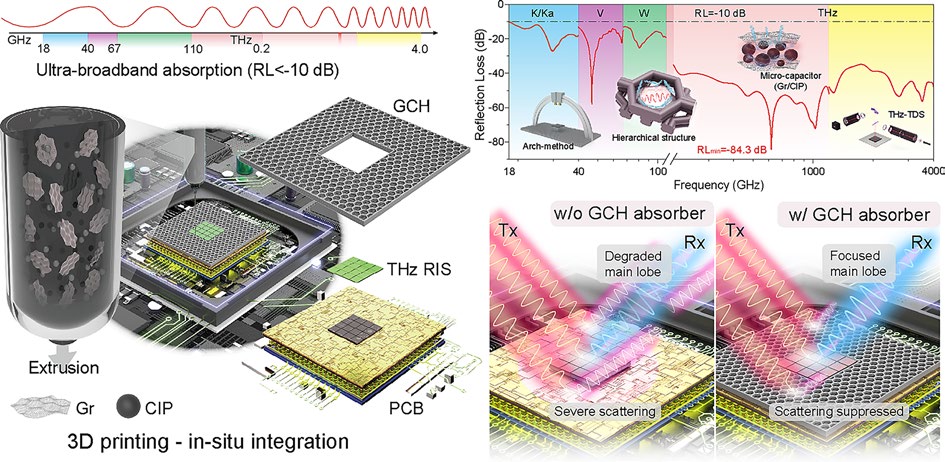

As wireless communication, radar imaging, and electronic systems continue to move toward millimeter-wave and terahertz frequencies, electromagnetic compatibility (EMC) has become increasingly challenging. Conventional electromagnetic absorbers often struggle to simultaneously achieve broadband attenuation, strong absorption, thin thickness, and complex device-compatible geometries, while highly loaded functional composites are particularly difficult to process because excessive filler content can severely compromise ink flow and printing fidelity. Researchers from the University of Electronic Science and Technology of China, led by Professors Xiao Sun, Feng Lan, Yaxin Zhang, and Qiye Wen, have developed a rheologically engineered direct ink writing (DIW) 3D-printing strategy for highly loaded graphene/carbonyl iron (Gr/CIP) magneto-dielectric composites. By quantitatively linking ink composition, rheological behavior, and printing fidelity, the team fabricated gradient honeycomb absorbers that combine ultra-broadband electromagnetic attenuation with direct device-level integration.
Why This Absorber Matters
The rapid expansion of millimeter-wave and terahertz technologies, including 6G communication, high-speed interconnection, high-resolution imaging, and advanced radar systems, demands electromagnetic absorbing materials capable of suppressing unwanted electromagnetic energy across multiple frequency bands. However, conventional absorbers typically rely on material composition or thickness optimization and often operate effectively only within limited frequency ranges. Meanwhile, increasing the content of magnetic fillers such as carbonyl iron powder can improve electromagnetic loss but dramatically increases viscosity, particle aggregation, sedimentation, and structural instability, making high-loading inks difficult to print with high geometric accuracy. The researchers therefore targeted a key but often overlooked bottleneck: how to simultaneously achieve high functional filler loading, printable rheology, and precisely controlled three-dimensional architectures.
Innovative Design and Mechanism
The key innovation is the introduction of graphene as both an electromagnetic-loss component and a rheological network regulator within the Gr/CIP-PDMS composite ink. The two-dimensional graphene sheets reconstruct the supporting network around spherical carbonyl iron particles, providing enhanced yield stress, shear-thinning behavior, and structural recovery while simultaneously introducing conductive electromagnetic loss pathways. Quantitative rheological analysis established a critical CIP loading of approximately 84.06 wt%, while the addition of graphene expanded the printable rheological window and enabled stable extrusion and deposition. The optimized inks exhibited rapid structural recovery, with viscosity recovery exceeding 95% within 180 s, allowing the printed filaments to retain their designed geometry after deposition. Importantly, the study established a quantitative relationship between rheological parameters and printing fidelity, showing that the rheological window can predict filament formation, pore geometry, and three-dimensional structural stability rather than relying solely on empirical formulation optimization.
The resulting gradient honeycomb architecture further couples material-level electromagnetic losses with structure-level wave manipulation. By gradually varying the honeycomb aperture from approximately 2.6 to 4.6 mm, the structure creates a smooth impedance transition and extends the propagation path of incident electromagnetic waves through repeated refraction and scattering. At the microscopic level, graphene provides conductive and interfacial polarization losses, while carbonyl iron contributes magnetic hysteresis and resonance losses. The numerous Gr/CIP/PDMS interfaces additionally generate Maxwell–Wagner polarization, producing a synergistic magnetic–dielectric attenuation mechanism.
Outstanding Performance
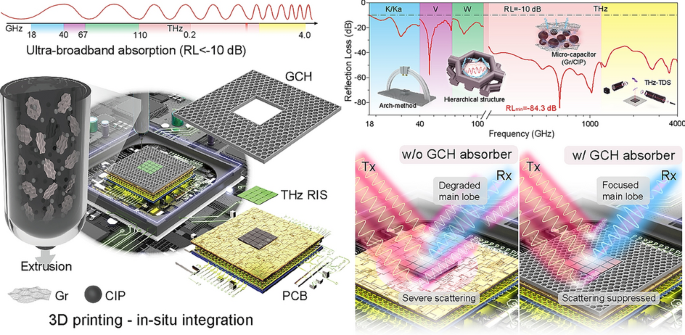
The optimized 3D-printed graphene/carbonyl iron honeycomb (GCH) absorber achieves remarkable broadband electromagnetic absorption spanning 18 GHz to 4 THz with reflection loss (RL) ≤ −10 dB. In the terahertz region, the optimized H2 gradient structure reaches an exceptionally low RLmin of −84.30 dB, with an average reflection loss below −35.2 dB and a thickness of only 2.6 mm. To further address low-frequency absorption, a DIW-printed porous matching layer was introduced, enabling continuous effective absorption from 18–67 GHz, while the standalone 2.6-mm-thick GCH covers 67–4000 GHz. Combining the matching layer and GCH therefore produces continuous absorption across the entire 18 GHz–4 THz range with a maximum thickness of only 4.25 mm and an average reflection loss of −31.4 dB.
The absorber also demonstrates strong environmental and mechanical durability. After six months of air exposure, followed by 168 h of hygrothermal aging at 85 °C/85% relative humidity, the broadband absorption performance remained largely intact. After 200 bending–release cycles at a radius of 8.5 mm, the RL response also remained stable, highlighting the robustness of the printed structure for practical electromagnetic protection.
Applications and Future Outlook
Beyond material-level absorption measurements, the researchers demonstrated the practical value of the GCH absorber through direct integration with terahertz reconfigurable intelligent surfaces (RIS). By conformally 3D-printing the absorber around the RIS array, parasitic reflections and edge scattering were suppressed without introducing the gaps and assembly errors associated with conventional bonding. The integrated absorber increased the average main-lobe gain by approximately 3.3 dBi to ~16 dBi, improved the main-lobe–sidelobe level difference to 1.9–3.3 dB, and reduced the specular-reflection beamwidth by approximately 58% to 3°. In a 120 GHz radar-imaging demonstration, the absorber substantially weakened high-intensity scattering around aircraft-model edges and structural discontinuities. A further stealth-structure simulation showed that the GCH matching-layer system could reduce radar cross section by up to 21.4 dBsm at 30 GHz.
Overall, this work moves electromagnetic absorbers beyond conventional material-only optimization by establishing a rheology–printing–structure–electromagnetic performance design framework. The combination of highly loaded magneto-dielectric composites, programmable DIW fabrication, gradient honeycomb architectures, and conformal device integration provides a scalable route toward next-generation electromagnetic compatibility solutions for 6G/THz communications, radar imaging, electromagnetic scattering suppression, and stealth technologies.

Editor of Nano-Micro Letters, which is an Open-Access, peer-reviewed journal reported papers that have at least one dimension ranging from a few sub-nanometers to a few hundreds of micrometers. The journal is published by Springer Nature and indexed by SCI, EI, SCOPUS, Pubmed, etc. The 2025 JCR Impact Factor is 38.5. The 2025 CiteScore is 58.9.
Follow the Topic
-
Nano-Micro Letters
Nano-Micro Letters is a peer-reviewed, international, interdisciplinary and open-access journal that focus on science, experiments, engineering, technologies and applications of nano- or microscale structure and system in physics, chemistry, biology, material science, and pharmacy.