Saving the Tree-Dwellers: Where Wild Orchids Thrive in Bangladesh's Forests
Published in Plant Science

The Spark and the Two-Year Journey
- The team spent months trekking through dense, humid jungles.
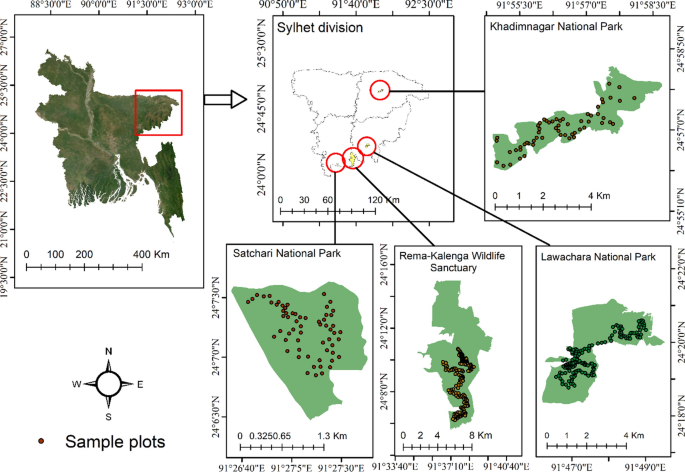
- They walked rugged trails across four national forests.
- They carefully tracked 21 rare orchid species.
- The fieldwork spanned from mid-2023 all the way to late 2024.
Three Students, One Mission
- They dodged rain, heat, and insects to set up circular sample plots.
- They measured giant host trees, bark thickness, and canopy shadows.
- They worked as a tight unit to gather flawless, honest data.
Rabeya's Devotion: Owning the Dream
- Pure Passion: Rabeya personally identified the tricky epiphytic orchids (orchids that grow on trees) out in the wild.
- Total Devotion: She braved every difficult forest trail with absolute energy.
- Stepping Up: Because she handled the science with such deep care, she earned the ultimate academic honor.
- The Joint Leader: She co-led the writing and handled the tough publication process as a corresponding author alongside her mentor.
A Proud Milestone

I am an academic and researcher in the Department of Forestry and Environmental Science at SUST, specializing in tropical forest ecology and biodiversity conservation. My career began in public service as an Assistant Conservator of Forests for the Bangladesh Forest Department (2005–2009), where I managed critical ecological sites, including the Bangabandhu Sheikh Mujib Safari Park, Chunati Wildlife Sanctuary, and Banskhali Ecopark. In 2009, I transitioned to academia to dedicate my teaching and research to protecting national biodiversity. My current research integrates field-level ecological data—including vascular plant diversity, habitat structures, and avifauna biophysical attributes—with remote sensing data to map habitat quality across tropical, human-modified landscapes.
Follow the Topic
-
Discover Forests
A fully open access, peer-reviewed journal supporting multidisciplinary research and policy developments across all fields from forest science and engineering to agroforestry.

Related Collections
With Collections, you can get published faster and increase your visibility.
Forest Soils: How Harvesting Methods and Management Shape Soil Properties, Functions, and Resilience
Intensifying climate pressures and timber demands are refocusing attention on forest soils, the foundation of productivity, biodiversity, and ecosystem services. Harvesting methods can alter physical soil properties, hydrology, and nutrient cycles, while management incentives such as increased structural and species diversity, retention of deadwood and legacy trees, or the maintenance of refugia may buffer or reverse impacts.
Together, these practices govern soil carbon dynamics, greenhouse-gas fluxes, microbial and faunal communities, mycorrhizal networks, and erosion and water quality, yet the mechanistic links and context dependencies remain underexplored across forest types and pedoclimatic zones. This collection invites original research, perspectives and reviews that quantify how harvesting systems (e.g., reduced-impact logging, mechanized operations, continuous-cover forestry) and diversity/retention strategies (e.g., mixed-species stands, structural complexity, coarse woody debris) affect soil properties and functions.
We especially welcome studies that bridge scales, from plot to landscape and from short-term responses to long-term recovery, and that integrate physiology, biogeochemistry, soil ecology, and hydrology using field experiments, long-term trials, chrono sequences, remote sensing, geostatistical analysis, synthesis/meta-analysis, and/or innovative analytics (e.g., modelling, eDNA, isotopes). Submissions with regional to global scope and data-driven policy relevance (i.e., nature-based solutions) are encouraged.
Our goal is to draw attention to forest management practices that hinder or improve ecosystem functions and services by hampering or stewarding soil life and function.
Publishing Model: Open Access
Deadline: Dec 28, 2026
Forest Biodiversity and Carbon Sequestration in a Changing Climate
Forests are central to climate change mitigation and biodiversity conservation because they store large amounts of carbon while supporting diverse ecological communities. However, the capacity of forests to sequester and retain carbon is increasingly influenced by species composition, functional diversity, disturbance regimes, land-use change, and climatic variability. Understanding these relationships is essential for developing effective and sustainable forest management and restoration strategies.
This Special Collection seeks to advance knowledge on the interactions between forest biodiversity and carbon dynamics across natural, managed, and restored forest ecosystems. Contributions are encouraged that examine how taxonomic, functional, and phylogenetic diversity influence carbon stocks, productivity, nutrient cycling, resilience, and long-term ecosystem stability.
The Collection welcomes interdisciplinary studies that integrate ecology, forestry, biogeochemistry, remote sensing, modelling, and policy analysis to address current challenges in forest conservation and climate adaptation. Research that provides practical insights for enhancing both biodiversity conservation and carbon sequestration through sustainable forest management is particularly encouraged.
Topics of Interest include, but are not limited to:
- Assessment and monitoring of forest carbon stocks and fluxes
- Effects of biodiversity on carbon cycling and storage
- Functional traits, species interactions, and ecosystem productivity
- Carbon sequestration in mixed-species forests and plantations
- Forest restoration and reforestation for climate mitigation
- Vegetation dynamics, succession, and long-term carbon storage
- Impacts of disturbance, drought, and land-use change on carbon balance
- Soil-plant interactions and belowground carbon processes
- Remote sensing and modelling approaches for forest carbon assessment
- Policy and management strategies linking biodiversity conservation with carbon sequestration
By bringing together innovative research from diverse forest ecosystems, this Collection aims to provide a comprehensive understanding of how biodiversity contributes to carbon sequestration and ecosystem resilience, thereby supporting evidence-based approaches to sustainable forest management and global climate change mitigation.
Keywords: forest biodiversity; carbon sequestration; carbon stocks; carbon cycling; ecosystem resilience; functional diversity; mixed-species forests; forest restoration; climate change mitigation; sustainable forest management; vegetation dynamics; soil carbon
This Collection supports and amplifies research related to SDG 11, SDG 12, SDG 13 and SDG 15.
Publishing Model: Open Access
Deadline: May 11, 2027