Scalable Fabrication of Large‑Scale Electrochromic Smart Windows for Superior Solar Radiation Regulation and Energy Savings
Published in Materials
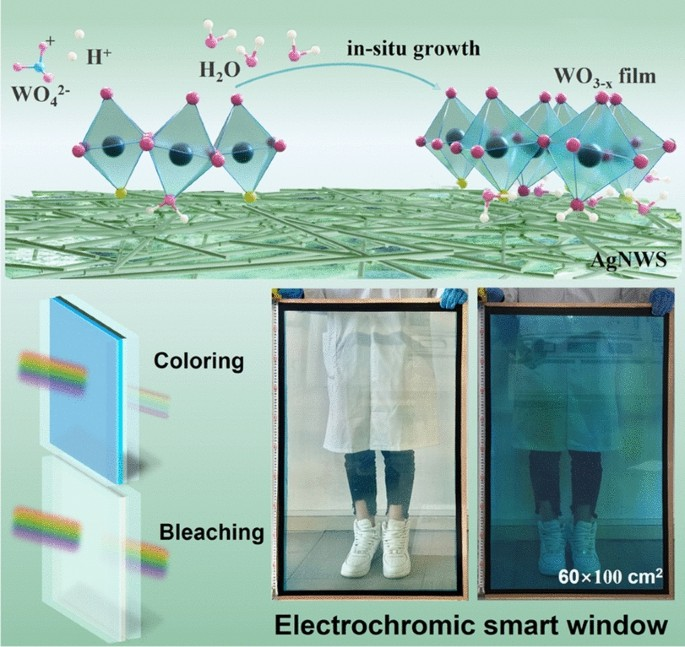
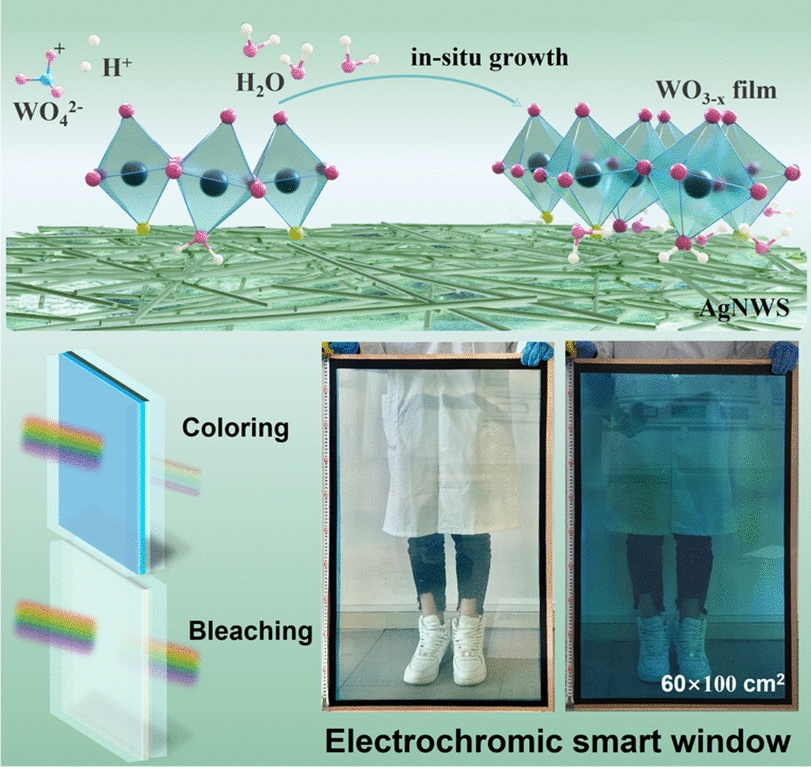

As global energy demand continues to rise, improving building energy efficiency has become a critical challenge. Electrochromic smart windows (ESWs) have emerged as a promising technology that can dynamically regulate solar radiation and significantly reduce energy consumption in buildings. Recently, researchers from Guizhou University and the University of Electronic Science and Technology of China, led by Professor Rongzong Zheng and Professor Chunyang Jia, developed a scalable strategy for fabricating large-area electrochromic smart windows based on tungsten oxide films. This work demonstrates a practical pathway toward industrial production of smart windows for energy-saving buildings.
Why Electrochromic Smart Windows Matter
- Energy Savings in Buildings: Electrochromic smart windows can dynamically regulate both visible (VIS) and near-infrared (NIR) light, helping buildings reduce lighting and temperature control energy consumption by 20–40%.
- Adaptive Solar Radiation Control: By modulating light transmission under applied voltage, smart windows can optimize indoor comfort while minimizing unwanted solar heat gain.
- Sustainable Architecture: Smart window technologies enable dynamic management of solar radiation, providing an effective strategy for reducing global building energy demand.
Innovative Design and Fabrication Strategy
- In-Situ Growth of WO3 Films: The researchers developed a simple immersion process to grow WO3-based electrochromic films directly on substrates, enabling low-cost and scalable fabrication.
- Role of Silver Nanowires: Silver nanowires act as sacrificial reducing agents during film growth, generating electrons that promote the deposition of WO42- species and introduce oxygen vacancies in the tungsten oxide structure.
- Enhanced Electronic Structure: Density functional theory calculations reveal that silver nanowires regulate oxygen vacancy formation and modify the electronic structure of WO3, improving optical modulation and electrochemical performance.
- Large-Area Film Fabrication: Using this approach, uniform electrochromic films can be produced over large areas under simple laboratory conditions, demonstrating strong potential for industrial manufacturing.
Applications and Future Outlook
- Excellent Optical Modulation: The optimized tungsten oxide film exhibits a maximum transmittance modulation of 90.8% at 1100 nm, enabling efficient regulation of solar radiation.
- Outstanding Cycling Stability: The electrochromic films maintain strong performance over 20,000 switching cycles, demonstrating long-term operational stability.
- Large-Scale Smart Window Demonstration: A large electrochromic smart window with an area of 6000 cm2(100 × 60 cm) was successfully fabricated, showing uniform coloration and reliable switching behavior.
- Significant Energy-Saving Potential: Building simulations across more than 40 global cities reveal that these smart windows can reduce building energy consumption by up to 140.0 MJ m-2compared with conventional windows.
This work presents a scalable strategy for producing high-performance electrochromic smart windows with excellent optical modulation, durability, and large-area manufacturability. By integrating simple fabrication methods with advanced materials design, the study provides an important step toward the commercialization of smart window technologies for energy-efficient buildings.

Editor of Nano-Micro Letters, which is an Open-Access, peer-reviewed journal reported papers that have at least one dimension ranging from a few sub-nanometers to a few hundreds of micrometers. The journal is published by Springer Nature and indexed by SCI, EI, SCOPUS, Pubmed, etc. The 2025 JCR Impact Factor is 38.5. The 2025 CiteScore is 58.9.
Follow the Topic
-
Nano-Micro Letters
Nano-Micro Letters is a peer-reviewed, international, interdisciplinary and open-access journal that focus on science, experiments, engineering, technologies and applications of nano- or microscale structure and system in physics, chemistry, biology, material science, and pharmacy.

Please sign in or register for FREE
If you are a registered user on Research Communities by Springer Nature, please sign in