Self‑Sensing NiFe@N‑doped Carbon Aerogel: Integrating Excellent Radar Stealth, Inherent Structural Health Monitoring, Thermal Management, and Flame Retardancy
Published in Materials
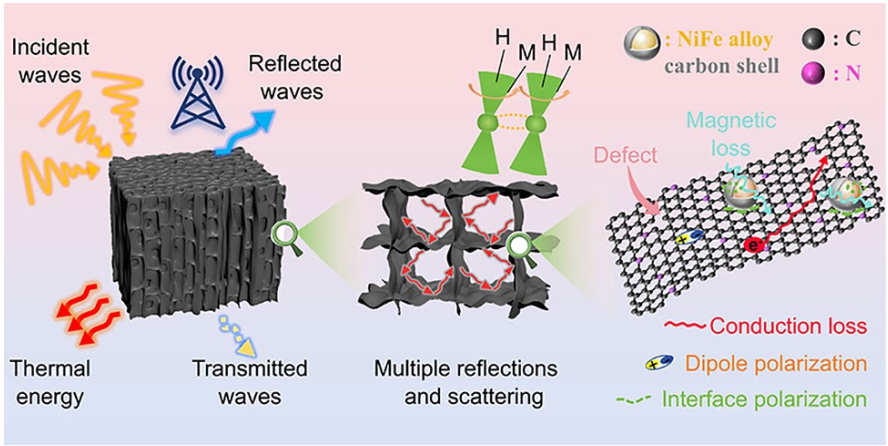

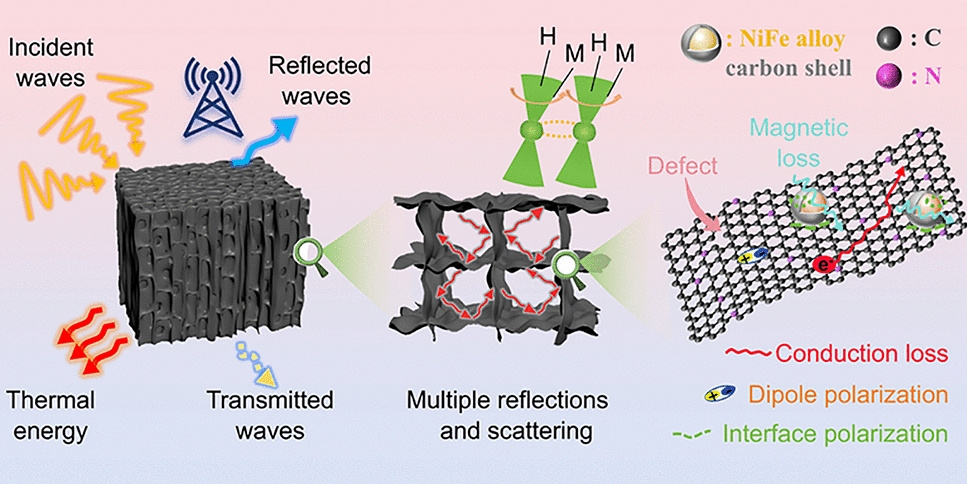

As electromagnetic pollution from rapidly expanding 5G infrastructure poses growing threats to public health and device functionality, developing multifunctional electromagnetic wave absorbing materials with environmental adaptability has become increasingly critical. Now, researchers from Shaanxi University of Science and Technology, led by Professor Jianhua Zhou, have presented a breakthrough biomimetic carbon aerogel that seamlessly integrates multiple essential functionalities into a single lightweight structure.
Why Multifunctional Integration Matters
Traditional electromagnetic wave absorbing materials often focus solely on attenuation performance while neglecting critical operational requirements such as real-time damage detection, thermal protection, and fire safety. This innovative NiFe@N-doped carbon aerogel (NFNCA) addresses these gaps through a rationally designed architecture that combines radar stealth, structural health monitoring, thermal management, and flame retardancy—capabilities essential for aerospace, defense, and advanced electronics applications.
Innovative Design and Fabrication
The NFNCA is fabricated through an elegant strategy involving in situ growth of NiFe-Prussian blue analog particles within a dialdehyde cellulose nanofibril-crosslinked collagen protofibril network, followed by unidirectional freeze-drying and pyrolysis carbonization. This approach creates a 3D hierarchically biomimetic honeycomb-like porous structure with low density (~103.6 mg cm-3), high magnetic nanoparticle dispersion, and strong interfacial connectivity. The unidirectional freezing technique generates anisotropic pore structures that optimize mechanical properties and functional performance.
Exceptional Multifunctional Performance
- The optimized NFNCA-2 exhibits outstanding electromagnetic wave absorption with a minimum reflection loss of −53.49 dB at 1.93 mm thickness and an effective absorption bandwidth of 6.24 GHz covering the entire X-band. This performance stems from synergistic dielectric-magnetic coupling: conduction loss through the 3D conductive network, dipole and interfacial polarization from nitrogen defects and heterogeneous interfaces, and magnetic loss from embedded NiFe alloy nanoparticles.
- Remarkably, the 3D cross-linked conductive network enables inherent self-sensing capability. The aerogel functions as a strain sensor with gauge factors up to 0.303, allowing real-time monitoring of structural integrity through resistance changes—critical for detecting micro-cracks or impact damage without disassembly.
- For thermal management, NFNCA-2 demonstrates excellent infrared thermal stealth through outstanding thermal insulation (0.056 W m-1K-1), maintaining surface temperatures of 44.5°C and 11.4°C when placed on 130°C and liquid nitrogen-cooled surfaces respectively. The material also exhibits rapid photothermal conversion, reaching 80.4°C under 200 mW cm-2 illumination.
- Safety is ensured through exceptional flame retardancy with a limiting oxygen index of 46.3% and zero heat release rate during combustion, attributed to synergistic mechanisms including nitrogen-dilution, catalytic char formation by NiFe nanoparticles, and heat dissipation through the porous structure.
Applications and Future Outlook
This multifunctional aerogel represents a paradigm shift from single-capability materials to integrated structural-functional systems. Its combination of lightweight robustness (supporting 4000× its own weight), broadband electromagnetic absorption, real-time self-monitoring, and environmental resilience positions it as an ideal candidate for next-generation aerospace components, protective electronics enclosures, and defense applications. The sustainable biomass-derived approach further enhances its practical value for scalable deployment.
This comprehensive work provides a feasible design strategy for developing high-efficiency, multifunctional biomass-based carbon aerogels, demonstrating that interdisciplinary innovation in materials chemistry can address complex real-world challenges. Stay tuned for more groundbreaking developments from Professor Jianhua Zhou's team at Shaanxi University of Science and Technology!

Editor of Nano-Micro Letters, which is an Open-Access, peer-reviewed journal reported papers that have at least one dimension ranging from a few sub-nanometers to a few hundreds of micrometers. The journal is published by Springer Nature and indexed by SCI, EI, SCOPUS, Pubmed, etc. The 2024 JCR Impact Factor is 36.3. The 2024 CiteScore is 53.1.
Follow the Topic
-
Nano-Micro Letters
Nano-Micro Letters is a peer-reviewed, international, interdisciplinary and open-access journal that focus on science, experiments, engineering, technologies and applications of nano- or microscale structure and system in physics, chemistry, biology, material science, and pharmacy.

Please sign in or register for FREE
If you are a registered user on Research Communities by Springer Nature, please sign in