Should Singapore Legislate Paid Fertility Leave for IVF Treatment? A Policy Brief and White Paper.
Published in Pharmacy & Pharmacology and Law, Politics & International Studies
Please refer to the following news media article:
Straits Times Forum: Legislated fertility leave is the missing piece in Singapore's parenthood reset
The Case for Legislated Paid Fertility Leave in Singapore - A Policy Brief and White Paper
Summary: Singapore is currently grappling with severe demographic challenges, marked by a record-low total fertility rate and a rapidly ageing workforce. While the government has implemented extensive pro-natalist measures — including enhanced parental leave and financial incentives — a significant policy gap remains regarding institutional support for couples undergoing Assisted Reproductive Technology, particularly In-Vitro Fertilisation. This white paper critically analyses the rationale, benefits, advantages, pitfalls, and limitations of legislating paid fertility leave in Singapore. Drawing upon local surveys, international policy comparisons, and peer-reviewed academic research, it evaluates how fertility treatments impact employee productivity, mental health, and career progression. The analysis reveals that while dedicated fertility leave could alleviate the intense physical and emotional burdens of treatment, it also risks exacerbating workplace discrimination — particularly the "motherhood penalty" — and imposing disproportionate administrative and financial strains on small and medium enterprises. To mitigate these risks, this paper advocates for a synergised approach that integrates fertility leave within a broader, gender-neutral family care framework, complemented by government subsidies, flexible work arrangements, and robust anti-discrimination protections. Ultimately, a fundamental shift in societal and corporate culture is imperative to transform statutory rights into tangible support for family formation in Singapore.
Keywords: Fertility Leave, Assisted Reproductive Technology, In-Vitro Fertilisation, Workplace Discrimination, Pro-natalist Policy, Singapore Demographics
Introduction: The Demographic Imperative
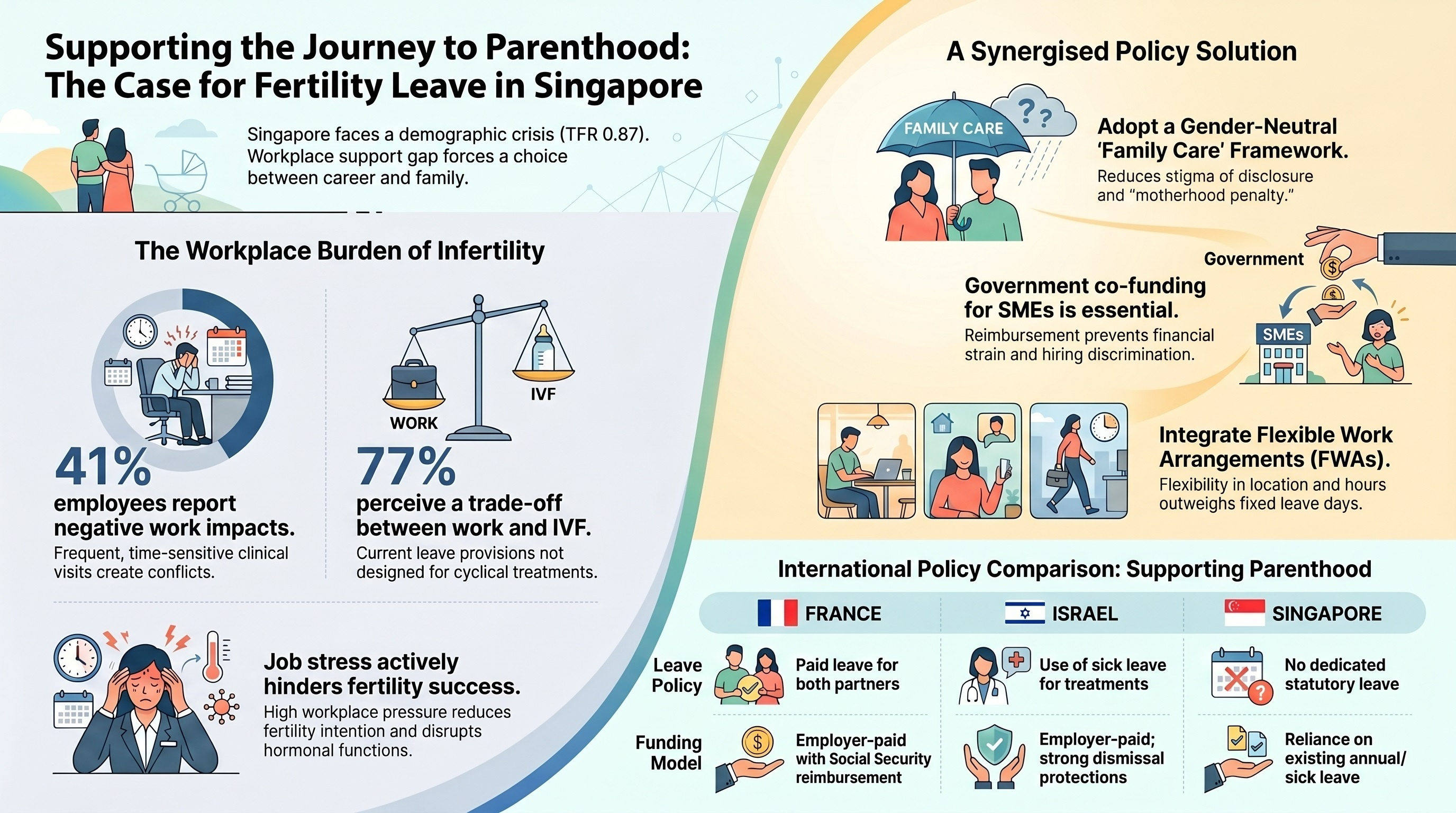
Singapore faces one of the most acute demographic crises in the developed world. The resident total fertility rate (TFR) fell to a historic low of 0.97 births per woman in 2023, remaining unchanged through 2024, and declining further to 0.87 in 2025 — a figure that places Singapore among the lowest in the world, well below the replacement rate of 2.1 [1, 2]. This sustained and accelerating decline poses profound long-term socioeconomic consequences, including a rapidly ageing population, a shrinking and less productive workforce, and mounting pressure on healthcare and social support systems. The proportion of Singapore's working-age individuals has been declining since the early 1990s, and without meaningful intervention, the nation's economic vitality and social stability face serious long-term threats [3].
The Singapore government has long recognised this challenge and has implemented a comprehensive suite of pro-natalist measures under the Marriage and Parenthood (M&P) package. Recent enhancements include the doubling of government-paid paternity leave from two to four weeks, an increase in the Baby Bonus Cash Gift, and the introduction of an additional 10 weeks of Shared Parental Leave effective April 2025 [4]. Despite these robust efforts, a critical gap persists in the policy landscape: the absence of dedicated, legislated support for couples undergoing Assisted Reproductive Technology (ART), particularly In-Vitro Fertilisation (IVF). As the modern workplace increasingly contributes to fertility barriers through high occupational stress and inflexible work schedules, the question of legislating paid fertility leave has emerged as a progressive yet complex policy imperative that warrants rigorous analysis.
This white paper examines the case for and against legislating paid fertility leave in Singapore. It draws on local demographic data, workplace surveys, international legislative precedents, and peer-reviewed academic research to provide a balanced and evidence-based assessment. The paper argues that while fertility leave is a necessary and overdue measure, its effectiveness depends critically on how it is designed, implemented, and embedded within a broader ecosystem of cultural, financial, and institutional support.
2. The Landscape of Infertility in Singapore: Scale and Workplace Impact
2.1 Prevalence and Trends
The scale of infertility in Singapore is substantial. Approximately one in six couples in Singapore experience infertility, defined as an inability to conceive after 12 months of regular unprotected intercourse [5]. As couples increasingly delay marriage and childbearing in pursuit of educational and career goals, the demand for ART has grown significantly. The government co-funds ART procedures at public healthcare institutions, providing eligible couples with up to 75% co-funding for up to three fresh and three frozen IVF cycles, and allowing MediSave withdrawals of up to S$15,000 per patient lifetime [5]. Despite this financial support, the clinical success rates of ART remain modest: the average success rate across Singapore's public and private centres between 2017 and 2021 was 24.0% for women below 30, declining sharply to 22.7% for those aged 30–34, 17.2% for those aged 35–39, and just 6.4% for women aged 40 and above [6]. These figures underscore the reality that IVF is a prolonged, iterative, and emotionally gruelling process, often requiring multiple cycles before success — or ultimately ending in failure.
2.2 The Workplace Burden
The intersection of fertility treatment and professional life is a growing concern in Singapore. An IVF cycle is inherently unpredictable and time-sensitive, requiring frequent clinic visits for monitoring, hormonal injections, egg retrieval procedures, and embryo transfers. These appointments are often scheduled at short notice and cannot be deferred, creating significant conflicts with workplace obligations. Under the current legislative framework, employees undergoing IVF have no dedicated leave entitlement and must rely on annual leave, sick leave, or hospitalisation leave — provisions that were never designed to accommodate the chronic, cyclical nature of fertility treatment.
The human cost of this policy gap is considerable. A 2025 national survey by Fertility Support Singapore (FSS), which polled 504 members who had faced fertility struggles, found that 41% reported that fertility treatment negatively affected their work. Of these, 13% stopped working entirely, 17% took on less work, and 11% transitioned to less demanding roles to accommodate their treatment schedules [7]. A separate population-based study conducted by FSS in partnership with Milieu Insight, involving 400 Singaporeans aged 25 to 55, found that 77% perceived a trade-off between work and pursuing fertility treatments, and only 27% said their companies provided any form of fertility-related benefits [8]. These findings reveal a systemic failure of the current workplace support framework to address the realities of fertility treatment.
The impact extends beyond mere absenteeism. Academic research has consistently demonstrated that job stress exerts a significant adverse effect on fertility, fertility intention, and the infertility treatment process. A 2025 systematic review by Dehkordi and colleagues, published in BMC Public Health, examined 16 studies across four major databases and found that job stress showed significant associations in five out of eight studies on fertility, all three studies on fertility intention, and six out of eight studies on the infertility treatment process [9]. The mechanisms identified include physiological disruption of hormonal and reproductive function, psychological effects that reduce fertility intention, and the practical reality that work pressure reduces the time available to pursue treatment. This creates a vicious cycle: workplace inflexibility exacerbates infertility, while the demands of infertility treatment further compromise workplace performance.
3. The Rationale for Legislating Paid Fertility Leave
3.1 Closing the Policy Gap
The case for legislated fertility leave rests fundamentally on the principle of equity. Employees facing serious medical conditions — including cancer, cardiac disease, or orthopaedic injuries — are entitled to sick leave and hospitalisation leave to manage their treatment. Infertility is a recognised medical condition by the World Health Organization, yet it is uniquely excluded from the standard leave framework. This exclusion is not merely an administrative oversight; it reflects a broader societal tendency to treat fertility challenges as a private matter rather than a legitimate health concern deserving institutional support. Legislating fertility leave would close this gap, formally recognising infertility as a medical condition that warrants dedicated workplace accommodation.
3.2 Signalling Societal Commitment to Family Formation
Beyond the immediate practical benefit, legislated fertility leave carries profound symbolic significance. It would signal a clear and unambiguous societal commitment to supporting family formation, reinforcing the government's broader pro-natalist agenda. In a society where fertility rates continue to decline despite decades of financial incentives, a legislative statement that "Singapore supports your journey to parenthood" could have a meaningful normative effect — shifting workplace culture from one of silent tolerance to active support. Minister Indranee Rajah, who oversees the National Population and Talent Division, has explicitly called for more companies to provide fertility benefits such as paid time off and manager training, emphasising that "it should not be a zero-sum game" between family aspirations and career goals [5].
3.3 Economic and Organisational Benefits
The business case for fertility leave is increasingly compelling. The FSS-Milieu study found that 58% of respondents would be more likely to join a company that offers fertility benefits, and 41% indicated that such benefits would positively impact employee retention [8]. In a tight labour market, the ability to attract and retain talent is a significant competitive advantage. Furthermore, the costs of employee turnover — including recruitment, onboarding, and lost institutional knowledge — typically far exceed the costs of providing fertility leave. A global report by Ferring Pharmaceuticals and Fertility Matters at Work, covering five countries including Australia, France, Japan, Poland, and the United Kingdom, found that 39% of employees have left their jobs or are considering leaving due to fertility treatment challenges, and 94% report that fertility treatment affects their mental wellbeing [10]. These figures suggest that the absence of fertility support is itself a significant driver of talent attrition.
3.4 International Legislative Precedents
Singapore would not be pioneering uncharted territory in legislating fertility leave. Several jurisdictions have already enacted meaningful protections. France, which had a TFR of 1.62 in 2024, recently expanded employer-paid leave entitlements for both male and female employees attending medically assisted conception appointments, alongside strengthened anti-discrimination protections for those undergoing such treatments [11]. In Israel, a country with strong pro-natalist policies, employees are entitled to use accrued sick leave specifically for fertility treatments and are protected from dismissal during the treatment period [12]. These international examples demonstrate that fertility leave is not merely aspirational but practically implementable within diverse legal and cultural frameworks.
A 2024 survey experiment conducted by Wang and Dong at the National University of Singapore and Peking University respectively, published in the European Journal of Population, found that all three types of flexible working arrangements — reduced hours, flexible schedules, and flexible workplace — significantly improved fertility intentions among young, unmarried working Singaporeans, with the effects being especially pronounced for women in professional and managerial occupations [13]. This research provides direct empirical evidence that work-related policy changes can meaningfully influence fertility intentions in the Singapore context, lending strong support to the case for fertility leave as part of a broader package of workplace reforms.
4. Pitfalls and Limitations: Navigating the Complexities
Despite the compelling case for fertility leave, its implementation in Singapore's high-pressure corporate environment presents significant challenges that must be carefully managed to prevent unintended negative consequences.
4.1 The Risk of Exacerbating Workplace Discrimination
The most serious concern is that a distinct category of "fertility leave" could inadvertently exacerbate discrimination against women of childbearing age. Employers aware of an employee's fertility treatment status may perceive them as a "high-risk" hire — prone to frequent, unpredictable absences, potential pregnancy, and extended maternity leave. This perception could lead to pre-emptive discrimination in hiring, promotion, and project assignment, effectively extending the well-documented "motherhood penalty" to those who are merely attempting to conceive.
Academic evidence from comparable policy contexts supports this concern. Studies on China's two-child policy have demonstrated that pro-natalist policies that increase the perceived cost of employing women can lead to pre-emptive discrimination and reduced labour market opportunities for women of reproductive age [14]. The "motherhood penalty" — the documented loss of pay and career advancement opportunities that mothers experience — is already a well-established phenomenon in labour economics, and policies that make an employee's reproductive intentions visible to employers risk extending this penalty to an earlier stage of the family formation process [15]. In Singapore, where meritocracy and productivity are deeply embedded cultural values, the risk of such discrimination is particularly acute.
4.2 The Stigma of Disclosure and the "Quiet Firing" Phenomenon
Infertility remains a deeply personal and emotionally sensitive struggle, often accompanied by significant social stigma. A qualitative study by Taebi and colleagues, published in the International Journal of Fertility and Sterility, found that infertile women face both social stigma and self-stigma, experiencing feelings of shame, guilt, and devaluation that threaten their psychosocial wellbeing and self-esteem [16]. In a workplace context, the requirement to formally claim fertility leave necessitates disclosing one's reproductive status to human resources and management — a disclosure that many employees are deeply reluctant to make.
Currently, 35% to 37% of employees in Singapore do not disclose their fertility treatment to their workplace, primarily due to fear of stigma and career repercussions [7, 8]. In a corporate culture that often prioritises "presenteeism" and equates physical presence with professional commitment, such disclosure may be perceived as a lack of dedication, leading to subtle forms of discrimination, professional exclusion, or "quiet firing." The very act of legislating a specific leave category could paradoxically increase the pressure on employees to disclose — and thus expose themselves to discrimination — rather than providing a safe and confidential avenue for support.
4.3 Disproportionate Burden on Small and Medium Enterprises
Small and Medium Enterprises (SMEs), which form the backbone of Singapore's economy and employ the majority of its workforce, face unique challenges in accommodating fertility leave. Unlike large Multinational Corporations (MNCs) with robust HR departments, redundant staffing capacity, and the financial resources to absorb the costs of employee absences, SMEs operate with leaner teams where a single employee's extended or unpredictable absence can have a significant operational impact. When the government doubled paternity leave to four weeks in 2024, SME representatives expressed concern about the administrative complexity and financial burden of the new entitlement, with many calling for more substantial government support to offset the costs [4]. The introduction of fertility leave — which is inherently more unpredictable and potentially more frequent than paternity leave — would amplify these concerns considerably.
Without adequate government reimbursement mechanisms, mandating paid fertility leave could create a perverse incentive for SMEs to avoid hiring employees of reproductive age, thereby worsening the very discrimination it seeks to address. The design of any fertility leave scheme must therefore include a robust government co-funding or reimbursement mechanism, similar to the model used for government-paid maternity and paternity leave, to ensure that the financial burden does not fall disproportionately on smaller employers.
4.4 The Insufficiency of Leave Alone: The "Band-Aid" Risk
Even if legislated and well-implemented, fertility leave alone is insufficient to address the full scope of challenges faced by employees undergoing ART. The physical and emotional demands of IVF extend far beyond the specific days of medical appointments and procedures. Hormonal treatments cause significant side effects including fatigue, mood swings, bloating, and pain that affect an employee's capacity to work effectively throughout the treatment cycle. The psychological toll is equally severe: the international Ferring-Fertility Matters at Work study found that 94% of employees report that fertility treatment affects their mental wellbeing, and 80% experience anxiety or depression during their fertility journey [10]. A few days of designated leave do not address this chronic, pervasive impact on wellbeing and productivity.
Furthermore, the significant failure rate of ART — with success rates as low as 6.4% for women over 40 in Singapore [6] — means that many employees will return to work after a failed cycle carrying profound emotional devastation, grief, and renewed anxiety about future attempts. Without integrated psychological support, counselling services, and a broader culture of empathy and understanding, fertility leave risks becoming a mere "band-aid" — a procedural accommodation that does not address the underlying human experience of infertility.
4.5 The Gender Neutrality Challenge
A further limitation of fertility leave as typically conceived is its tendency to be framed as a "women's issue." While the physical burden of IVF falls disproportionately on women — who undergo hormonal stimulation, egg retrieval, and embryo transfer — infertility is a shared challenge that affects both partners. Approximately half of all infertility cases involve male factors [5]. A fertility leave policy that applies only or primarily to women risks reinforcing the gendered assumption that family formation is primarily a female responsibility, potentially compounding the "motherhood penalty" rather than challenging it. A truly progressive policy must be explicitly gender-neutral, actively encouraging male partners to take leave for support, for their own diagnostic and treatment appointments, and to share the emotional burden of the fertility journey.
5. Towards a Synergised and Holistic Policy Framework
The analysis above reveals that the question is not whether Singapore should legislate fertility leave, but rather how it should be designed and embedded within a broader policy ecosystem to maximise its benefits and minimise its risks. The following recommendations outline a comprehensive framework for effective implementation.
5.1 Integrating Fertility Leave within a Broader Family Care Framework
To reduce the stigma associated with a distinct "fertility leave" category, policymakers should consider incorporating fertility treatment leave within a broader, gender-neutral "Family Care and Medical Leave" framework. This approach would provide the necessary time off without creating a specific label that exposes employees to targeted discrimination. The leave could be structured as a dedicated sub-category within the broader framework, available to both partners, with clear eligibility criteria tied to documented medical treatment rather than a specific diagnosis of infertility. This framing aligns with the principle of medical confidentiality and reduces the pressure on employees to disclose the specific nature of their treatment to their employers.
5.2 Government Co-funding and Reimbursement Mechanisms
To ensure equitable access and prevent the burden of fertility leave from falling disproportionately on SMEs, the government should establish a robust co-funding or reimbursement mechanism for fertility-related leave days. This could be modelled on the existing Government-Paid Maternity Leave (GPML) and Government-Paid Paternity Leave (GPPL) schemes, under which the government reimburses employers for the cost of statutory leave entitlements. A dedicated fertility leave reimbursement scheme would remove the financial disincentive for SMEs to hire employees of reproductive age and ensure that the policy does not inadvertently worsen discrimination.
5.3 Complementary Flexible Work Arrangements
Fertility leave should not be conceived as a standalone measure but as one component of a broader package of workplace flexibility. The Tripartite Guidelines on Flexible Work Arrangement Requests, which came into effect on 1 December 2024, require all employers to fairly consider formal requests for flexible work arrangements [17]. For employees undergoing fertility treatment, the ability to adjust their work hours, location, or schedule to accommodate time-sensitive medical appointments may be as valuable — or more valuable — than a fixed number of leave days. The empirical evidence from Wang and Dong's Singapore-based study strongly supports this view, demonstrating that all three types of FWAs significantly improved fertility intentions, particularly for women in professional occupations [13]. Policymakers should ensure that the FWA guidelines are effectively enforced and that employees are aware of their right to request flexibility for medical reasons.
5.4 Robust Anti-Discrimination Protections
The effectiveness of fertility leave depends critically on the existence of robust anti-discrimination protections that prevent employers from penalising employees for exercising their leave entitlements. The Workplace Fairness Act (WFA), passed in January 2025, prohibits discrimination based on protected characteristics including sex, marital status, and pregnancy [18]. Policymakers should consider whether the WFA's protections extend sufficiently to cover discrimination based on fertility treatment status and reproductive intentions, and whether additional specific protections are needed. The Act's enforcement mechanisms must be sufficiently robust to deter subtle forms of discrimination, including the "quiet firing" and career stagnation that may result from an employee's disclosure of fertility treatment.
5.5 Integrated Psychological Support and Cultural Change
Beyond legislative measures, addressing the mental health dimension of fertility treatment is essential. Since 2023, the Ministry of Health has required Assisted Reproduction centres to offer psychosocial counselling to patients prior to any ART procedure and to refer patients for counselling if assessed as needed during treatment [5]. This is a commendable step, but workplace-based psychological support is equally important. Employers should be encouraged — and where appropriate, required — to provide access to Employee Assistance Programmes (EAPs) that include specialist fertility counselling, and to train managers in how to support employees undergoing fertility treatment with sensitivity and discretion.
Ultimately, no legislative measure can substitute for a genuine cultural shift in how Singapore's workplaces view and support the fertility journeys of their employees. The FSS-Milieu study found that 97% of employees consider their fertility journey to be a significant life event, yet only 27% feel their employer acknowledges it as such [8]. Bridging this gap requires sustained effort from business leaders, HR professionals, and policymakers alike — a recognition that supporting employees through one of life's most challenging journeys is not merely a matter of compliance but a reflection of organisational values and a strategic investment in human capital.
6. Comparative Policy Analysis: International Lessons for Singapore
The following table summarises the key features of fertility-related workplace policies in selected jurisdictions, providing a comparative framework for Singapore's policy development.
|
Jurisdiction |
Key Policy Measure |
Scope |
Funding Model |
Anti-Discrimination Protections |
|
France |
Paid leave for medically assisted conception appointments; expanded to male partners |
Both partners |
Employer-paid, with social security reimbursement |
Strengthened protections against dismissal during treatment |
|
Israel |
Use of sick leave for fertility treatments; protection from dismissal |
Primarily female employees |
Employer-paid sick leave |
Prohibition on dismissal during treatment period |
|
United Kingdom |
No statutory fertility leave (as of 2025); voluntary employer policies; parliamentary debate ongoing |
Varies by employer |
Employer-funded where offered |
General employment discrimination law applies |
|
Australia |
No statutory fertility leave; growing employer-led initiatives |
Varies by employer |
Employer-funded where offered |
General anti-discrimination law; some states have specific protections |
|
Singapore (current) |
No dedicated fertility leave; reliance on annual/sick/hospitalisation leave; FWA guidelines from Dec 2024 |
All employees |
Employee's own leave entitlement |
Workplace Fairness Act 2025; TAFEP guidelines |
The international experience suggests that the most effective approaches combine statutory leave entitlements with strong anti-discrimination protections and government support for employers. France's model, which extends leave rights to male partners and pairs them with anti-discrimination measures, is particularly instructive for Singapore's context.
7. Conclusion
Singapore's demographic crisis demands urgent and multifaceted policy responses. Legislated paid fertility leave represents a necessary and overdue step in acknowledging the medical reality of infertility, supporting couples on their journey to parenthood, and removing the workplace barriers that currently compound the physical and emotional burdens of ART treatment. The evidence is clear: the absence of dedicated fertility leave imposes significant costs on affected employees, their employers, and ultimately on Singapore's broader demographic and economic future.
However, the analysis presented in this paper demonstrates that fertility leave alone is insufficient and potentially counterproductive if not carefully designed and embedded within a broader policy ecosystem. The risks of exacerbating workplace discrimination, imposing disproportionate burdens on SMEs, and failing to address the full psychological and physical dimensions of fertility treatment are real and must be proactively managed. A fertility leave policy that is poorly designed could paradoxically worsen the very inequities it seeks to address.
The path forward requires a synergised approach: fertility leave integrated within a gender-neutral family care framework; robust government co-funding to protect SMEs; effective enforcement of flexible work arrangement rights; strengthened anti-discrimination protections under the Workplace Fairness Act; and integrated psychological support for employees and their partners. Above all, it requires a fundamental shift in Singapore's corporate culture — from one that treats fertility challenges as a private inconvenience to be managed quietly, to one that recognises family formation as a shared societal responsibility and a strategic organisational priority.
The stakes could not be higher. With Singapore's TFR declining to 0.87 in 2025, the window for meaningful intervention is narrowing. A well-designed fertility leave policy, embedded within a comprehensive and culturally sensitive support framework, could make a meaningful contribution to reversing this trend — not by compelling people to have children, but by removing the institutional barriers that prevent those who wish to do so from pursuing that aspiration without sacrificing their careers, their health, or their dignity.
References
- Channel NewsAsia. Singapore's total fertility rate stays at historic low of 0.97 in 2024. Singapore: Channel NewsAsia; 2025 Feb 28. Available from: https://www.channelnewsasia.com/singapore/singapore-fertility-rate-births-record-low-immigration-4966516
- The Straits Times. askST: What is total fertility rate? What does Singapore's record low rate mean? Singapore: The Straits Times; 2026 Mar 6. Available from: https://www.straitstimes.com/singapore/askst-what-is-total-fertility-rate-what-does-singapores-record-low-rate-mean
- ASEAN Macroeconomic Research Office. Silver linings: Unlocking the potential strengths in an aging Singapore. Singapore: AMRO; 2025 Feb 25. Available from: https://amro-asia.org/silver-linings-unlocking-the-potential-strengths-in-an-aging-singapore/
- The Straits Times. SMEs hope for more support with added parental leave; large firms confident of coping. Singapore: The Straits Times; 2024. Available from: https://www.straitstimes.com/singapore/smes-hope-for-more-support-with-added-parental-leave-large-firms-confident-of-coping
- Rajah I. Speech by Minister Indranee Rajah at Fertility and Inclusion in the Workplace event. Singapore: National Population and Talent Division; 2025 Jul 25. Available from: https://www.population.gov.sg/speech-by-minister-indranee-rajah-at-fertility-and-inclusion-in-the-workplace-event/
- Ministry of Health Singapore. Statistics of Assisted Reproductive Technology success rate for public and private centres. Singapore: Ministry of Health; 2024 Jan 10. Available from: https://www.moh.gov.sg/newsroom/statistics-of-assisted-reproductive-technology-success-rate-for-public-and-private-centres/
- Fertility Support SG. Infertility in the Workplace: FSS Workplace Support Guide. Singapore: Fertility Support SG; 2025 Jul. Available from: https://fertilitysupport.sg/infertility-in-the-workplace/
- Ang S. Career setbacks among challenges raised by those seeking fertility help in S'pore: Survey. Singapore: The Straits Times; 2025 Jul 25. Available from: https://www.straitstimes.com/singapore/time-off-career-setbacks-new-spore-survey-on-fertility-challenges-at-workplaces
- Dehkordi SM, Khoshakhlagh AH, Yazdanirad S, Mohammadian-Hafshejani A, Rajabi-vardanjani H. The effect of job stress on fertility, its intention, and infertility treatment among the workers: a systematic review. BMC Public Health. 2025 Feb 10;25:542. doi: 10.1186/s12889-025-21790-9
- Ferring Pharmaceuticals, Fertility Matters at Work, This Can Happen Global. The impact of fertility challenges at work: international insights. Ferring Pharmaceuticals; 2025 Nov. Available from: https://www.ferring.com/wp-content/uploads/sites/16/2025/11/Fertility-challenges-at-work-international-insights-2025.pdf
- France introduces additional rights for employees engaged in medically assisted conception or adoption processes. Lockton; 2025. Available from: https://global.lockton.com/us/en/news-insights/france-introduces-additional-rights-for-employees-engaged-in-medically
- Nefesh B'Nefesh. Women's rights in the workplace. Israel: Nefesh B'Nefesh; 2024. Available from: https://www.nbn.org.il/life-in-israel/employment/employee-rights-and-benefits/womens-rights-in-the-workplace/
- Wang S, Dong H. Flexible working arrangements and fertility intentions: a survey experiment in Singapore. Eur J Popul. 2024 Nov 21;40(1):33. doi: 10.1007/s10680-024-09719-1
- Institute of Real Estate and Urban Studies, National University of Singapore. Scared away: unintended consequences of pro-birth policies — a cautionary tale from China. Singapore: NUS IREUS; 2025. Available from: https://ireus.nus.edu.sg/scared-away-unintended-consequences-pro-birth-policies/
- Correll SJ, Benard S, Paik I. Getting a job: Is there a motherhood penalty? Am J Sociol. 2007;112(5):1297–1338. doi: 10.1086/511799
- Taebi M, Kariman N, Montazeri A, Majd HA. Infertility stigma: a qualitative study on feelings and experiences of infertile women. Int J Fertil Steril. 2021 Jul-Sep;15(3):189–196. doi: 10.22074/IJFS.2021.139093.1039
- Ministry of Manpower Singapore. Tripartite guidelines on flexible work arrangement requests. Singapore: Ministry of Manpower; 2024 Apr. Available from: https://www.mom.gov.sg/employment-practices/good-work-practices/flexible-work-arrangements
- Chang M. Fair play at work: unpacking Singapore's Workplace Fairness Act. Mayer Brown; 2025 Jul 2. Available from: https://www.mayerbrown.com/en/insights/publications/2025/07/fair-play-at-work-unpacking-singapores-workplace-fairness-act

Please sign in or register for FREE
If you are a registered user on Research Communities by Springer Nature, please sign in