Simple coating makes E.coli different
Published in Chemistry

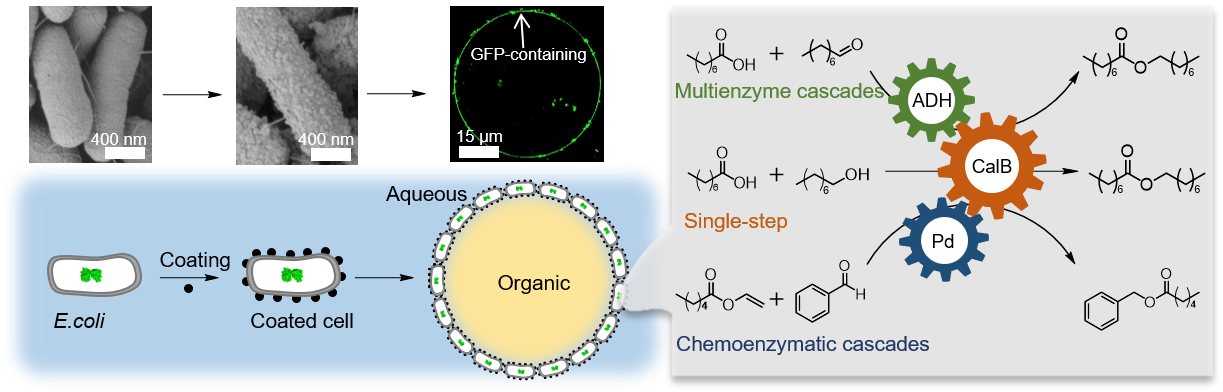

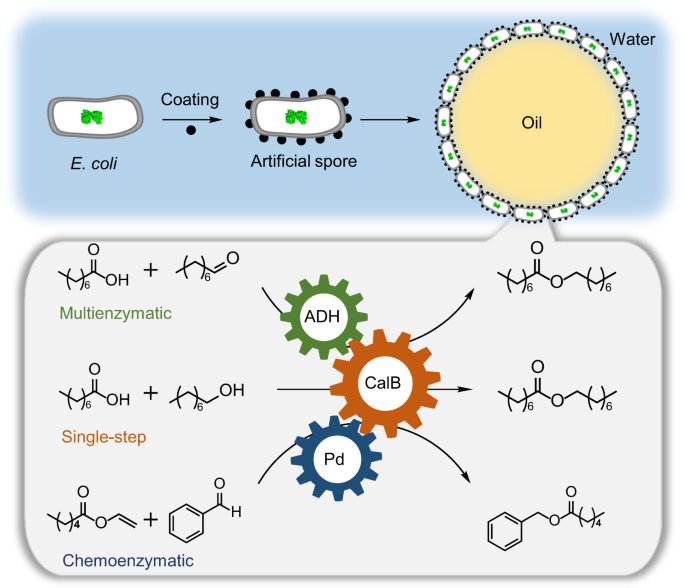

Whole-cell biocatalysis is an attractive approach in the organic synthesis and pharmaceutical industry because it embraces the advantages of enzymatic catalysis while avoids the tedious enzyme purification. Same as enzyme catalysis, the application of whole cells is limited in water where polar substrates present low solubility. To solve the solubility issue, an immiscible organic solvent is normally added to form a water-organic biphasic system where cells and substrates fit in their favorable environment. However, there is small interfacial area between the two phases which cause mass transfer difficulties for the substrates to access the catalyst. Moreover, the organic solvent can impose extra stress on cells which will lead to the cell death and decreased enzymatic activity.
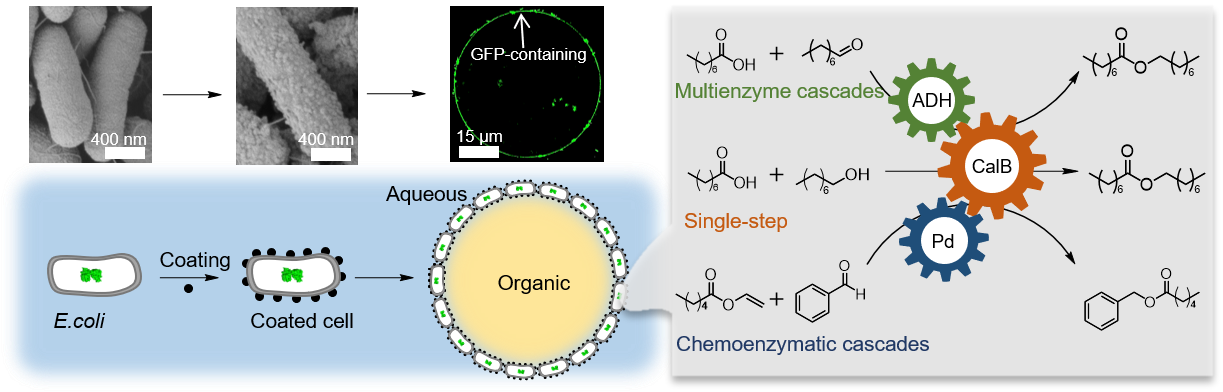
Figure 1. Coated cells for interfacial biocatalysis
In our work, we aim to solve these problems via a biocompatible and tunable coating strategy to protect the cells from external stresses, such as UV irradiation, heating, organic solvents and interfacial tensions, enabling the cells to be metabolically and interfacially active to stabilize a water-organic emulsion for biocatalysis with minimum mass-transfer resistance. In specific, the cells were coated with polydopamine which was confirmed by SEM and TEM. The excellent biocompatibility of the coating was proved by the live/dead assay. The protectability against various environmental stresses was also investigated, showing that the cell viability and enzyme stability were significantly improved. Afterwards, we used the coated cells to stabilize the Pickering emulsion which is key for interfacial biocatalysis. And we proved that the cells were on the emulsion interface via confocal laser microscopy and SEM.
Encouraged by these results, we investigated the catalytic performance of the emulsion system compared to normal biphasic system. In all three single-step enzymatic reactions, the interfacial catalysis performed much better in conversion and enzymatic activity than the controls. This is due to the cells on the large interface of the emulsion which breaks down the mass transfer barrier between the two phases, enabling easy access of substrates to catalyst. Moreover, the coated cells were robust which can be recycled for several times without enzyme activity loss. We then further conducted three cascade reactions in the emulsion system which also show much better catalytic performance than the biphasic controls.
Inspired the robustness of the coated cells, we further loaded palladium nanoparticles on the cells, which did not impact the cell growth ability and surface properties. A chemoenzymatic cascade was established in the emulsion for interfacial catalysis. With this success, we envision this simple and generic coating strategy can be further developed to integrate a wide array of chemo catalysts and biocatalyst to address challenging synthesis under harsh conditions.
For more details, please read the article on Nature Communications via https://www.nature.com/articles/s41467-022-30915-2.
Follow the Topic
-
Nature Communications
An open access, multidisciplinary journal dedicated to publishing high-quality research in all areas of the biological, health, physical, chemical and Earth sciences.

Related Collections
With Collections, you can get published faster and increase your visibility.
Women's Health
Publishing Model: Hybrid
Deadline: Ongoing
Tumor Microenvironment Crosstalk and Therapeutic Implications
Publishing Model: Hybrid
Deadline: Nov 02, 2026