Solving Water Scarcity, Creating Carbon Risk: A Monthly National Accounting Framework Reveals the Hidden Trade-offs of Desalination in the Maldives
Published in Sustainability


Small island nations live with a paradox. They are surrounded by water, yet face persistent freshwater scarcity. In places like the Maldives, where thin freshwater lenses, saline intrusion and climate variability constrain natural supply, desalination has become not just an option—but a necessity.
At first glance, desalination appears to solve the problem. It produces reliable drinking water, independent of rainfall. It supports growing populations and tourism-driven demand. It provides resilience against drought. But as I began working on this study, a deeper question emerged: what if solving water scarcity in this way quietly introduces another kind of risk?
This paper began with a simple observation. While desalination is widely studied, the way we measure its role in national water systems is often fragmented. Some studies focus on individual plants, others on energy efficiency, and many report results at annual scales. What is often missing is a unified, time-resolved view that connects water demand, supply and carbon emissions within a single system.
This gap matters, especially for small island developing states. These systems operate under tight constraints: limited storage, highly variable rainfall, and strong demand pressures from tourism. At the same time, electricity systems are often diesel-based, meaning that producing more water through desalination directly increases carbon emissions. Yet these linkages are rarely tracked together in a consistent way.
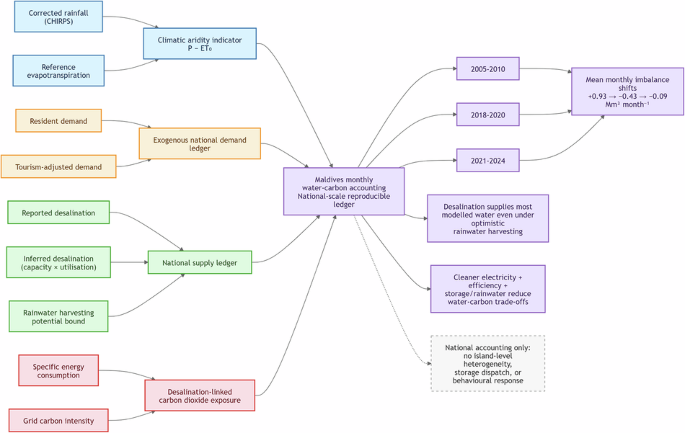
To address this, I developed a monthly national accounting framework for the Maldives. The idea was not to simulate the physical water cycle in detail, but to construct an auditable “ledger” that brings together key components of the system: rainfall, evaporation, reconstructed demand, desalination production, and electricity-linked carbon emissions. Each component is defined transparently, and where data are missing, assumptions are explicitly stated and bounded.
A central challenge in building this framework was data availability. Desalination production records, in particular, are not always complete. Instead of smoothing over these gaps, I chose to treat them directly. Months with missing data are either reconstructed using capacity and utilisation assumptions or flagged as uncertain. This allows the results to reflect not only central estimates but also the uncertainty inherent in the system.
The resulting framework produces a month-by-month picture of how water demand and supply interact, and how desalination contributes to balancing that system. More importantly, it links those volumes to carbon emissions through the energy required to produce desalinated water.
What emerges from this analysis is a clear structural shift. In earlier periods, the system is largely constrained by rainfall and the potential for rainwater harvesting. As desalination expands, it increasingly becomes the mechanism through which the system “closes” its water balance—at least in an accounting sense. In other words, desalination allows demand and supply to align more closely over time.
But this closure comes at a cost. Because desalination is energy-intensive, and because electricity in the Maldives is largely diesel-based, increases in desalination output are mirrored by increases in carbon emissions. The more the system relies on desalination, the more tightly water security becomes coupled to carbon exposure.
This creates a trade-off that is not always visible in conventional analyses. Water security improves, but emissions rise. Efficiency improvements can reduce emissions per unit of water, but they cannot eliminate the underlying dependence on the energy system. Without decarbonisation of electricity, desalination-driven water security remains carbon-intensive.
One of the key insights of the study is that this trade-off is not unique to the Maldives. The framework is intentionally designed to be transferable to other small island developing states, where similar constraints apply. The required inputs—precipitation, evapotranspiration, population and tourism data, desalination capacity and electricity carbon intensity—are generally available or can be approximated. This means that the approach can be used to build comparable national “ledgers” across different island contexts.
From a policy perspective, the implications are relatively direct, even if the system itself is complex. First, decarbonising electricity is central. Without it, desalination will continue to carry a significant carbon burden. Second, improving the energy efficiency of desalination processes can yield meaningful reductions in emissions, though these are incremental rather than transformative. Third, demand-side measures—particularly in tourism-intensive systems—can reduce peak pressures and lower the required desalination output. Finally, complementary options such as rainwater harvesting and storage remain important, especially during wetter periods.
At the same time, this work is deliberately framed as an accounting exercise rather than a predictive model. Demand is treated as exogenous, and processes such as storage, optimisation and behavioural responses are not explicitly simulated. The goal is not to claim that desalination “solves” water scarcity in a welfare sense, but to provide a transparent way of tracking how different components of the system interact under clearly stated assumptions.
Looking back, one of the most interesting aspects of the project was how much insight could be gained from relatively simple components, once they were brought together in a consistent framework. By aligning data on a common monthly timeline and defining each term explicitly, it becomes possible to see patterns that are otherwise obscured—particularly the coupling between water and carbon systems.
In a broader sense, this study is about visibility. Many of the trade-offs that shape sustainability outcomes are not hidden because they are unknowable, but because they are not measured in integrated ways. When systems are analysed in isolation—water separately from energy, or supply separately from emissions—important linkages can be missed.
The Maldives provides a clear example of this. A system that appears to be achieving water security through desalination is, at the same time, accumulating carbon exposure through its energy base. Recognising this does not negate the importance of desalination. Rather, it highlights the need to think of water, energy and climate as part of a single, interconnected system.
The future of water security in small island states will depend not only on expanding supply, but on understanding and managing these connections. Transparent, reproducible accounting frameworks can play a role in that process by making trade-offs visible and by providing a common basis for comparison and policy design.
Ultimately, the question is not whether desalination should be used—it already is, and will continue to be. The question is how it is embedded within a broader system that aligns water security with climate goals. This work is a small step toward making that system more visible, and therefore, more governable.

Follow the Topic
-
Communications Sustainability
An open-access journal publishing high-quality, editorially selected and peer-reviewed advances in all sustainability-related areas of science, including the natural and social sciences as well as engineering.

What are SDG Topics?
An introduction to Sustainable Development Goals (SDGs) Topics and their role in highlighting sustainable development research.
Continue reading announcementRelated Collections
With Collections, you can get published faster and increase your visibility.
One Health 2026
Publishing Model: Open Access
Deadline: Jan 28, 2027
Carbon Dioxide Removal
Publishing Model: Hybrid
Deadline: Jan 16, 2027


