Strengthening a Partnership
Published in Biomedical Research

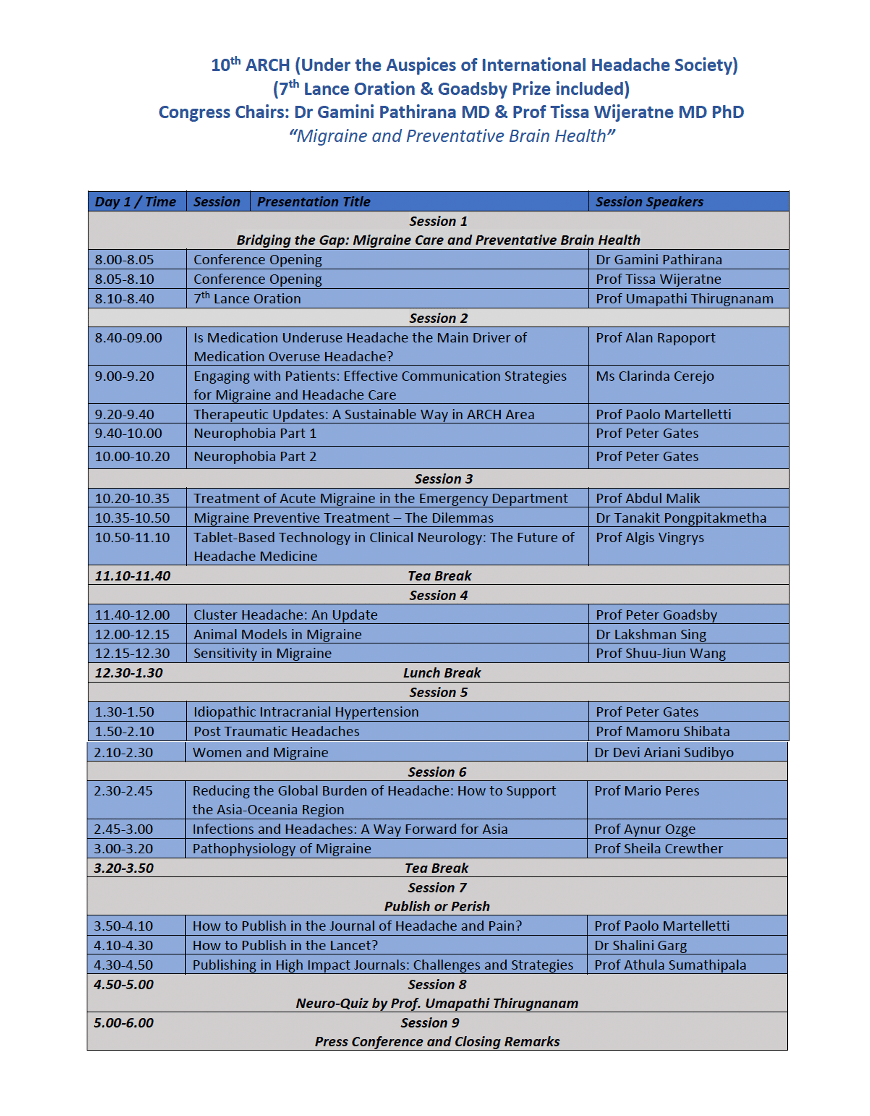
The collaboration between the Asian Regional Consortium for Headache (ARCH) and The Journal of Headache and Pain is strengthened. The proceedings of the 10th ARCH Congress, 18-19 December 2024, Colombo, Sri Lanka, will be published as a Supplement to The Journal of Headache and Pain.
Following the publication of the Thematic Series Migraine and Brain Health: Towards Better Understanding from the Asia-Oceania Region this further step of collaboration will contribute to global migraine research while emphasizing the perspectives and needs of the Asia-Oceania community.

Clinical Medicine and Headache Expert
Follow the Topic
-
The Journal of Headache and Pain
The Journal of Headache and Pain is a peer-reviewed open access journal specifically dedicated to researchers involved in all aspects of headache and related pain syndromes, including epidemiology, public health, basic science, translational medicine, clinical trials and real-world data.

Related Collections
With Collections, you can get published faster and increase your visibility.
Focus India
Headache disorders, especially migraine, constitute a major neurological health challenge and are increasingly recognized as leading contributors to disability worldwide. Their impact extends beyond episodic pain, influencing cognitive performance, emotional well-being, and overall quality of life. India carries a substantial share of the global migraine burden, yet remains affected by significant gaps in awareness, diagnosis, access to specialist care, and research output. Although global research has clarified many aspects of headache pathophysiology, the expression of these disorders varies across populations due to genetic, environmental, cultural, and healthcare access factors in the Indian context.
Migraine, in particular, demonstrates substantial heterogeneity in symptom patterns, triggers, and response to therapy, underscoring the need for population specific data. India’s vast and heterogeneous population offers a unique opportunity to generate locally relevant epidemiological, clinical, and translational insights. In many regions, underdiagnosis and inadequate treatment remain persistent problems, often compounded by stigma and limited awareness. Understanding the burden of headache disorders within specific communities in India is essential for designing effective public health strategies, improving diagnostic pathways, and tailoring management approaches. Moreover, the chronic nature of recurrent headaches places a significant economic burden on individuals and healthcare systems through lost productivity and frequent medical consultations. Through this Collection, we aim to stimulate nationally driven research, foster collaboration across institutions and care settings, and strengthen India’s contribution to global headache and brain health science.
Topics of interest include but are not limited to:
- Epidemiology of migraine in India
- Management strategies of migraine in Indian patients
- Cultural perceptions of tension-type headache
- Treatment approaches for cluster headaches
- Trigeminal autonomic cephalalgias in diverse populations
- Chronic daily headache management strategies
- Impact of lifestyle factors on headache prevalence
- Public health initiatives for headache awareness
- Innovations in headache research methodologies
We welcome submissions from author groups with their main affiliated institution in India. Cross-international authorship groups are welcome to submit their work to The Journal of Headache and Pain outside of this Collection.
This Collection supports and amplifies research related to SDG 3, Good Health and Well-Being.
All submissions in this collection undergo the journal’s standard peer review process. Similarly, all manuscripts authored by a Guest Editor(s) will be handled by the Editor-in-Chief. As an open access publication, this journal levies an article processing fee (details here). We recognize that many key stakeholders may not have access to such resources and are committed to supporting participation in this issue wherever resources are a barrier. For more information about what support may be available, please visit OA funding and support, or email OAfundingpolicy@springernature.com or the Editor-in-Chief.
Publishing Model: Open Access
Deadline: Dec 01, 2026
Chronobiology of Headaches
The recurrence and associated clinical features of headaches are significantly affected by circadian rhythms and internal biological cycles in our bodies. Changes in the operation of our hypothalamus master clock and the periodic release of hormones due to genetic predisposition are likely to influence the cyclical manifestation of headache pain. There exists a bidirectional association between the frequency of headaches and the recurrence of the seasons. In this regard, headaches resemble other functional diseases, including mood disorders, anxiety, unpleasant gastrointestinal illnesses, and sleep disorders, among others. Circadian disruption is a significant contributor to headache recurrence. Irregular sleep-wake patterns, night shift work, and jet lag can lead to a state of circadian misalignment, where the body's internal clock is out of sync with external time cues.
This thematic series aims to investigate the neurological, genetic, and hormonal foundations, along with the clinical and morpho-functional correlations, of the association between chronobiological rhythms and the rhythmic occurrence of primary and secondary headache attacks. This is also considering the cyclical manifestation of other systemic and central illnesses that are significantly associated with headaches. Nonetheless, it will be intriguing to investigate novel behavioural strategies, potentially transdisciplinary, and pharmaceutical methods aimed at addressing these chronobiological factors. The exploration of how circadian entrainment and resetting can alleviate headache burden presents an important new frontier in treatment.
This Collection supports and amplifies research related to SDG 3, Good Health and Well-Being.
All submissions in this collection undergo the journal’s standard peer review process. Similarly, all manuscripts authored by a Guest Editor(s) will be handled by the Editor-in-Chief. As an open access publication, this journal levies an article processing fee (details here). We recognize that many key stakeholders may not have access to such resources and are committed to supporting participation in this issue wherever resources are a barrier. For more information about what support may be available, please visit OA funding and support, or email OAfundingpolicy@springernature.com or the Editor-in-Chief.
Publishing Model: Open Access
Deadline: Oct 31, 2026