Suitability of using areca nut fiber as reinforcing material in compressed stabilized earth blocks (CSEB) for low-cost housing
Published in Civil Engineering
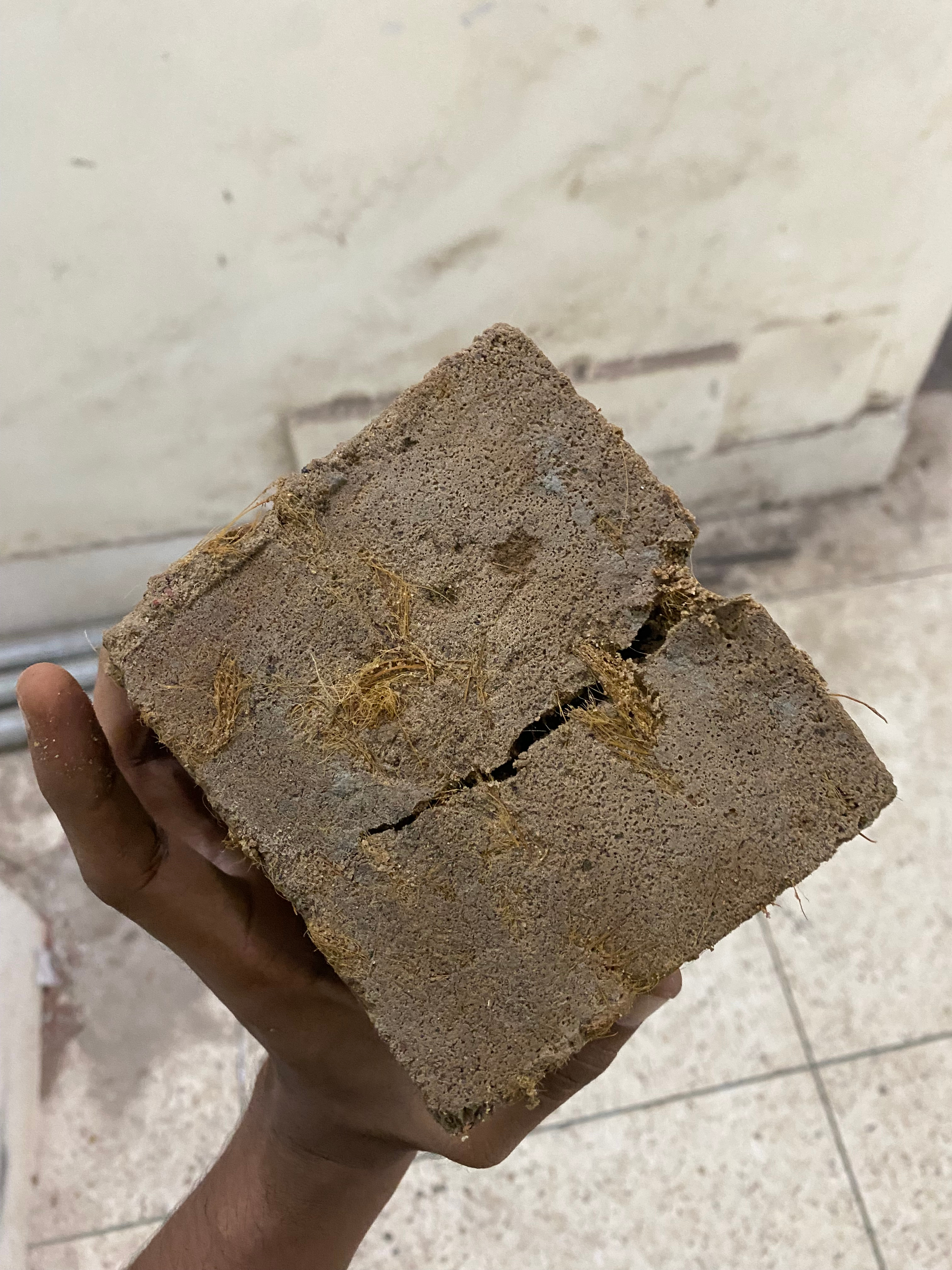
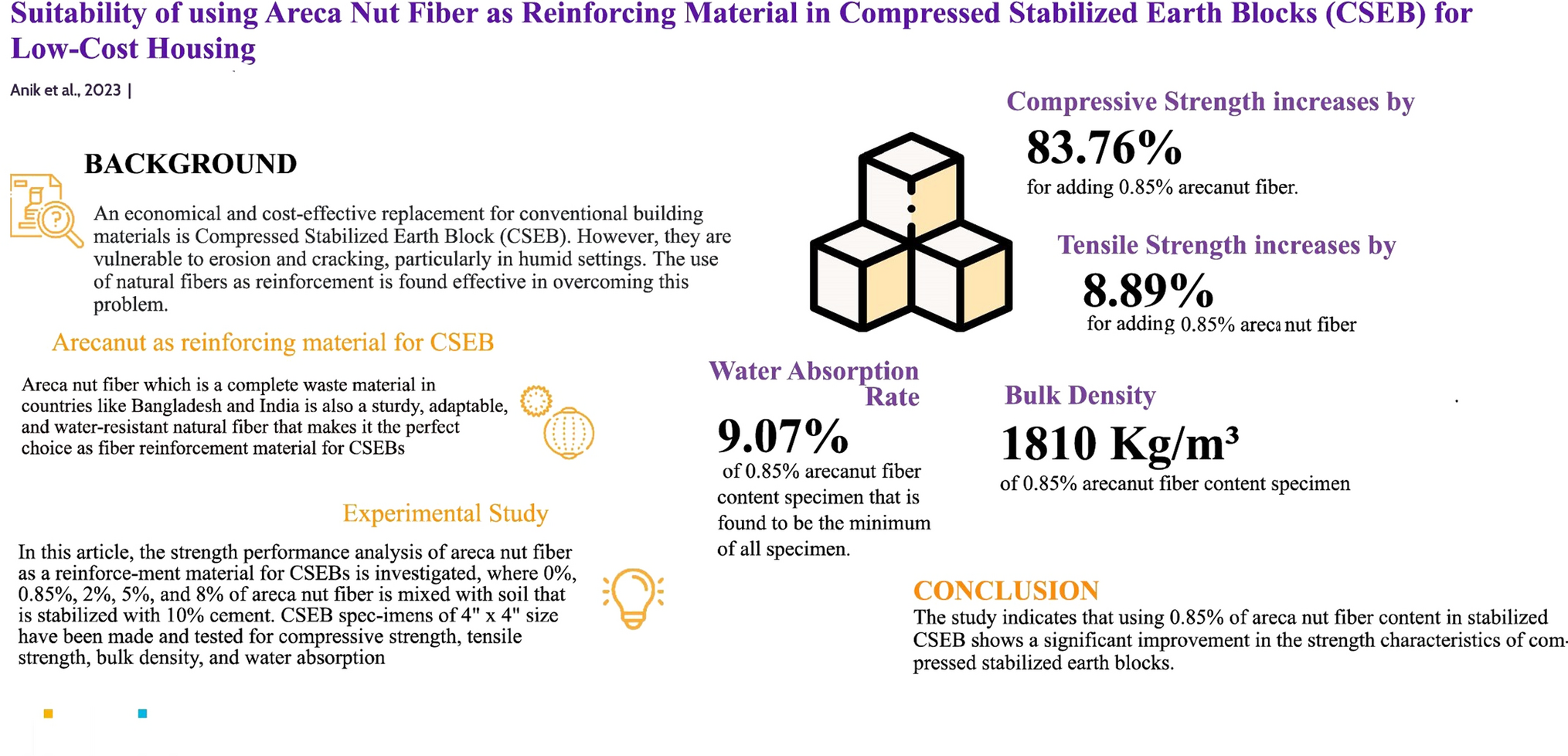

My name is Atique Ishrak Anik, and I would like to share my journey from conceiving a random idea to developing an innovative building material concept. It all began in 2022 when I was tasked with my undergraduate thesis. While my classmates were exploring existing research works, I sought an innovative solution to improve construction practices for low-income communities in Bangladesh. Initially drawn to Compressed Stabilized Earth Blocks (CSEBs), I found a lack of recent advancements in the field.
Extensive research led me to explore the integration of natural fibers such as jute, coconut coir, banana fiber, and sisal fiber to address the low tensile strength, water absorption rate, and density issues of CSEBs. One day, while wandering around the New Market area of Chattogram city, I stumbled upon a large quantity of arecanut husks strewn across the street. This serendipitous encounter sparked an idea. Upon tracing the source of the fiber to a nearby vendor selling arecanuts, commonly known as betelnuts in Bangladesh, I discovered another alarming sight – piles of arecanut husks discarded near drains.
Upon inquiry, the vendor explained that these husks were deemed useless. Motivated by the environmental implications of such waste, I rushed back to my university campus, Chittagong University of Engineering and Technology, to delve into researching arecanut husks. Surprisingly, there was minimal existing research on utilizing this fiber in any industry. Determined to make a difference, I proposed incorporating arecanut fibers into CSEBs. With the support of my supervisor, Dr. Md. Moinul Islam, and the encouragement of another esteemed professor, Dr. Md. Saiful Islam, I embarked on this endeavor.
Through our collaborative efforts, we successfully enhanced the properties of CSEBs by incorporating 0.85% of arecanut fiber by weight of soil. During the course of my research, I engaged with Mr. Babu, a local vendor of arecanuts, who agreed to supply arecanut husks instead of discarding them in drains upon understanding the environmental consequences. His willingness to participate encouraged me to consider scaling up the idea to an industrial level, thereby mitigating environmental hazards.
After completing our study in March 2023, we diligently documented our findings and submitted them for publication. Following a thorough peer review process, our study was accepted in the Discover Civil Engineer Journal (open access) by Springer Link, providing a platform to disseminate our research and make it accessible to a wider audience.
I am deeply grateful to the Almighty Allah and my parents, Md. Rozab Ali Biswas and Nilufa Easmin, for their unwavering support during challenging times. For those interested, my work can be accessed via the provided link.
Thank you.

I am a structural Engineer. My interest is in innovative housing materials for low income communities .
Follow the Topic
-
Discover Civil Engineering
This is a fully open access, peer-reviewed journal that supports multidisciplinary research and policy developments across the field of civil engineering.

Related Collections
With Collections, you can get published faster and increase your visibility.
Resilient Urban Transportation Systems: Planning, Design, Governance, and Technological Innovation
Urban transportation systems are critical components of modern cities, facilitating mobility and access while contributing to economic vitality. However, these systems face significant challenges, including climate change, population growth, and increasing urbanization, which can compromise their resilience and efficiency. As cities evolve, there is a pressing need to rethink transportation planning, design, and governance frameworks to better adapt to these challenges. Emphasizing resilience in urban transportation is essential to ensure that systems can withstand disruptions and continue to function effectively in the face of unforeseen events.
The purpose of this Collection is to provide a scholarly platform for exploring the multifaceted dimensions of resilient urban transportation systems.
Topics of interest include:
- Smart mobility and intelligent transport systems for adaptive and disruption-responsive urban movement.
- Policy and governance frameworks that promote sustainable, inclusive, and resilient mobility.
- Transportation equity and accessibility during public emergencies and urban disruptions.
- GIS and data-driven vulnerability assessment for transport infrastructure risk mitigation.
- Multi-modal transport planning integrating public transit, cycling, walking, and other sustainable modes to enhance network robustness.
- Climate-resilient transport infrastructure, including design and material innovations for roads, bridges, and transit systems under extreme weather and long-term climate change.
- Disaster preparedness and recovery frameworks for rapid restoration of mobility and logistics networks.
- Energy transition in urban transport, including electric mobility, renewable charging infrastructure, and low-carbon systems.
- Digital twins and predictive simulation for evaluating transport system performance under disruption scenarios.
- Resilient urban logistics and freight systems, including last-mile delivery during crises.
- AI and predictive analytics for incident management, including real-time monitoring and response.
- Safety and security in transport systems, addressing physical, digital, and cyber resilience.
This Collection supports and amplifies research related to: SDG 9 and SDG 11.
Keywords: Urban transport resilience; climate adaptation; intelligent transport systems; multi-modal networks; GIS and data analytics; transport equity; sustainable mobility; emergency response; digital twins; resilient logistics.
Publishing Model: Open Access
Deadline: Dec 23, 2026
Waste-Based and Sustainable Concrete Materials: Performance and Structural Applications
The construction industry is under increasing pressure to reduce its environmental impact while maintaining the safety, durability, and performance of civil infrastructure. In this context, waste-based and sustainable concrete materials have emerged as promising alternatives to conventional concrete through the incorporation of recycled aggregates, industrial by-products, agricultural wastes, supplementary cementitious materials, and other environmentally friendly constituents.
This Topical Collection aims to provide a focused platform for recent advances in the development, characterization, and application of waste-based and sustainable concrete materials. Particular emphasis is placed on material design, mechanical properties, durability performance, microstructural behavior, structural response, and practical applications in sustainable construction.
The Collection welcomes original research articles and review papers addressing experimental investigations, numerical modeling, performance assessment, durability evaluation, life-cycle considerations, and structural applications of sustainable concrete materials. Topics may include, but are not limited to, recycled aggregate concrete, waste ceramic concrete, fiber-reinforced sustainable concrete, geopolymer and alkali-activated materials, supplementary cementitious materials, low-carbon binders, durability under aggressive environments, structural strengthening, and performance-based design of sustainable concrete elements.
By bringing together contributions from researchers worldwide, this Collection seeks to advance knowledge on environmentally responsible and high-performance concrete technologies and to support the development of resilient, durable, and sustainable civil infrastructure.
This Collection supports and amplifies research related to SDG 9, and SDG 11.
Keywords: Sustainable Concrete, Fiber-Reinforced Concrete, Waste Materials, Recycled Aggregates, Cementitious Composites, Durability, Mechanical Performance, Structural Applications, Sustainable Construction, Advanced Concrete Materials
Publishing Model: Open Access
Deadline: Apr 30, 2027