Superhydrophobic Wearable Strain Sensors: From Strategic Design to Robustness Paradigm
Published in Bioengineering & Biotechnology and Materials
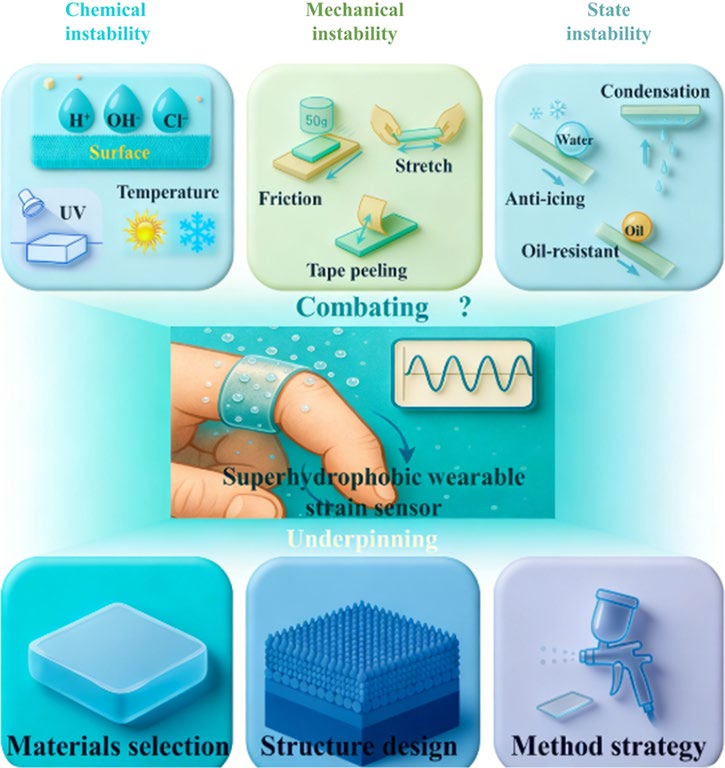
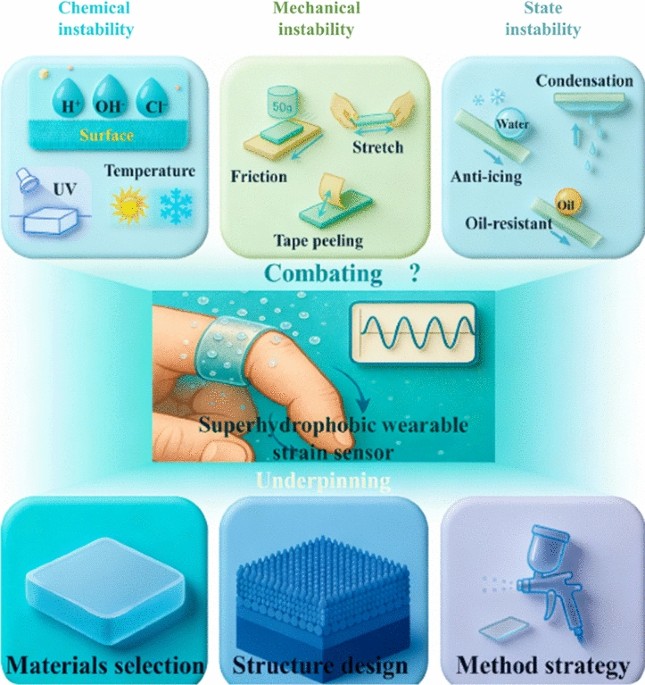

As flexible electronics move from laboratory demonstrations to practical applications in humid, corrosive, and underwater environments, conventional wearable strain sensors face a critical bottleneck: environmental robustness. Now, researchers from Northeastern University, led by Professor Yongquan Qing and his team—Haoyang Song, Yibo Liang, Guangying Zhang, Kaiqi Long, Ke Shi, Xinyu Han, and Changsheng Liu—have presented a comprehensive review that redefines how we design, evaluate, and optimize superhydrophobic wearable strain sensors for extreme conditions.
Why This Review Matters
Traditional wearable strain sensors suffer from rapid performance degradation when exposed to sweat, rain, corrosive media, or mechanical wear. While superhydrophobic surfaces offer a paradigm shift by creating a stable solid–air composite interface that repels water and contaminants, their long-term stability under harsh, end-use conditions has remained the critical barrier limiting commercial transition. Current literature lacks systematic insights into coupled multimode failures and integrated optimization frameworks, with standardized protocols for robustness evaluation still absent.
A Failure-Mechanism-Driven Paradigm
This review introduces a groundbreaking "failure-mechanism-oriented robustness optimization" framework that moves beyond single-failure-mode analysis. The team systematically deconstructs sensor failure across three coupled dimensions:
- Chemical instability: UV radiation, corrosive media (pH 1–14), and extreme temperatures (–60°C to 300°C) hydrolyze coatings and oxidize conductive networks
- Mechanical degradation: Repeated stretching, friction, and impact fracture fragile surface roughness, reducing both water repellency and strain sensitivity
- Wetting state transition: External pressure, low-surface-tension liquids, and frost-induced condensation drive irreversible Cassie-to-Wenzel transitions
The framework establishes key quantitative benchmarks—including resistance drift, contact angle retention, and cyclic stability—providing the first unified theoretical foundation and practical technological roadmap for next-generation robust amphibious flexible sensing.
Strategic Design Innovations
The review surveys cutting-edge material–structural–functional integration strategies:
- Substrate engineering: From PDMS and Ecoflex elastomers to textile substrates (polyester, nylon, spandex) with tailored micro-/nanostructures
- Conductive networks: Metallic nanomaterials (AgNWs, liquid metal), carbon allotropes (graphene, MXene, CNTs), and conductive polymers (PEDOT, PPy) optimized through nanostructuring and hybridization
- Superhydrophobic integration: Low-surface-energy chemistry (fluorinated polymers, siloxanes) combined with hierarchical micro-/nanotopography to maintain Cassie–Baxter states under dynamic deformation
Outstanding Multifunctional Performance
State-of-the-art superhydrophobic strain sensors now deliver:
- Underwater sensing: Stable signal acquisition at 20 cm depth with zero attenuation
- Self-cleaning & antifouling: Lotus-effect-inspired surfaces repelling water, oil, and biological contaminants
- Antibacterial protection: >99% bacteriostatic rate against coli and S. aureus through synergistic physical barriers and Ag⁺ release
- Extreme environment tolerance: Sensors maintaining superhydrophobicity (WCA >150°) after 10,000+ stretch cycles, sandpaper abrasion, and corrosive immersion
Applications and Future Outlook
When deployed in real-world scenarios—from underwater diver motion monitoring and fire alarm systems transmitting "SOS" Morse code, to long-term healthcare wearables resisting sweat-induced biofouling—these sensors demonstrate exceptional metrics: gauge factors exceeding 10,000, stretchability up to 800%, and stable operation across temperature extremes.
The review identifies urgent future directions: development of eco-friendly low-surface-energy modifiers to replace fluorinated compounds, unified testing protocols replicating coupled chemical–mechanical–biological stresses, and scalable manufacturing capable of faithfully replicating critical micro-/nanotextures at commercial scale.
This work establishes a new robustness paradigm for flexible electronics, opening promising avenues for next-generation wearable devices combining high safety, environmental adaptability, and reliable long-term performance in the most demanding real-world conditions.
Stay tuned for more groundbreaking research from this collaborative team at Northeastern University and the Chinese Academy of Sciences!

Editor of Nano-Micro Letters, which is an Open-Access, peer-reviewed journal reported papers that have at least one dimension ranging from a few sub-nanometers to a few hundreds of micrometers. The journal is published by Springer Nature and indexed by SCI, EI, SCOPUS, Pubmed, etc. The 2025 JCR Impact Factor is 38.5. The 2025 CiteScore is 58.9.
Follow the Topic
-
Nano-Micro Letters
Nano-Micro Letters is a peer-reviewed, international, interdisciplinary and open-access journal that focus on science, experiments, engineering, technologies and applications of nano- or microscale structure and system in physics, chemistry, biology, material science, and pharmacy.