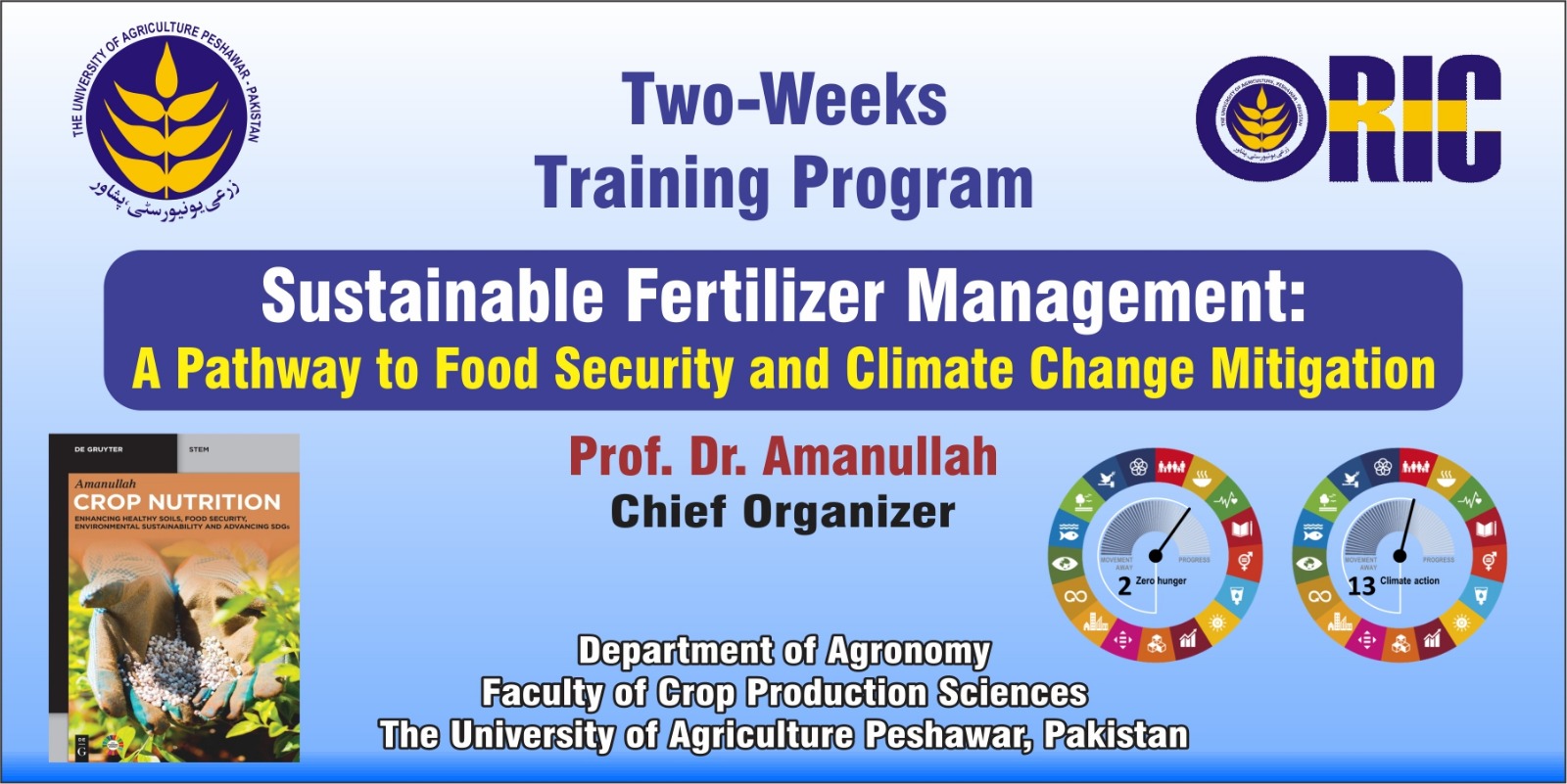
Sustainable Fertilizer Management: A Pathway to Food Security and Climate Change Mitigation
Published in Agricultural & Food Science

Importance of Fertilizer Training for the Global Research Community
1. Strengthening Scientific Understanding of Nutrient Dynamics
Effective fertilizer management begins with a solid understanding of crop nutrition principles. Training enhances comprehension of:
-
The 17 essential plant nutrients and their physiological roles
-
Nutrient interactions and synergistic/antagonistic effects
-
Liebig’s Law of the Minimum and limiting factors in crop growth
-
Soil–plant–atmosphere nutrient cycling processes
For researchers, this foundation is essential to design experiments, interpret nutrient response curves, develop fertilizer recommendations, and refine nutrient models. Advanced understanding also supports the development of biofortification strategies to combat micronutrient deficiencies in human populations.
2. Improving Fertilizer Use Efficiency (FUE)
Globally, improving nutrient use efficiency is one of the most cost-effective strategies to enhance productivity while reducing environmental harm. Training promotes:
-
Balanced fertilization instead of excessive nitrogen use
-
Integration of organic and inorganic nutrient sources
-
Site-specific nutrient management
-
Adoption of the 4R Nutrient Stewardship approach (Right source, Right rate, Right time, Right place)
For research institutions, improved FUE translates into more robust agronomic recommendations, improved farmer profitability, and reduced nutrient losses to the environment.
3. Addressing Soil Degradation and Declining Organic Matter
Soil organic carbon is central to soil fertility, structure, water retention, and nutrient availability. Many agricultural soils are experiencing degradation due to erosion, intensive cultivation, and insufficient organic inputs.
Training programs emphasize:
-
Integrated Nutrient Management (INM)
-
Use of crop residues, composts, manures, and green manures
-
Conservation agriculture principles
-
Soil health monitoring and carbon restoration strategies
For the global research community, soil health restoration is directly linked to long-term sustainability and climate mitigation goals.
4. Climate Change Mitigation and Adaptation
Agriculture contributes significantly to greenhouse gas emissions, particularly through nitrogen fertilizer mismanagement. At the same time, it is highly vulnerable to climate variability.
Fertilizer training contributes to climate-smart agriculture by:
-
Reducing nitrous oxide emissions through efficient nitrogen management
-
Enhancing carbon sequestration via improved soil management
-
Promoting precision fertilizer technologies
-
Supporting resilient cropping systems under drought and heat stress
Research-based training ensures that nutrient management strategies align with global climate commitments and national adaptation plans.
5. Promoting Precision and Digital Agriculture
Modern fertilizer management increasingly relies on digital tools and precision technologies. Training introduces participants to:
-
Soil testing and plant tissue analysis
-
Variable-rate fertilizer application
-
GIS and nutrient mapping
-
Decision-support systems
-
Remote sensing and sensor-based nutrient diagnostics
For the global scientific community, integrating digital agriculture with nutrient management enhances data-driven research and improves scalability of solutions.
6. Enhancing Food Security and Economic Stability
Balanced fertilizer use directly influences:
-
Crop yield and quality
-
Nutrient density of food (biofortification)
-
Farm profitability
-
National food self-sufficiency
In countries heavily dependent on fertilizer imports, improving use efficiency reduces foreign exchange burdens and strengthens national resilience. Training researchers and extension professionals helps translate scientific advances into farmer-friendly recommendations.
7. Supporting Sustainable Development Goals (SDGs)
Sustainable fertilizer management directly contributes to:
-
SDG 2 – Zero Hunger
-
SDG 12 – Responsible Consumption and Production
-
SDG 13 – Climate Action
-
SDG 15 – Life on Land
By strengthening technical capacity in fertilizer science, the research community plays a critical role in achieving these global development targets.
Key Components of the Training Program
The training covered:
-
Principles and laws of crop nutrition
-
Causes of low soil fertility and nutrient losses
-
Fertilizer types, grades, and application methods
-
Nutrient deficiency diagnosis
-
Economic evaluation of fertilizer use
-
Integrated Nutrient Management (INM)
-
4R Nutrient Stewardship
-
Climate-smart nutrient practices
-
Precision fertilizer technologies
Hands-on sessions ensured participants developed practical competencies, not just theoretical understanding.
Broader Implications for the Global Research Community
For the global agricultural research community, capacity building in fertilizer management is a strategic investment. Well-trained scientists and extension professionals are better equipped to:
-
Develop region-specific fertilizer recommendations
-
Design sustainable cropping systems
-
Reduce environmental footprints
-
Influence evidence-based agricultural policy
-
Train future generations of agriculturists
Such training fosters interdisciplinary collaboration between agronomy, soil science, environmental science, economics, and policy studies.
Concluding Perspective
Training on sustainable fertilizer management is not merely an academic exercise—it is a cornerstone of global food security, environmental sustainability, and climate resilience. As agricultural systems face mounting pressure from population growth, resource scarcity, and climate change, the need for scientifically grounded, economically viable, and environmentally responsible fertilizer practices becomes increasingly urgent.
Investing in fertilizer education and research capacity strengthens the bridge between laboratory research, field application, and policy formulation. It empowers scientists, students, and practitioners to make informed decisions that enhance crop productivity while protecting soil, water, and atmospheric resources.
In essence, sustainable fertilizer training equips the global research community with the knowledge, tools, and responsibility to nourish crops, sustain soils, protect ecosystems, and secure food for future generations.
Dr. Amanullah, a distinguished Professor in the Department of Agronomy at The University of Agriculture Peshawar, Pakistan, is an accomplished scientist with an impressive track record. With over 150 papers published in ISI impact factor journals and co-author/editor of more than 25 books/reports, Dr. Amanullah's expertise is highly regarded.
Notably, Dr. Amanullah has collaborated with esteemed organizations like UN-FAO, co-authoring books such as "Soil and Pulses: Symbiosis for Life" (2016), "Unlocking the Potential of Soil Organic Carbon" (2017), and "Soil Pollution: a hidden reality" (2018). Additionally, Dr. Amanullah's involvement with Intech Open includes editing books on diverse topics like "Rice - Technology and Production" (2017) and "Agronomy - Climate Change & Food Security" (2020).
Recognized for his research contributions, Dr. Amanullah has received three Research Productivity Awards from the Pakistan Council for Science and Technology (PCST). Furthermore, he represented Pakistan in the FAO Intergovernmental Technical Panel on Soil (ITPS) as part of the Global Soil Partnership from 2015 to 2018.
As an esteemed editor in a prominent scientific report journal focused on agriculture and related fields, Dr. Amanullah is passionate about the publication and encourages colleagues, students, and friends to submit their papers to this world-class journal.
Dr. Amanullah's areas of expertise encompass a wide range of topics, including agronomy, crop production, crop physiology, biodiversity, carbon estimation, greenhouse gas emissions in agriculture, crop nutrition, sustainable crop production, and environmental pollution control. His extensive knowledge and dedication to sustainable agricultural practices make him an invaluable contributor to the scientific community.