Synergistic Design of Flexible Nanopapers for High-Performance Proton Pseudocapacitors
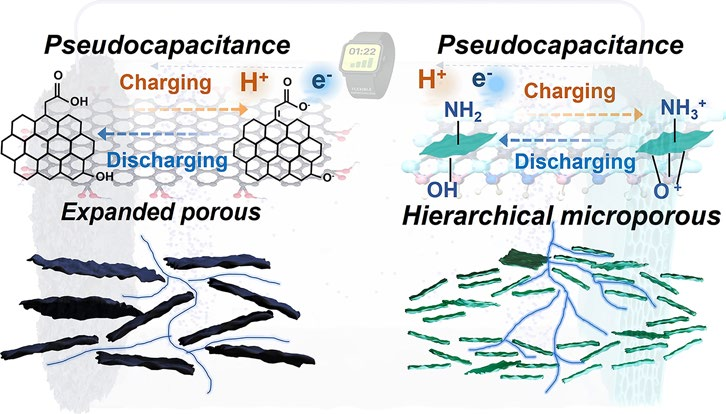
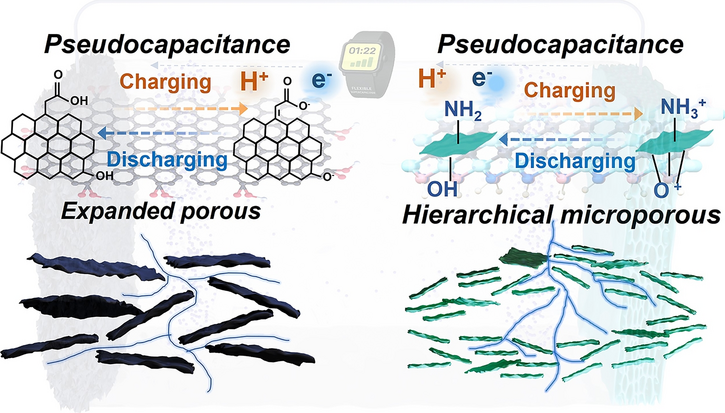

Two-dimensional materials for flexible energy storage commonly face huge challenges in limited active surface and hindered charge transport. Herein, we report an innovative asymmetric pseudocapacitor based on synergistic design of modified MXene and graphene, integrating gas-induced rapid expansion technology and precise surface chemical regulation methods. For graphene modification, rapid vaporization induces exfoliation and expansion of graphene oxide layers. Subsequently, pseudocapacitive oxygen-containing groups were selectively introduced through acid oxidation, yielding expanded-and-oxidized graphene (OEG) for positive porous-nanopaper electrode. For MXene modification, alkali-treated MXene underwent hydrazine assistance to facilitate gas expansion and –NH2 grafting, producing MXene-NH2 (NOM) for negative porous-nanopaper electrode. Density functional theory calculations show that –COOH more effectively modulate graphene’s electronic structure by inducing charge redistribution and creating active sites, thereby enhancing H+ adsorption and ion interactions compared to –OH. Meanwhile, –NH2 on MXene enable electron delocalization and dynamic Ti–N–H+ interactions, speeding up proton adsorption/desorption and boosting both pseudocapacitance and conductivity. Through collaborative optimized spatial architecture and surface properties, flexible OEGB and NOMB exhibited of 333.6 and 500.5 F g−1 at high mass loading, respectively. The assembled proton pseudocapacitor readily achieved energy and power densities of 58.9 Wh kg−1 and 3802 W kg−1, respectively, with excellent stability for potential applications.

Editor of Nano-Micro Letters, which is an Open-Access, peer-reviewed journal reported papers that have at least one dimension ranging from a few sub-nanometers to a few hundreds of micrometers. The journal is published by Springer Nature and indexed by SCI, EI, SCOPUS, Pubmed, etc. The 2024 JCR Impact Factor is 36.3. The 2024 CiteScore is 53.1.
Follow the Topic
-
Nano-Micro Letters

Nano-Micro Letters is a peer-reviewed, international, interdisciplinary and open-access journal that focus on science, experiments, engineering, technologies and applications of nano- or microscale structure and system in physics, chemistry, biology, material science, and pharmacy.



Please sign in or register for FREE
If you are a registered user on Research Communities by Springer Nature, please sign in