Synthesis Strategies and Multi-field Applications of Nanoscale High-Entropy Alloys
Published in Materials
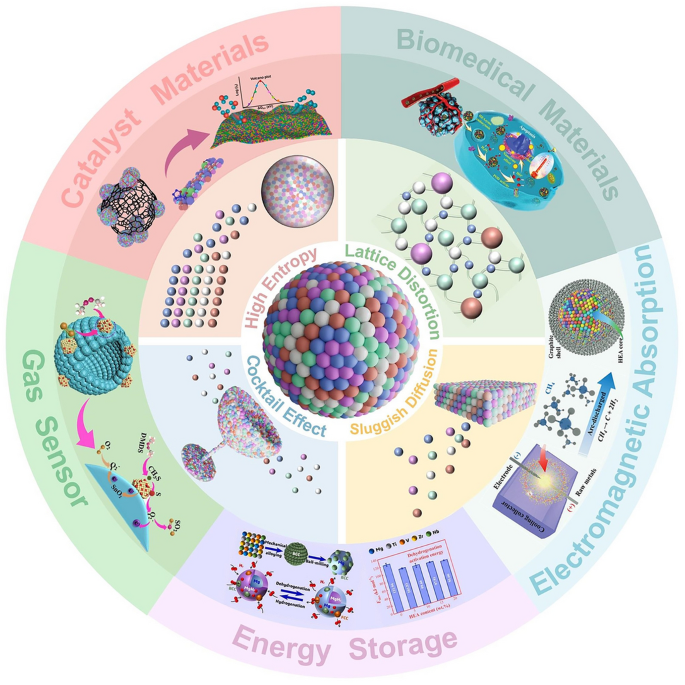

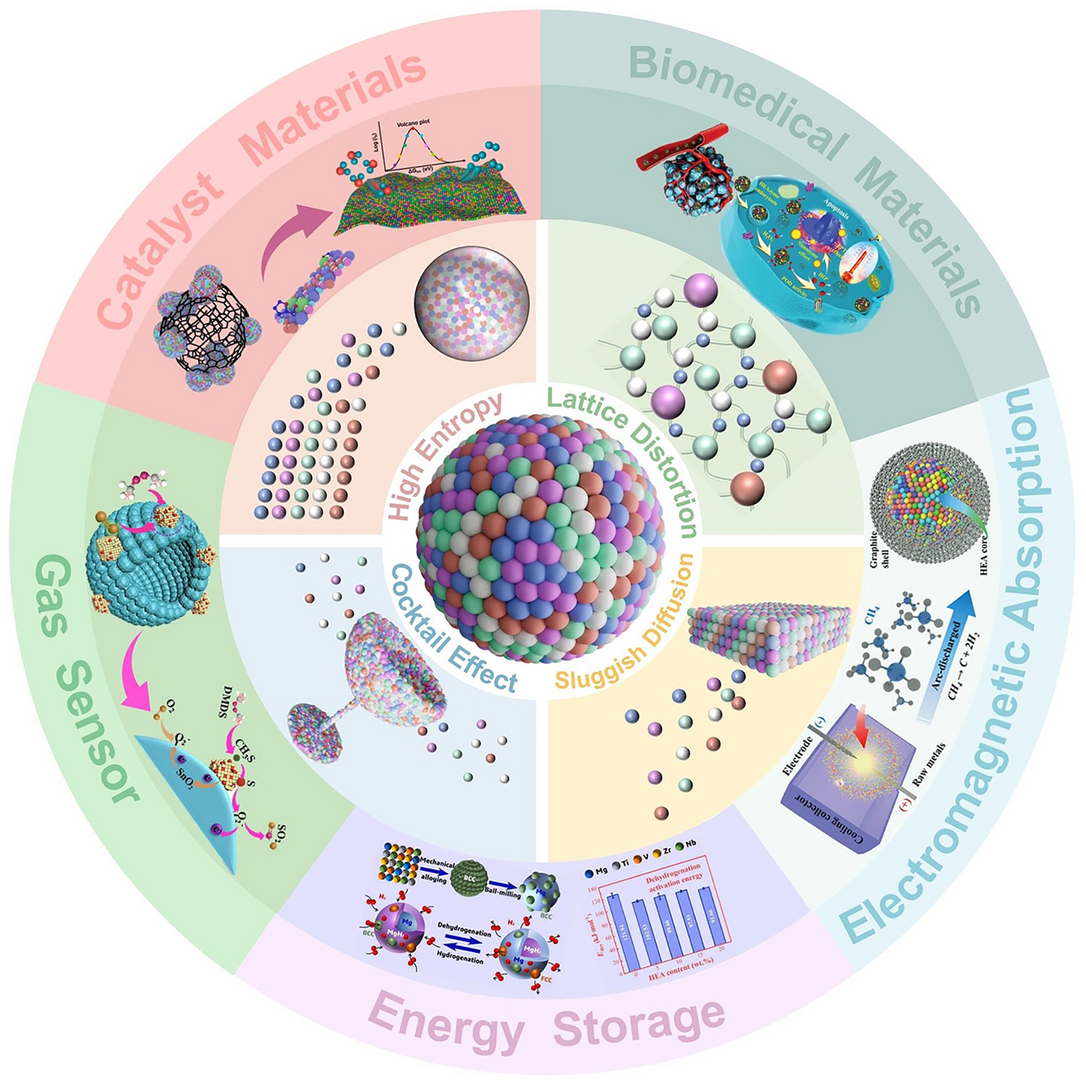

High-entropy alloys (HEAs) shattered the “one-major-element” paradigm two decades ago, but only at the nanoscale do their five-plus-element cocktails truly electrify energy, health, and environmental technologies. A comprehensive review led by Prof. Taolei Sun and Prof. Guanbin Gao at Wuhan University of Technology distills the latest synthesis breakthroughs and multi-field triumphs of nano-HEAs in “Synthesis Strategies and Multi-field Applications of Nanoscale High-Entropy Alloys” published in Nano-Micro Letters.
Why Nanosizing HEAs Changes Everything
- Entropy-Stabilized Solid Solutions: Atomic-scale mixing of ≥5 elements (5–35 % each) delivers continuous binding-energy landscapes and near-limitless active-site ensembles—impossible in conventional alloys.
-
Core Effects in Action
– High-Entropy Effect: ΔS_mix ≥ 1.5R suppresses phase separation, enabling 21-element ultramixes (FeCoNiCrYTiVCuAlNbMoTaWZnCdPbBiAgInMnSn) in a single 3 nm nanoparticle.
– Lattice Distortion & Sluggish Diffusion: Local strain accelerates catalytic kinetics yet locks atoms in place, yielding 500 h HER stability with <10 mV decay.
– Cocktail & Size Effects: Synergistic electronic interactions plus ultrahigh surface-to-volume ratios deliver record activities.
Toolbox of Next-Gen Syntheses
- Flash-Thermal Shock: 55 ms, 2000 K pulses generate 3–25 nm HEAs on carbon nanofibers—scalable, ambient-air compatible.
- Microwave Heating: 1850 K in seconds yields 12 nm PtPdFeCoNi spheres with uniform mixing and 98 % photothermal conversion.
- Wet-Chemical & Seed-Mediated: Programmable 0D/1D/2D/3D morphologies—2D nanorings boost ethanol-oxidation mass activity 25.6× over Pt/C.
- Dealloying & Laser Ablation: Nanoporous 16-element HEAs (1.5 nm ligaments) and sub-2 nm single-atom films push the size/activity frontier.
Cross-Domain Performance Highlights
-
Catalysis
– HER: PtMoPdRhNi delivers 9.7 mV @ 10 mA cm-2 in 1 M KOH.
– ORR/OER: FeCoNiRu hollow nanoframes achieve 1.47 V @ 10 mA cm-2 overall water splitting and 1.34 A mg-1_Pt ORR mass activity after 30000 cycles.
– CO2RR: PdCuAuAgBiIn aerogels yield 98 % Faradaic efficiency for formate at −1.1 V vs RHE. -
Energy Storage
– Zn–Air: PtRuNiCoFeMo cathodes reach 214 mW cm-2 peak power and 2000 cycle durability.
– Supercapacitors: Na_x(FeMnNiCuCo)[Fe(CN)6] Prussian-blue analogues retain 68 mAh g-1 after 3000 cycles at 100 % Coulombic efficiency. -
Electromagnetic Shielding
– FeCoNiCuMn@honeycomb carbon fibers: −65.8 dB reflection loss over 7.68 GHz at only 2 wt % loading—best-in-class bandwidth. -
Gas Sensing & Biomedicine
– CH4 sensor: 25 ppm detection limit at 50 nW power.
– Nanozyme therapy: PtPdRuRhIr clusters kill 75 % of 4T1 tumor cells at 100 µg mL⁻¹ while sparing 90 % of normal IEC-6 cells.
Future Outlook
- AI-Accelerated Discovery: Graph-attention networks predict surface adsorption energies (MAE 0.09 eV) and circumvent scaling relations for bespoke HEA design.
- Green & Scalable Routes: Microwave and flash-thermal methods promise roll-to-roll production of kilogram-scale nano-HEAs.
- Multidimensional Architectures: 3-D printed lattices and aerogel scaffolds are poised to translate lab records into industrial reactors, batteries, and biomedical devices.
With entropy as the architect and nanoscale precision as the toolkit, high-entropy alloys are redefining what’s possible in catalysis, energy, and beyond.

Editor of Nano-Micro Letters, which is an Open-Access, peer-reviewed journal reported papers that have at least one dimension ranging from a few sub-nanometers to a few hundreds of micrometers. The journal is published by Springer Nature and indexed by SCI, EI, SCOPUS, Pubmed, etc. The 2025 JCR Impact Factor is 38.5. The 2025 CiteScore is 58.9.
Follow the Topic
-
Nano-Micro Letters
Nano-Micro Letters is a peer-reviewed, international, interdisciplinary and open-access journal that focus on science, experiments, engineering, technologies and applications of nano- or microscale structure and system in physics, chemistry, biology, material science, and pharmacy.