Textile‑Scale Liquid–Metal Fibers with Strain‑Invariant Conductivity Enable Absorption‑Enhanced EMI Shielding
Published in Materials
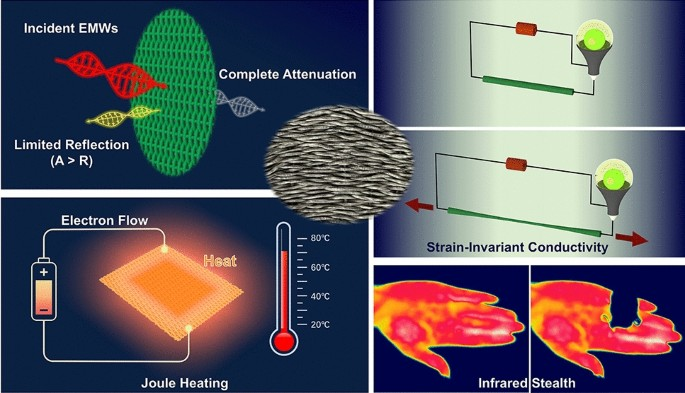
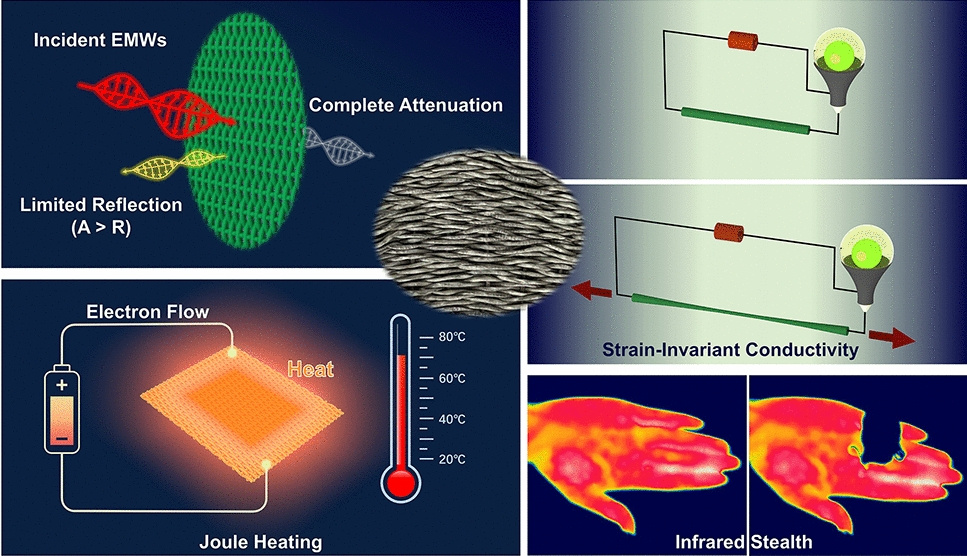

As the demand for stretchable, multifunctional wearable electronics continues to grow, conventional conductive elastomeric composites face critical limitations in strain-induced performance degradation and limited multifunctionality. Now, researchers from Northwest University, led by Professor Liping Wei, Professor Yuan Yan, and Professor Daidi Fan, have presented a breakthrough core–sheath magnetic liquid metal fiber that bridges the gap between extreme stretchability and stable electronic performance.
Why This Fiber Matters
Traditional liquid metal composites typically suffer from conductivity instability under mechanical deformation and high reflectivity in EMI shielding, which causes secondary electromagnetic pollution. The novel Fe-EGaIn/TPU core–sheath fiber overcomes these limitations by enabling strain-invariant conductivity with only −6% resistance change at 100% strain, while shifting the shielding mechanism from reflection-dominated to absorption-dominated—achieving true multifunctional integration in a single textile platform.
Innovative Design and Mechanism
The material is fabricated through coaxial wet spinning of magnetic liquid metal (Fe-embedded eutectic gallium–indium alloy) within a thermoplastic polyurethane matrix, followed by freeze-pressure activation. COMSOL simulations reveal that its exceptional performance originates from a unique dynamic re-percolation mechanism: under strain, EGaIn droplets deform and reorganize into 3D calabash-bunch networks, while Poisson-induced transverse compression maintains stable electron pathways. The magnetic Fe particles enable responsive actuation and enhance magnetic loss for absorption-dominated EMI shielding.
Outstanding Performance
MLM-7/TPU delivers exceptional conductivity of 2.1×10⁴ S m-1, extreme stretchability of 482% elongation, and remarkable strain-invariant resistance (ΔR/R₀ = 6% at 100% strain, 16% at 200% strain). The textile achieves absorption-dominated EMI shielding of 33.82 dB with 0.520 absorptivity at only 7 wt% Fe loading—surpassing commercial silver-plated fabrics. Additionally, it enables precise Joule heating (75.8°C at 1.2 V), infrared stealth through low-emissivity surface design, and magnetically driven remote switching with 1.5–2.0 s response time.
Applications and Future Outlook
This scalable textile-scale approach integrates high conductivity, extreme stretchability, magnetic responsiveness, thermal regulation, and absorption-enhanced EMI protection on a single platform—opening promising avenues for next-generation adaptive wearables, soft robotics, and intelligent fabrics requiring multifunctional reliability under mechanical stress.
Stay tuned for more groundbreaking research from this collaborative team at Northwest University, Xi'an Jiaotong University, and Fudan University!

Editor of Nano-Micro Letters, which is an Open-Access, peer-reviewed journal reported papers that have at least one dimension ranging from a few sub-nanometers to a few hundreds of micrometers. The journal is published by Springer Nature and indexed by SCI, EI, SCOPUS, Pubmed, etc. The 2024 JCR Impact Factor is 36.3. The 2024 CiteScore is 53.1.
Follow the Topic
-
Nano-Micro Letters
Nano-Micro Letters is a peer-reviewed, international, interdisciplinary and open-access journal that focus on science, experiments, engineering, technologies and applications of nano- or microscale structure and system in physics, chemistry, biology, material science, and pharmacy.

Please sign in or register for FREE
If you are a registered user on Research Communities by Springer Nature, please sign in