The 2025 Chemistry Nobel Prize Celebrated Porous Materials—But What Are We Still Getting Wrong About Scaling MOFs?
Published in Earth & Environment and Materials
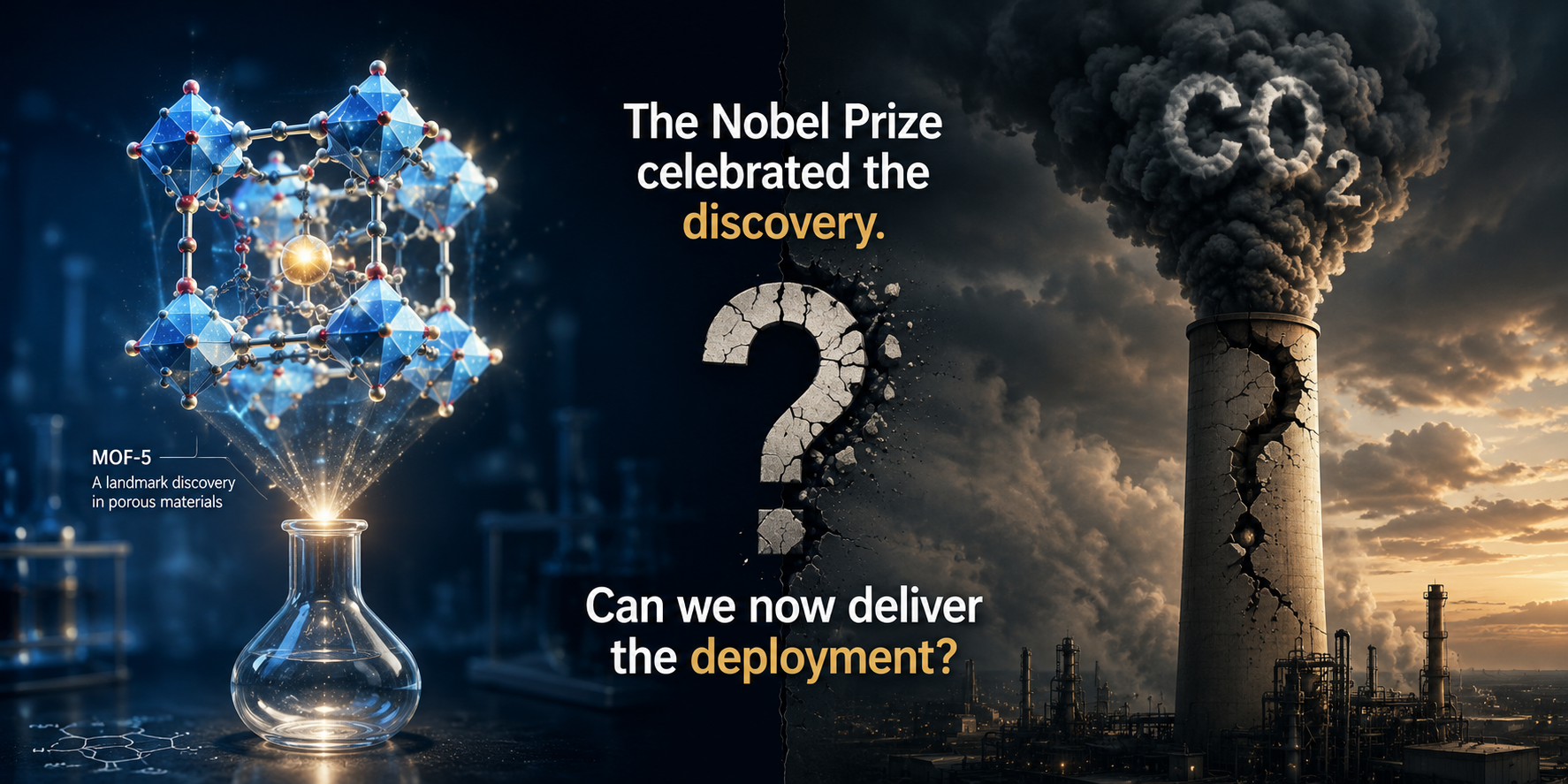

The Recognition the Field Earned—and the Reality It Exposed
In October 2025, the Nobel Committee awarded Susumu Kitagawa, Richard Robson, and Omar M. Yaghi chemistry’s highest honor, recognizing a field that has fundamentally redefined molecular architecture. By linking metal nodes with organic ligands into programmable crystalline frameworks, reticular chemistry transformed porous materials from passive adsorbents into programmable molecular systems.
The Nobel citation highlighted planetary-scale applications: carbon capture, atmospheric water harvesting, and resource recovery. And yet, beneath the celebration lies an uncomfortable reality.
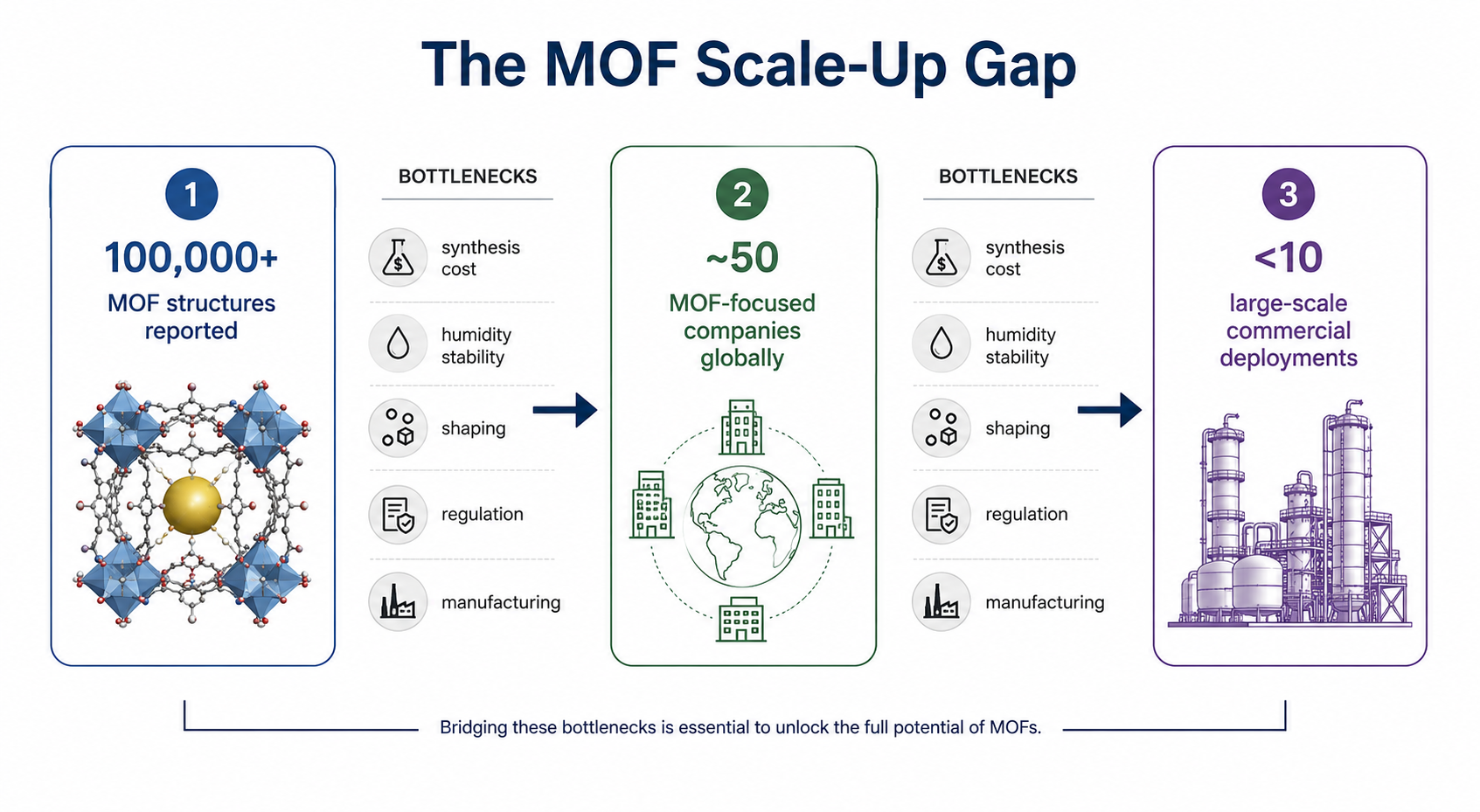
After more than three decades of explosive research and well over 100,000 reported MOF structures, only a remarkably small number of technologies have achieved meaningful commercial deployment. The Nobel Prize validated the molecular discovery. Now the field must confront the harder challenge: delivering scalable, economically viable, and regulation-ready deployment.
The Scale-Up Chasm: The "Powder Fantasy"
One of the biggest misconceptions outside the field is that MOF commercialization is merely a manufacturing-cost issue. It is not. The real challenge is systems integration.
A perfect adsorption isotherm measured on 20 milligrams of pristine powder is not an industrial process. Real deployment requires monoliths, membranes, pellets, and continuous-flow integration. When we transition from grams to tonnes, we introduce entirely different engineering constraints:
-
Shaping and Pelletization: Binders often collapse delicate pores, sacrificing surface area for mechanical robustness.
-
Hydrodynamic Flow: Fine powders cause catastrophic pressure drops in industrial reactors.
-
Fouling: A benchmark MOF that performs beautifully in a pristine lab may suffer irreversible fouling under realistic wastewater or flue-gas operating conditions.
This is the field’s "powder fantasy." We are succeeding in idealized vials but failing in structured reactors.
The Policy Vacuum and the Reproducibility Crisis
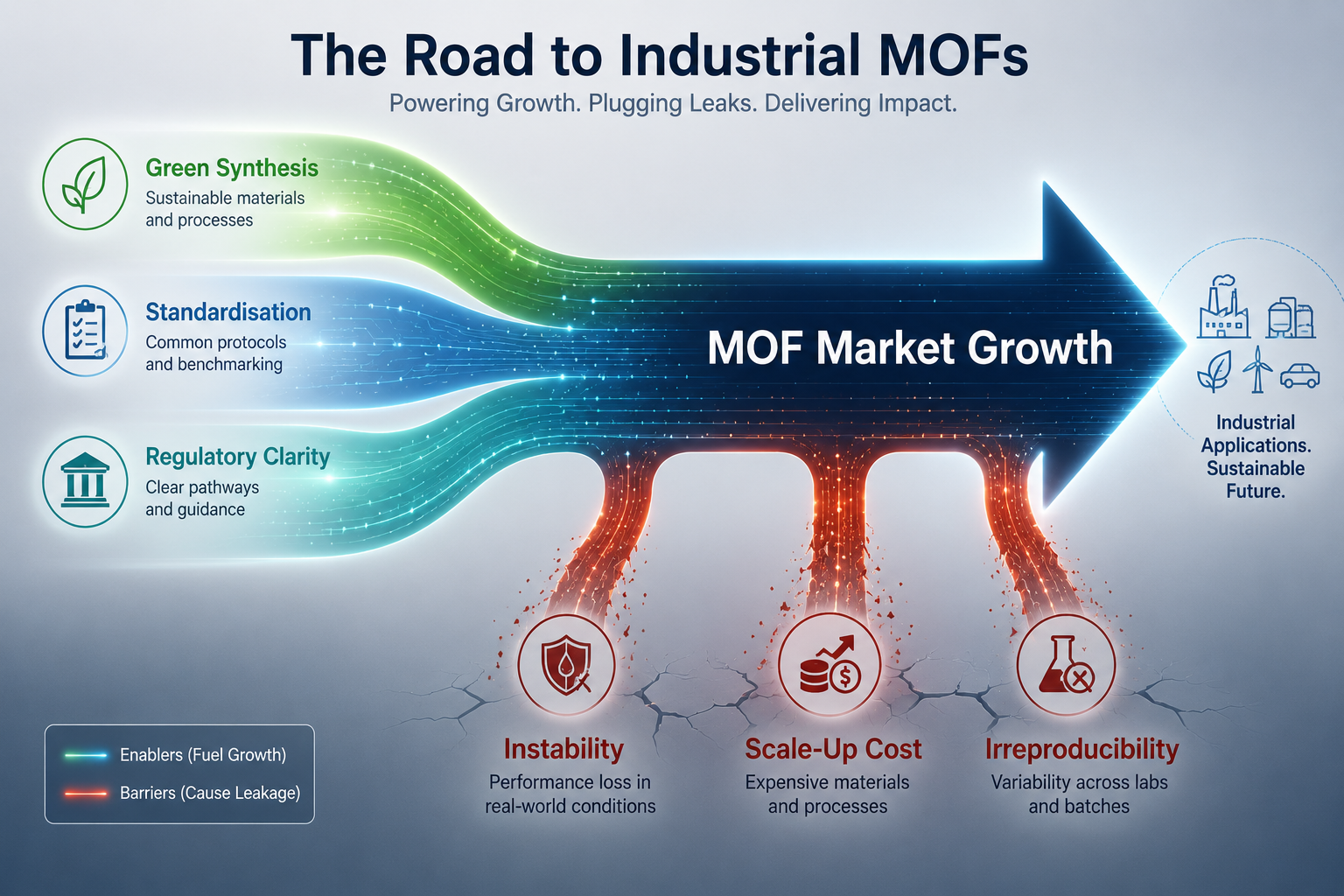
Beyond the reactor, MOFs occupy an unusually difficult regulatory position. They exist somewhere between porous solids, advanced chemicals, and nanomaterials. Current regulatory frameworks, such as REACH in Europe and TSCA in the United States, were never designed for programmable porous crystals whose environmental behavior depends heavily on linker identity, defect density, and degradation chemistry. When regulation remains ambiguous, capital investment slows.
Furthermore, the next great frontier in MOF science may not be discovering new structures; it may be standardization. Many published MOF syntheses remain notoriously difficult to reproduce. Tiny deviations in humidity, precursor quality, or thermal ramp rates produce dramatically different materials.
Initiatives like the EU4MOFs COST Action and their interlaboratory Round Robin studies are essential. Standardizing synthesis and characterization for benchmark MOFs (like ZIF-8) is not administrative housekeeping—it is the foundation of industrial trust.
Start-Ups, Translation, and the Missing Middle
The MOF ecosystem is entering a critical industrial phase. A major problem is the “missing middle”: the lack of medium-scale manufacturing infrastructure capable of bridging academic synthesis and commodity-scale deployment.
Start-ups like Promethean Particles and novoMOF are attempting to fill this gap through scalable production platforms, while massive industrial partnerships (involving players like Baker Hughes) are increasingly focused on translating MOFs into deployable decarbonization technologies. But the path remains fragile.
The Next Breakthrough Will Not Be Molecular
The Nobel Prize confirmed that MOFs represent one of the great conceptual triumphs of modern chemistry. But the next phase of the field will not be won through surface area records alone. It will be won through systems engineering, technoeconomic transparency, and regulatory maturity.
The future leaders of the MOF era will not necessarily be the ones who synthesize the most exotic structures; they will be the scientists and engineers who finally make these extraordinary materials robust enough to survive the real world.
To my peers in materials science: Which bottleneck do you believe is most urgent to solve first: synthesis cost, long-term stability, standardization, or regulatory clarity?
#MOFs #PorousMaterials #NobelPrize2025 #MaterialsScience #CarbonCapture #WaterHarvesting #AdvancedMaterials #ChemicalEngineering #ScaleUp #CircularEconomy

Dr. Akeem Adeyemi Oladipo is a globally recognized Research Professor of Materials and Environmental Chemistry at Eastern Mediterranean University. Ranked among the world's Top 2% Scientists, his expertise bridges nanotechnology, renewable energy, and electro-analytical chemistry. He specializes in advanced materials synthesis for wastewater treatment, highly sensitive electrochemical biosensors, and solar energy conversion. By integrating machine learning and artificial neural networks, his research drives scalable deep-tech innovations in environmental sustainability and energy storage.


Please sign in or register for FREE
If you are a registered user on Research Communities by Springer Nature, please sign in