The association of rs1111875 in HHEX with type 2 diabetes: A comprehensive meta-analysis

T2DM is the prevailing form of diabetes, representing over 90% of all instances. It mainly arises from insulin resistance and irregular insulin production. As T2DM continues to rise, particularly in India, gaining insight into the genetic factors influencing the disease is essential.
The association of rs1111875 in HHEX with type 2 diabetes: A comprehensive meta-analysis
Like

Share this post

Choose a social network to share with, or copy the URL to share elsewhere

This is a representation of how your post may appear on social media. The actual post will vary between social networks

Explore the Research

SpringerLink
SpringerLink SpringerLink

The association of rs1111875 in HHEX with type 2 diabetes: A comprehensive meta-analysis - International Journal of Diabetes in Developing Countries

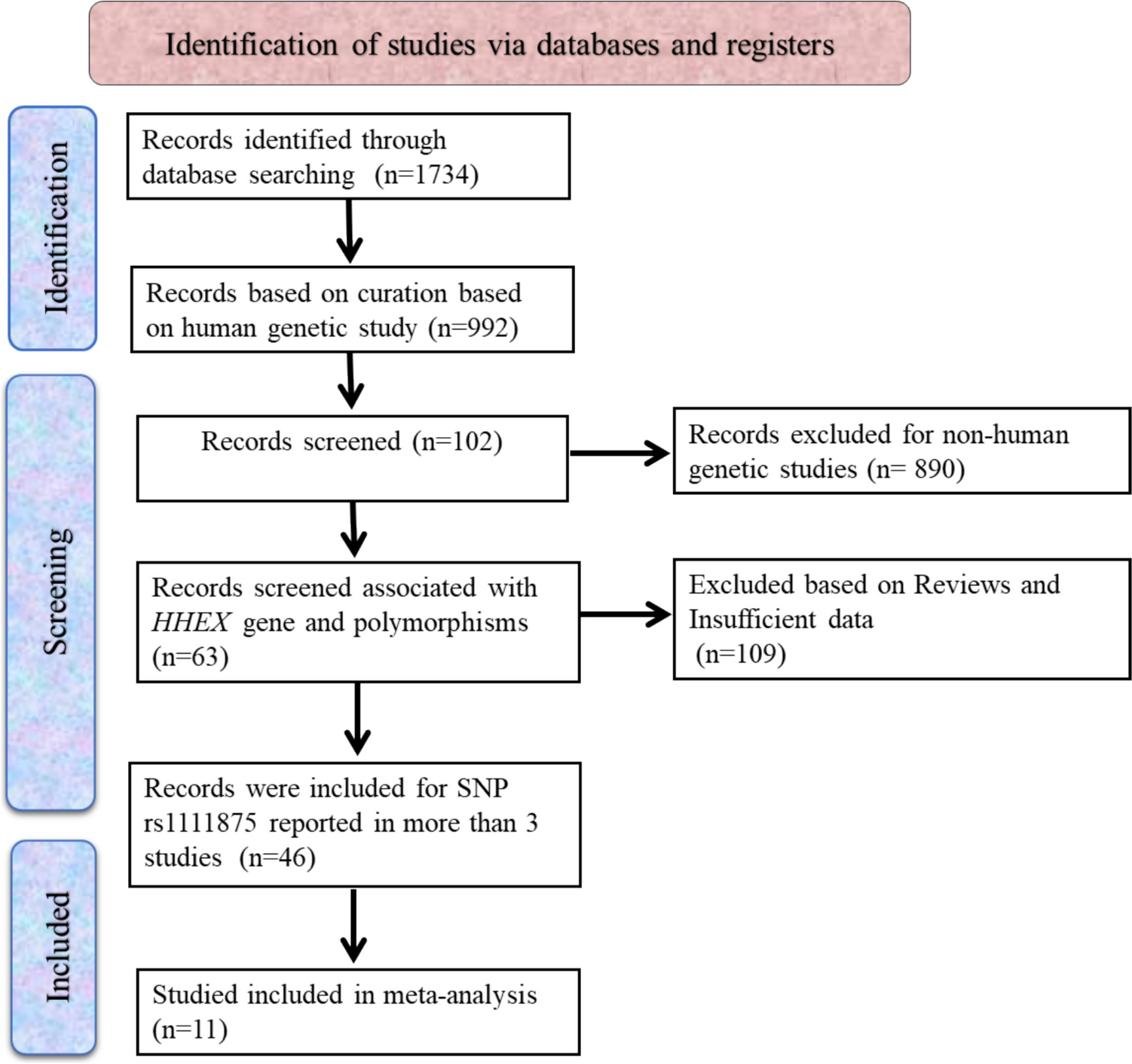
Background T2DM is the prevailing form of diabetes, representing over 90% of all instances. It mainly arises from insulin resistance and irregular insulin production. As T2DM continues to rise, particularly in India, gaining insight into the genetic factors influencing the disease is essential. Objective To find out the association between the risk of T2DM and genetic variations in the HHEX gene, particularly the rs1111875 variant. Methods We conducted a meta-analysis to identify relevant studies through NCBI, Science Direct, and Google Scholar. Studies that examined the relationship between the listed SNPs and T2DM were case–control studies and offered enough information to calculate OR were included. Results The meta-analysis encompassed 11 studies involving 5030 controls and 5196 cases of T2DM, concentrating on the rs1111875 polymorphism of the HHEX gene. No significant associations were found between the HHEX polymorphisms across various genetic models. The p-values obtained were < 0.01 for the allele model (C vs T; OR: 0.74, 95% CI: 0.51–1.09, I2 = 97%), < 0.01 for the dominant model (CC + CT vs. TT; OR: 0.76, 95% CI: 0.43–1.32, I2 = 94%), and < 0.01 for the recessive model (TT vs. CT + CC; OR: 0.73, 95% CI: 0.47–1.11, I2 = 96%). In the over-dominant model (CT vs. CC + TT), an odds ratio of 1.09 (95% CI: 0.86–1.37, I2 = 83%) was reported, with a p-value < 0.01. Conclusion The rs1111875 polymorphism in the HHEX gene was not significantly linked to T2DM risk, thereby reducing the risk of disease that is likely to occur. This indicates that further evaluation is crucial to delve into the potential of HHEX as a biomarker for assessing risk and guiding targeted interventions to understand its underlying mechanisms better.

T2DM poses a major global health challenge, with its prevalence rising quickly, especially in countries such as India. Genetic factors, including those associated with the HHEX gene, are crucial in T2DM susceptibility. The rs1111875 polymorphism within HHEX has emerged as a key genetic variant linked to T2DM, mainly through GWAS across diverse populations. Although previous research on the genetic association between HHEX and T2DM has yielded mixed results, our meta-analysis specifies a more precise interpretation of this relationship. By emphasizing the significance of genetic markers like HHEX, this study underscores the potential for personalized medicine in predicting T2DM risk and tailoring treatment approaches based on individual genetic profiles. This more profound understanding of genetic contributions to T2DM could lead to more effective strategies for managing and preventing this chronic condition.