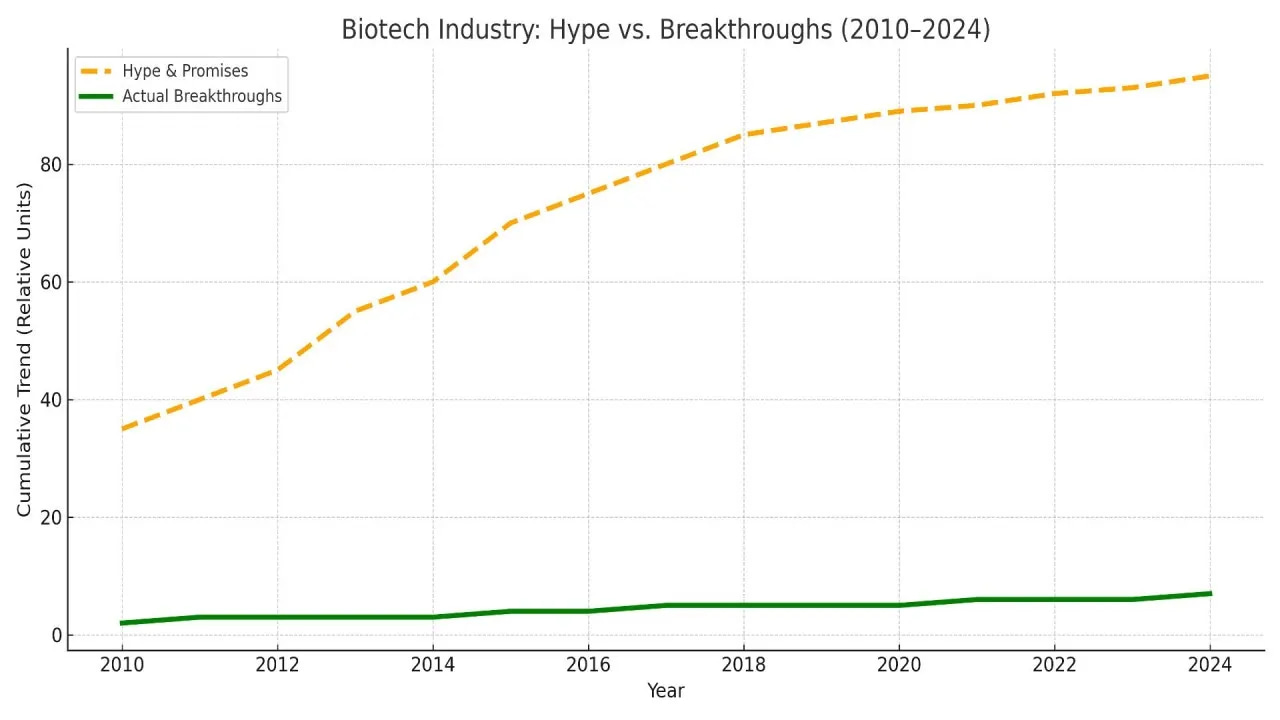
The biotechnology industry, once brimming with the promise of saving lives and rewriting the future of medicine, now stands precariously atop a hollowed-out foundation. Beneath the polished veneers of scientific ambition and investment optimism lies a cycle so tragically predictable, it has become almost farcical, a self-perpetuating loop of overpromising, overfunding, and underdelivering.
In the past ten to fifteen years, hundreds of biotech companies have emerged from stealth mode, armed with charismatic founders, complex science, and sweeping declarations about curing the incurable. And yet, one by one, most have vanished - some quietly, others in high-profile implosions. A number of the survivors linger in prolonged decline, their original missions obscured by desperate pivots and diluted visions. A rare few still boast a cash runway, but the underlying reality is often the same: they have not delivered on their central promise.
This is no longer anecdotal. It is systemic.
A Slow-Motion Collapse in Five Acts
Biotech’s fall from grace does not come as a sudden crash. It unfolds slowly, masked by the glitter of press releases, investor decks, and handshakes at conferences. The choreography has become painfully familiar:
Act I: The Idea
A founder, or a group of founders, concocts a complicated idea. Often the science is deeply obscure, wrapped in technical language that few truly understand. The more impenetrable the concept, the more “visionary” it appears.
Act II: The Capital
The idea finds early believers - venture capital firms or private equity groups - who are quick to deploy capital, seduced not by the soundness of the science, but by the allure of its novelty. Multiple fundraising rounds follow, each one inflating the valuation and further detaching it from clinical reality.
Act III: The Burn
The company enters a protracted phase of research and development. Millions are funneled into discovery projects, platform builds, and theoretical work. Years pass. The cash burn is staggering. Yet meaningful milestones - reproducible results, translatable therapies, clinically validated breakthroughs - remain elusive.
Act IV: The Decline
Eventually, the market catches on. Investor confidence wanes. The company, still with nothing concrete to offer, begins to restructure, lay off employees, and quietly exit the spotlight. The science that once captured imaginations proves incapable of moving the needle. And then, with a final press release or none at all, the company disappears.
Act V: The Resurrection of the Founder
Most ironic of all: the founder, having overseen the company’s decline, rarely fades into obscurity. Instead, they are rebranded as “pioneers” and reabsorbed into the ecosystem - joining another company, another advisory board, another VC portfolio - to repeat the cycle, often celebrated for their “experience” rather than their outcomes.
The Investors Who Feed the Machine
In this ecosystem, failure isn’t punished. It’s recycled.
Venture capital and private equity groups continue to play a central role in sustaining this illusion. Though they profess to care about science, their true allegiance lies with ROI. And the reality is: this model works for them, at least in the short term.
They seek the story, not the science. They back companies that are media-friendly, jargon-heavy, and anchored in buzzwords. The more convoluted the hypothesis, the easier it is to sell the dream. “Platform plays”, “precision medicine engines”, “AI-driven drug discovery” - all receive a disproportionate share of attention and money, regardless of their actual ability to deliver results.
In the early years, these companies become unicorns not because of what they achieve, but because of what they might achieve. Valuations soar, early investors exit with gains, and new investors are ushered in with the promise of even greater upside.
By the time scientific validation fails to materialize, the capital well runs dry. There is no equity left to trade, no narrative left to pitch. But the financiers have already moved on, raising new funds and launching new ventures, none held accountable for the trail of scientific dead ends left behind.
The Moral Vacuum
This cycle is more than inefficient, it’s ethically hollow.
The biotechnology sector, at its best, exists to serve patients. To relieve suffering. To extend and improve lives. But today, much of the industry has mutated into a spectacle of hollow innovation. Companies are not rewarded for solving problems, but for storytelling. Success is measured in capital raised, not lives touched.
Meanwhile, patients, the people this industry claims to serve, continue to wait. Some wait for better diagnostics. Others for effective treatments. Many die waiting.
This is the tragedy that no one dares to say aloud: that in the pursuit of innovation, biotech has lost its soul.
The Way Out: A Manifesto for Reform
The industry does not need more capital. It needs clarity, conscience, and course correction. And the path forward, though difficult, is not abstract. It is concrete.
Let us insist on the following:
1. Back only what can be translated. Fund science that has real-world implications. Ideas should not just be novel, they must be actionable, scalable, and clinically relevant. If the work cannot be tested, validated, and deployed, it does not belong in a billion-dollar venture.
2. Demand reproducibility. No more hand-waving over flawed preclinical data or anecdotal signals. Require robust, repeatable evidence before celebrating “breakthroughs.” Make reproducibility a prerequisite for funding.
3. Stop glorifying capital raises. Valuation is not validation. It’s a speculative number until lives are improved. Media, analysts, and investors alike must stop confusing financial momentum with scientific progress.
4. Prioritize patient outcomes. Let us return the spotlight to those who need the innovation most. The measure of success should be lives extended, diseases halted, suffering reduced, not slide decks, not exit multiples.
5. Hold people accountable. Founders, executives, and VCs must be judged by the impact of their ventures, not just their ability to raise or recycle capital. Past failures must inform future investments, not be whitewashed by prestige.
The Truth, Finally Spoken
It is time to break the silence. To speak plainly about what is broken, and to stop pretending that a system built on unfulfilled promises is somehow acceptable because “this is how biotech works.”
This is not how it must work. This is how it has been allowed to work.
There are extraordinary scientists in this field. There are visionary founders with real discoveries. There are investors who care about more than spreadsheets. But until the industry reorients itself - until truth, translation, and accountability become non-negotiable - the biotech world will remain a mirage.
It’s time to dismantle the illusion, and build something worthy of the word innovation.
I am a physician-scientist, biotech founder, and former pharmaceutical executive working at the intersection of disease biology, computational science, drug development, and translational medicine.
My career has spanned clinical medicine, pharmaceutical R&D and medical leadership, biomarker and therapeutic discovery, and biotechnology entrepreneurship. A recurring question across these experiences has shaped much of my current work: how can we understand disease biology deeply enough to make better decisions about what to measure, what to target, and how to intervene?
I co-founded Bioada, where our research applies computational and multi-omics approaches to biomarker and therapeutic discovery across oncology, neurodegenerative disease, and other complex disorders. This work has increasingly led me beyond individual biomarkers and targets toward understanding the biological states, transitions, interactions, and mechanisms that organize disease.
My recent work is focused on Biological Intelligence: developing approaches for representing and reasoning about complex biology in ways that can inform scientific discovery, therapeutic development, asset strategy, and venture creation.
My current interests include disease architecture, biological reasoning systems, multi-omics and single-cell analysis, biomarker discovery, therapeutic target identification, drug resistance and response, and the use of AI to move from biological prediction toward biological understanding.
I am particularly interested in connecting with researchers and innovators exploring new ways to understand complex disease biology and translate that understanding into better diagnostics, therapeutics, and scientific decisions.