The compliment that changes nothing: Understanding negative self-beliefs in depression
Published in Neuroscience and Behavioural Sciences & Psychology



Imagine a colleague tells you that you gave an excellent presentation. You smile, thank them, and then quietly think, They were just being nice. Most people have had thoughts like this from time to time. For people with depression, this can be much more than an occasional experience.
Psychologists have long known that negative self-beliefs are a hallmark of depression. Yet we still know surprisingly little about how these beliefs are formed and maintained. Do people with depression process positive and negative feedback differently? And how do these experiences become part of the way they see themselves?
This led us to ask: How do experiences become beliefs, and how is this process altered in depression?
From self-beliefs to learning
Previous studies from our lab have investigated how healthy participants form beliefs about themselves. Rather than asking participants directly how they see themselves, we use experimental tasks that allow us to watch new beliefs develop throughout the task.
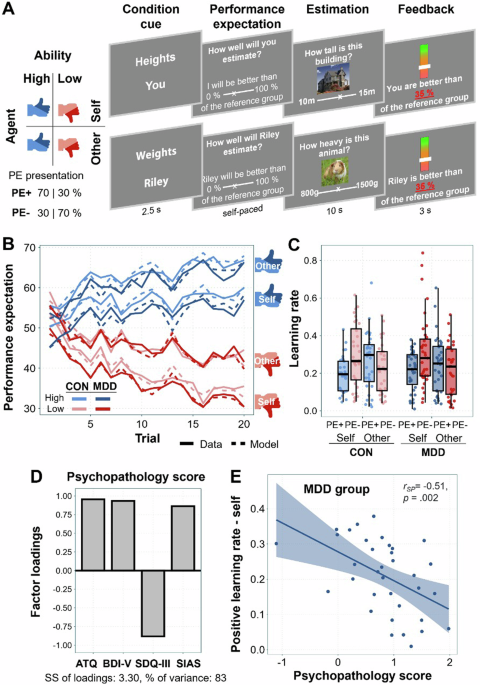
In this study, we invited people with depression and healthy volunteers to complete our "Learning Of Own Performance" (LOOP) task while undergoing functional MRI. Participants repeatedly estimated quantities such as the weight of animals or the height of buildings and received performance feedback after every trial. Over many repetitions, we tracked how they updated their beliefs about their own abilities and simultaneously observe how their brains responded to each piece of feedback. Computational models allowed us to quantify this learning process trial by trial, making it possible to connect changes in beliefs with activity in specific brain regions.
A result that surprised us
One finding challenged our initial expectations. Overall, participants with depression did not learn differently from healthy participants. Although this finding initially appeared surprising, given the many research studies reporting impaired learning in depression, it ultimately highlighted the importance of looking at mechanisms beyond simple between-group differences. In doing so, we found substantial differences within the group of people with depression. Those with a higher symptom burden were less likely to update their self-beliefs after unexpectedly positive feedback. At the same time, individuals with depression showed stronger responses to negative feedback in the insula, a region involved in emotional processing and the detection of personally relevant information.
This highlights something that is becoming increasingly important in psychological research: people with the same diagnosis can differ considerably, and these individual differences may reveal more about the underlying mechanisms than comparisons between diagnostic groups alone.
Why does this matter?
Negative self-beliefs are one of the defining features of depression and often remain even when people encounter evidence that contradicts them. Our findings suggest that this persistence may not reflect an inability to learn in general. Instead, it appears to arise from an imbalance: greater sensitivity to negative feedback combined with a reduced tendency to incorporate positive experiences into one's self-beliefs as symptoms become more severe.
Caption: Is this positive or negative feedback? Is the glass half full or half empty?
One way to understand this pattern is through the lens of previous learning. New experiences are never interpreted in isolation but are filtered through a person's learning history. In depression, this history may be dominated by emotionally significant negative experiences, so that negative feedback triggers particularly strong reactions. At the same time, if a negative self-perception is already firmly established, positive information may seem less plausible, making it more difficult to update self-beliefs in a positive direction.
For many of us, this question is more than an academic one. About half of the authors are also practicing psychotherapists, and we are interested in understanding how these mechanisms relate to what already happens in the therapy room. Many psychotherapeutic approaches already work with similar ideas: helping patients identify cognitive distortions that devalue positive feedback, respond less automatically to painful self-related thoughts, and become more receptive to positive feedback in the present moment. Rather than viewing our findings as direct recommendations for clinical practice, we see them as another step toward connecting social neuroscience with psychotherapy and developing a shared framework for understanding why maladaptive self-beliefs can be so difficult to change.
We hope that bringing these perspectives together will not only deepen our understanding of depression but also strengthen the dialogue between basic research and clinical practice. After all, understanding how people learn about themselves is not just a fascinating scientific question; it is also highly relevant for helping people build a kinder and more flexible view of themselves.
Follow the Topic
-
Translational Psychiatry
This journal focuses on papers that directly study psychiatric disorders and bring new discovery into clinical practice.

Related Collections
With Collections, you can get published faster and increase your visibility.
Moving Towards Mechanism, Causality and Novel Therapeutic Interventions in Translational Psychiatry
Publishing Model: Open Access
Deadline: Feb 28, 2027