The Data Center Treasure Hunt
Published in Sustainability, Mathematical & Computational Engineering Applications, and Business & Management



Is this a city or a computer motherboard? Data centers are changing the fabric of our cities, and their future too. (Image generated with Google Gemini)
The spark for this project came from a family drive with my daughter, Caterina, and my wife, Maria, from Brooklyn to Ithaca last year, when we visited Cornell University for a research seminar hosted by the Sibley School of Mechanical and Aerospace Engineering. Passing through small towns in upstate New York, we noticed a striking number of protest signs posted by community members opposing new data center developments. There were so many signs that they kept me up at night, driving me to read more about data centers: what they are, what they do, why people care, and so on. I am an electrical engineer by training, but in all honesty, I am not the most tech-savvy person you may meet, so the reading to catch up was plentiful.
What I read online was a mixed bag; some news was in line with what I saw on the road, but most was not. The clash between the technical abstraction of an invisible, harmless digital cloud I encountered online and the tangible, local resistance I saw on the ground during my drive revealed how little we actually know about where this infrastructure is physically anchored. The pervasive narrative surrounding "the cloud" presents it as something remote and detached—a network of data centers quietly tucked away in empty rural landscapes where space is cheap and land is plentiful. But the reality of our digital infrastructure is far less bucolic, and it is hitting closer to our homes than most people realize.
When I got back to Brooklyn, this observation stayed with me, and the Business Insider's recent "Exposing The Dark Side of America's AI Data Center Explosion" documentary gave me no excuse not to get my hands dirty and dig into the geography and impact of data centers. I admit that being the Director of the Center for Urban Science and Progress (CUSP) at New York University’s Tandon School of Engineering greatly helps in converting intellectual and societal curiosities into scientific actions, thanks to an amazing team of students and faculty who are committed to advancing the science of cities and developing solutions that improve urban quality of life. And so, I chatted with Camilla Ancona and Ofek Lauber Bonomo, post-docs in my Dynamical Systems Laboratory, and we embarked on this amazing project.
With the feeling of being in the classic movie The Goonies, searching for the lost fortune of the legendary pirate One-Eyed Willy, we set out to answer two fundamental questions: where are the data centers in the U.S., and why are they there? As a kid, this was one of my favorite movies, and I am so happy to brush up on my memories by watching it again and again with Caterina—one of the privileges of fatherhood that I am discovering.
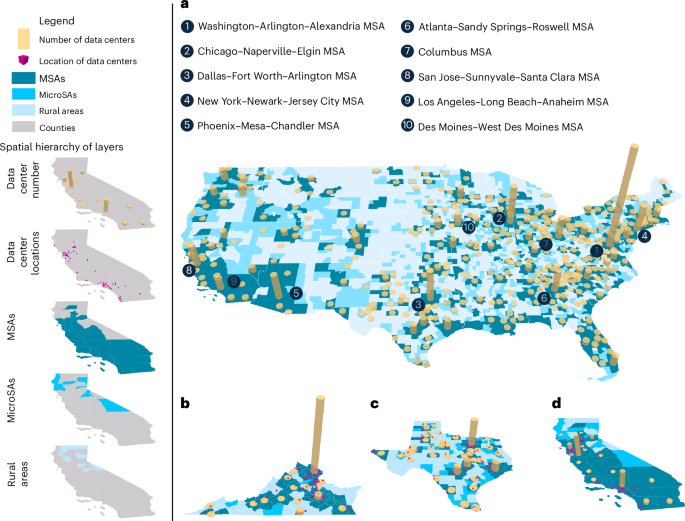
Back to data centers now. We purchased a comprehensive dataset of 4,283 data centers across the U.S. from Data Center Map and mapped them onto U.S. cities. What we found was hard to believe: an astonishing 97.5% of all data centers in the U.S. are anchored to cities—specifically, inside metropolitan and micropolitan statistical areas. Nearly three-quarters sit directly inside dense urban footprints, while the remainder occupy the immediate peripheral extensions of our cities. The “cloud” is not rural after all: it is thoroughly, overwhelmingly urban.
After clearing the "where" part of the research, we moved on to the "why". By searching for open datasets online, we amassed an impressive dataset covering a wide range of potential drivers of companies' decisions to locate facilities in a given city (power capacity, internet quality, energy pricing, policy incentives, etc.). Using a simple regression model, we found that the single most powerful driver of where a data center is sited is local infrastructure supply—specifically, the nameplate capacity of local power plants. These facilities draw massive, continuous power loads that rural grids are unlikely to support. Consequently, they mushroom where the power infrastructure is deep and reliable.
Not unsurprisingly, IT employment concentration, broadband quality, and the number of retired coal plants are other salient factors. Providers are likely to locate their facilities in cities with a thriving IT sector and strong internet connectivity, where low-latency AI use is needed and possible. Legacy energy assets may offer two direct pathways to support the AI boom. First, they leave behind grid and transmission infrastructure designed for large, continuous loads that may now be ready for data center development. Second, retirement may not be permanent – like the one many of us dream about when thinking about work: retired generation assets may be repowered and mothballed electrical stations reactivated.
To fully unpack what this urban concentration means for regional sustainability, we needed to look at the broader picture of energy governance. For this part of the treasure hunt, we brought in our CUSP colleague Anton Rozhkov, whose expertise allowed us to overlay our facility maps with EPA’s eGRID data and the federal Energy Community framework.
Not only did these additional analyses support our findings on the role of fossil-fuel industrial legacy assets, but they also point to a challenging outlook for urban sustainability. Data centers heavily rely on local grid mixes, so their carbon footprints are highly localized and path-dependent. For example, siting the exact same data center in California versus Oregon may result in a 50% increase in CO2 emissions solely because of differences in the cleanliness of state-level electricity generation.
Worse still, our population-based projections out to 2050 suggest that the ongoing AI expansion will not naturally decentralize or revitalize struggling rural spaces. Instead, it will likely reinforce existing urban hierarchies, continuing to concentrate power demands and environmental burdens inside already strained urban hubs. For the people living in these communities, this translates to real-world challenges to urban livability—including noise, resource strain, and reduced land availability.
What started as a fleeting observation from a car window on a road trip evolved into a highly interdisciplinary, collaborative effort to uncover the urban footprint of the U.S. digital infrastructure, published in Nature Cities. Aligning the growth of digital infrastructure with global climate goals and equitable urban planning requires timely, coordinated governance across local, state, and federal levels.

Follow the Topic
-
Nature Cities
This journal aims to deepen and integrate basic and applied understanding of the character and dynamics of cities, including their roles, impacts and influences — past, present and future.

What are SDG Topics?
An introduction to Sustainable Development Goals (SDGs) Topics and their role in highlighting sustainable development research.
Continue reading announcement