The Frankenstein Oscillator: Stabilizing the Impossible
Published in Electrical & Electronic Engineering and Mechanical Engineering
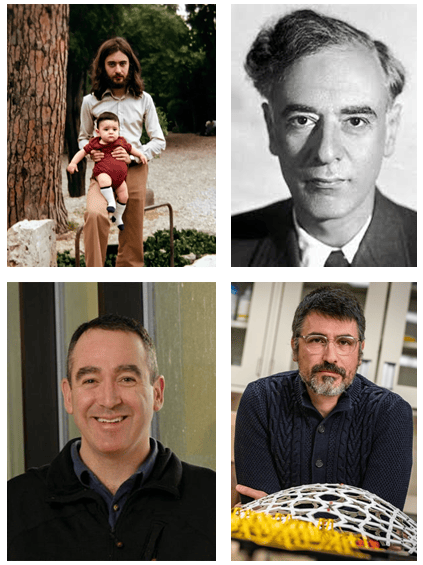

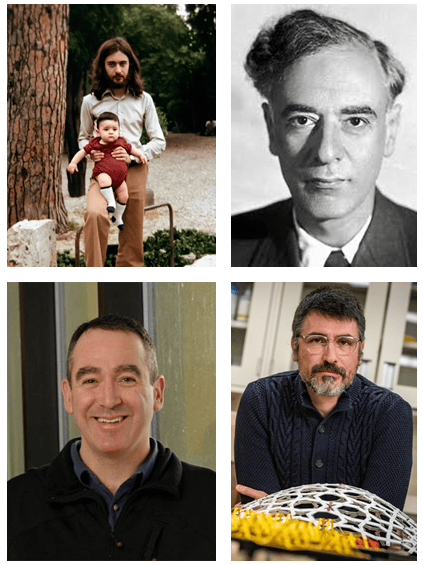
Three of them are with people who are no longer with us, but who left a profound trace on me as a person and as a scholar: my uncle, Roberto Carullo; one of my dear mentors, Erik Bollt; and one of my academic heroes, Lev Landau. My uncle taught me the love for science, books, and languages, which has been my compass since I was a child. Erik introduced me to the beautiful, intricate area of dynamical systems theory, bringing together disparate fields, from information theory to network science and cryptography. And Lev Landau, from a distance, forged my academic backbone; I remember buying those amazing volumes of his Course of Theoretical Physics of Editori Riuniti in Rome every time I had scraped together enough money for a new adventure. From electrodynamics to quantum mechanics, those books weren't just textbooks—they were the blueprints of my intellectual identity.
This project really started 20 years ago when I began working on switched dynamical systems with Dan Stilwell and Erik, exploring the fast-switching limit of network synchronization. In parallel with Igor Belykh (who went on to become a dear friend and collaborator), we discovered that networks of coupled chaotic systems will exhibit synchronous dynamics if the average network supports synchronization and the switching is fast enough. This "fast-switching" regime became a cornerstone of my early career, but it also planted the seeds of a deeper, more nagging curiosity. I found myself constantly returning to the boundaries of that theory: Could synchronization emerge in an intermediate switching range and break down in slow- and fast-switching regimes? What are the specific switching patterns or rhythms that would support such a state?
I have been thinking about these questions for many years and have offered some answers with Igor in a series of papers, always focusing on nonlinear (typically chaotic) systems. Over those years of focusing on chaos, I realized that while timing was always the "when," the true secret of stability lay in the "where"—specifically, in phase-plane dynamics. My long-term obsession with synchronization laid the groundwork for a realization that had been staring me in the face: stability does not require the overwhelming complexity of chaotic attractors. Instead, it can emerge from the precise geometric interplay of trajectories in the phase plane, even in the most elementary systems.
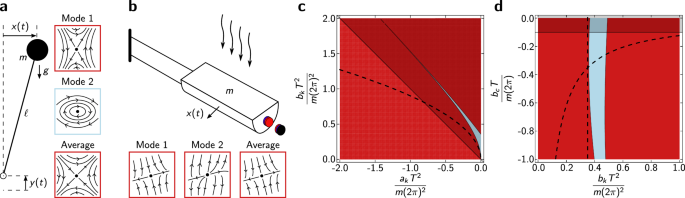
This paper takes a dramatic step away from those studies, focusing instead on simple, linear systems. I was honestly astounded to observe that stable dynamics can occur when alternating between linear unstable systems with an unstable average, provided the switching frequency is chosen within specific "windows of opportunity." The proof of the argument can be carried out by modifying the theory of motion in rapidly oscillating fields found in the first volume of the masterpiece by Landau and Lifshitz. We can show that the classical mass-damper-spring model—the very first thing a student learns in dynamics—is sufficient to design the "impossible" system I have been searching for over the past 2 decades. What it takes is to alternate positive stiffness and negative damping (unstable focus or node) with negative stiffness and positive damping (saddle) — maintaining the average damping positive, but the average stiffness negative.
To make the theory meaningful (and likely believable), we need an experiment. And here it comes, the fourth encounter, with Paolo Celli. I met Paolo about ten years back, when he was a graduate student at the University of Minnesota. We immediately clicked—it is difficult not to click with somebody so bright and curious—and we have stayed in touch ever since. It was with Paolo that we started tinkering with the idea of a simple mass-damper-spring model to achieve this impossible stability regime, with support from the National Science Foundation. Along with Paolo and his then undergraduate (now graduate) student David Xiedeng, we designed the "Frankenstein oscillator" to experimentally demonstrate the possibility of stabilizing the impossible.
Our theoretical and experimental findings, recently published in Nature Communications, show that a mechanical system can be kept stable simply by switching between two behaviors at the right rhythm, even when neither behavior is stable on its own. No sensors are watching the motion. No software is constantly correcting it. Once the timing is set, the physics takes over.
To explore this, we built a simple experiment: a thin plastic cantilever beam fixed at one end with a small weight at the tip. We then created two distinct kinds of instability. First, a magnetic coil pushed the beam away from its resting position, similar to a ball balanced on a horse’s saddle: if it moves slightly off-center, it slides away. Second, a small fan blew air across the strip, feeding energy into the motion so that its swings grew larger rather than fading—much like a playground swing rising higher when someone pushes at the right moment. When both forces were switched on and off in carefully timed pulses, the result was striking. Stability was observed only within a narrow band of switching speeds, with periods ranging from roughly 218 to 238 milliseconds. Inside that window, the beam stayed nearly still. Outside it, the motion quickly exploded.
Why should switching between two unstable behaviors make anything stable? The idea builds on Kapitza’s pendulum, but we asked a different question: what happens if there are no stable states at all? The answer lies in the nature of the instabilities. The "sliding" type (saddle) has one special direction in which motion actually shrinks. The "swinging" type (unstable focus or node) rotates the motion through different directions. If the switching is timed correctly, that rotation steers the motion into the shrinking direction before it has time to run away. The two instabilities, surprisingly, end up stabilizing each other.
“In between ups and downs on the research, I was almost convinced that stabilization of two unstable systems would require some form of nonlinearity or even chaotic dynamics,” I recall. But the solution was in front of me for years, an extension of the marvelous ideas presented by Landau and Lifshitz in the very first volume of their Course of Theoretical Physics that my uncle gave me to start the collection that would become my compass.
The broader implication is a new design philosophy for the future of engineering. Instead of relying on power-hungry processors and complex feedback loops to keep a robot from tipping or a wing from vibrating, we can build stable systems from unstable components. By harnessing the laws of physics rather than fighting them, we can design metamaterials and network systems that are presently beyond reach. We have shown that, with the right rhythm, the impossible becomes stable.
Follow the Topic
-
Nature Communications
An open access, multidisciplinary journal dedicated to publishing high-quality research in all areas of the biological, health, physical, chemical and Earth sciences.

Related Collections
With Collections, you can get published faster and increase your visibility.
Women's Health
Publishing Model: Hybrid
Deadline: Ongoing
Tumor Microenvironment Crosstalk and Therapeutic Implications
Publishing Model: Hybrid
Deadline: Nov 02, 2026