

I have wanted to tell this story for a long time. But Ada never agreed. She never wanted me to tell people what she had done for me. Perhaps that was very much Ada—she could stand before the world as a Nobel laureate, but never wanted the world to know about the quiet things she did when nobody was watching.
Today, I feel it is the right time. Not to remember Ada Yonath1, the Nobel laureate, but Ada, the human being.
The story begins with a photograph taken on 20 November 2022.
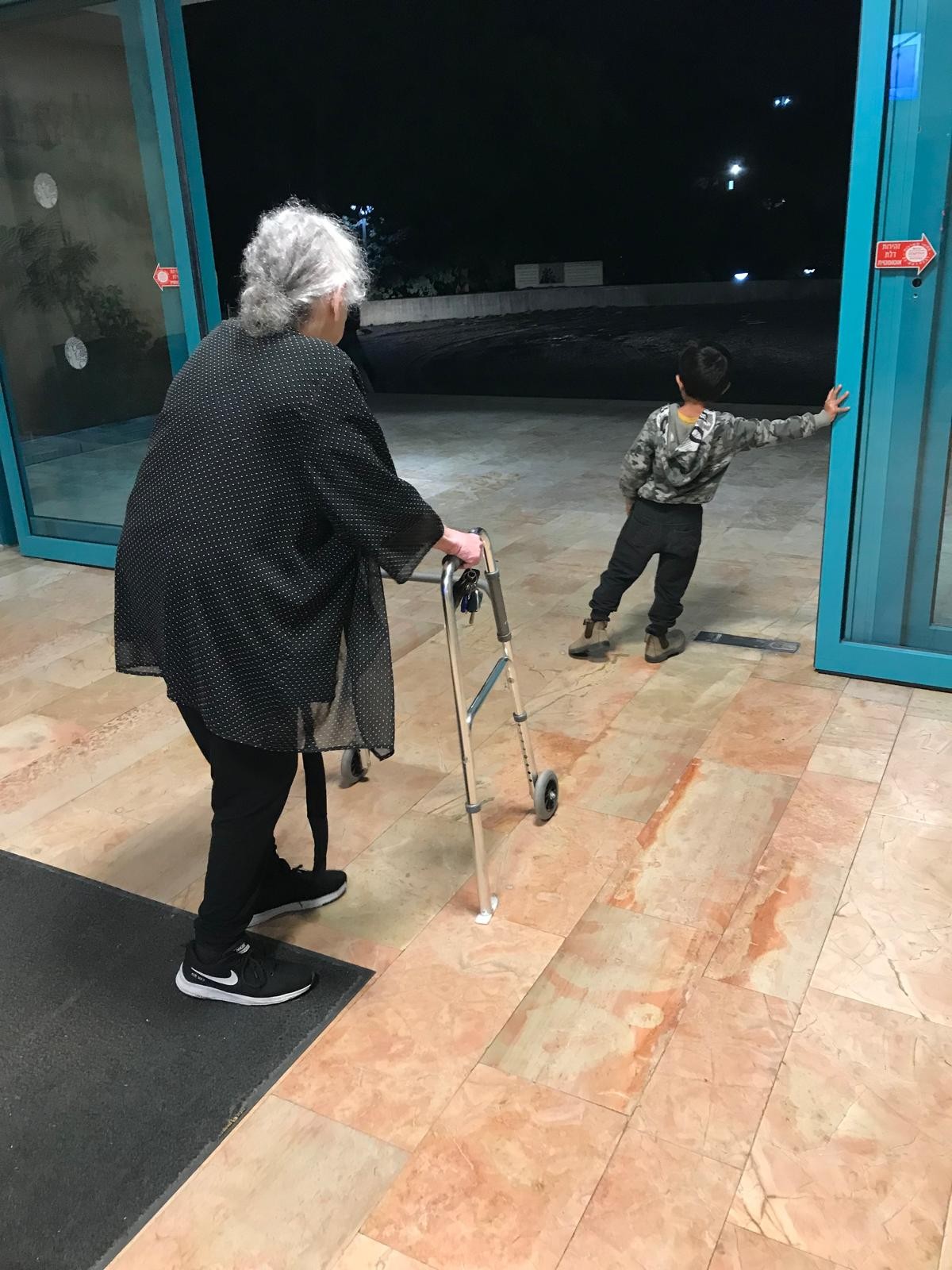
In this picture, our son, Turjo, stands at the gate of the Kimmelman Building at the Weizmann Institute of Science in Israel2, holding it with his tiny hands for Ada. To anyone else, it may look like an ordinary photograph of a little boy. To me, that gate tells a story. Because before Turjo could walk through it, someone had to open a much bigger door for him.
October 2017
I was seven months pregnant and working as a postdoctoral researcher in Ada's laboratory, pursuing one of her favourite projects—the protoribosome3. I was determined to continue working for as long as I could before I went on maternity leave. Pregnancy had not changed my commitment to science.
Then, one day, my insurance agent called me to her office. What I expected to be a routine meeting turned into a shock. My health insurance did not cover childbirth or hospitalisation in Israel. If I delivered there, I would have to bear the entire cost myself, which could increase depending on the mode of delivery and the baby's health. There was no existing policy that could bridge this gap.
The amount was enormous—roughly equivalent to four months of my salary, possibly more. We had moved to Israel only a year earlier and had not saved enough to afford it.
There was another problem: I was already seven months pregnant. Returning to India meant leaving soon, before airline restrictions after the eighth month made flying difficult. The practical suggestion was to return home, deliver the baby and resume my postdoctoral work afterwards. It sounded logical, but it also meant interrupting the science I was pursuing.
My husband, Dr. Debabrata Dey, who is also a co-author of this story, suggested that I speak to Dr. Anat Bashan, a staff scientist in Ada's laboratory. I did. And then something unexpected happened.
The next day
Despite an extraordinarily busy travel schedule, Ada came to the office the very next day, specifically to see me. She said she had heard about my situation and would look into it.
A few days later, Anat told me that Ada wanted to speak to our insurance agent to explore what could be done.
Then Ada came to me and said:
"Don't worry. You continue working. We have spoken to your insurance agent, and we can pay for your delivery from the grants that we have."
That was all. No drama, no grand announcement. Just: don't worry, continue your work.
We were relieved. We believed that the expense had been arranged through Ada's research grant. We were later assured that everything had been sorted out, and that a cheque had been handed to the insurance agent.
I continued working until 26 December 2017. I was hospitalised the next day, and on 28 December, our son was born. I still remember Ada calling to find out whether I had delivered. She sounded more excited than my own mother.
I had a healthy baby. I went on maternity leave and eventually returned to the laboratory. Life went on. Or so I thought.
One year later
Almost a year later, during a meeting with Ada, Anat and several colleagues, Ada suddenly announced:
"Tanaya has changed the rules of childbirth and hospitalisation here."
I looked at her, puzzled. She explained that foreign women could now give birth in hospitals with appropriate insurance coverage. While I had been enjoying the first months of motherhood, Ada had taken up the issue with the authorities, insurance agencies and even the President of the Weizmann Institute. Discussions and meetings had eventually led to changes that made childbirth and hospitalisation more accessible to foreign researchers.
It was a change that could help women who came to pursue scientific careers abroad, so they would not have to choose between motherhood and their work because of an insurance barrier.
And, typically, Ada gave me the credit. I remember sitting there, not knowing what to say. I had done nothing beyond giving birth to my child. Ada had done the rest.
But there was something more I did not know.
The secret
As Ada continued telling the story, Anat interrupted.
"I want to tell you something else. Ada did not pay for your delivery from her grant."
I was confused. Anat explained that research grants could not be used for childbirth expenses. Making an exception for one researcher could also create pressure on individual principal investigators and potentially discourage them from hiring women postdoctoral researchers.
Then a question struck me. I had delivered my baby almost a year earlier, and nobody had ever asked me for the money.
"So who paid for my delivery?" I asked.
Anat looked at me and said:
"Ada paid for it from her own pocket."
I went completely silent.
For an entire year, I had believed that the expense had been covered by research funds. I had never imagined that the woman who told me, "Don't worry. Continue your work," had personally paid the bill.
She had not told me. She had not hinted at it. She had not expected me to know, let alone thank her.
That was Ada.
She had not simply helped a pregnant postdoctoral researcher pay for childbirth. She had quietly ensured that my career would not be interrupted because I was becoming a mother. She protected my science and my dignity, and opened a door for my child before he was even born.
Years later, when I look at the photograph of Turjo holding the gate of the Kimmelman Building, I see more than a little boy standing at the entrance of the institute. I see a door that had been opened long before he could reach it.
Ada never wanted me to tell this story. Perhaps, to her, it was not a big deal. To me, it was everything.
Greatness is not always measured by discoveries that carry your name or awards that place you in history. Sometimes, it is found in the things you do when nobody is watching—in the bill you quietly pay, the door you quietly open, and the young scientist you quietly protect.
That was Ada. Not just a Nobel laureate, but one of the most compassionate human beings I have ever known.
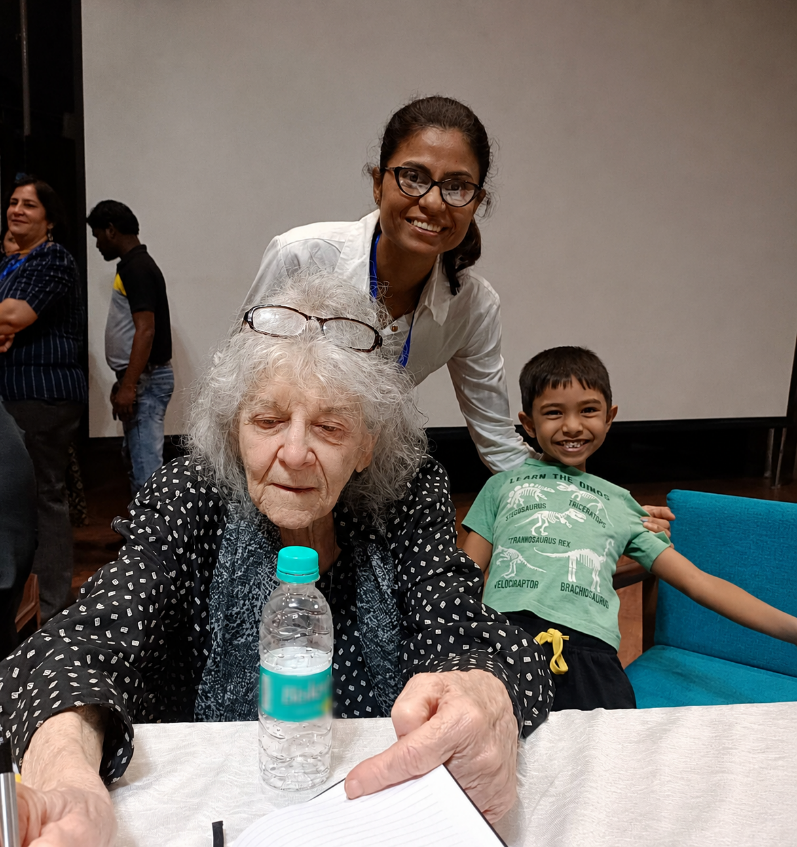
Photograph taken in 2024 during Ada’s visit to New Delhi, India
References:
- https://www.weizmann.ac.il/csb/faculty_pages/Yonath/home.html
- https://www.weizmann.ac.il/csb/
- Bose T, Fridkin G, Davidovich C, Krupkin M, Dinger N, Falkovich AH, Peleg Y, Agmon I, Bashan A, Yonath A. Origin of life: protoribosome forms peptide bonds and links RNA and protein dominated worlds. Nucleic acids research. 2022 Feb 28;50(4):1815-28.
Competing Interests
The authors declare no competing interests.
This content was prepared with editorial assistance from ChatGPT to enhance clarity and presentation. The authors take full responsibility for the content.
Follow the Topic
📢 Introducing: # Mental Health
Mental Health is a Topic created to increase visibility and impact of research in this area and facilitate exchange amongst researchers.
Continue reading announcement


