The gut microbiome following acute HIV-1 infection
Published in Microbiology

Explore the Research
Evolution of the gut microbiome following acute HIV-1 infection | Microbiome
The gut associated lymphoid tissue (GALT) is rapidly and severely damaged upon HIV-1 infection. The extreme damage to the GALT leads the leaky gut phenomenon, where bacterial cells and products usually contained within the gut lumen can now translocate the gut epithelia and enter the lamina propria, thus initiating immune activation and inflammation.
Hence, it is crucial to understand the changes occurring in the gut mucosa as well as in the gut microbiota following first stages of HIV-1 infection. Once we are able to identify them and understand the host-microbiota interplay, we may be able to design new therapeutic approaches to help ameliorate the immune deterioration linked to HIV-1 infection by modulating the gut microbiome.
A major strength in our work is prospectively following-up people from Mozambique after acute HIV-1 infection for up to one year and a half. This longitudinal studies in the developed countries are basically restricted to non-human primate models since acute infections are very difficult to diagnose. First fecal sample from our recently HIV-1 infected individuals (RHI) was collected within the first 1-2 months after viral infection and subsequent fecal and blood samples were periodically collected. Remarkably, we were also able to compare changes in the gut microbiota occurring within the first 18 months to two groups of chronically HIV-1 infected subjects, either on active antiretroviral treatment (ART) or ART-naïve, and HIV-1 negative individuals, thus conforming a huge and clinically relevant cohort.
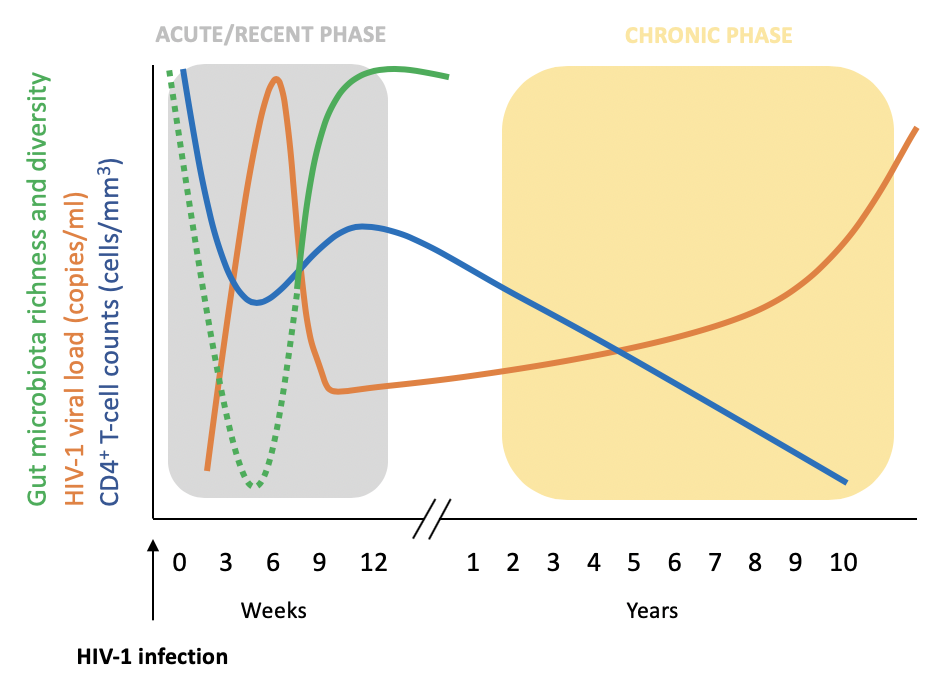
Surprisingly, longitudinal analysis reported significant increases in microbial richness and diversity in RHI subjects. Deeper analyses including clinical data showed significant decreases in HIV-1 viral load and in CD8+ T-cell counts for the first 6 months of follow-up. Interestingly, this observation led us to hypothesize whether the gut microbiota experiences some transient recovery after an initial negative impact (i.e. implying reduction in ecological markers) that mirror the partial recovery of CD4+T cells after initial peak of viremia (see figure below). If true, this would suggest that to understand the acute effect of HIV-1 infection on the gut microbiota, it is crucial to test the first days, at most the first weeks, after viral entry, and that collecting samples at month 1 might be already too late to see the negative impact on the gut microbiota following HIV-1 infection.
Interestingly we also saw a potential role of eukaryotic viruses related to HIV-1 pathogenesis with significant increased fecal shedding of Adenovirus, Enterovirus and Cytomegalovirus in HIV-1 infected groups. Remarkably, Adenovirus shedding was already increased in RHI and maintained in chronically HIV-1 infected groups regardless of ART, compared to HIV-1 negative controls. These observations reinforce the idea that analyses of the gut microbiome should expand beyond bacteria and understanding the inter and intra-dynamics within the gut microbiota during the first month after HIV-1 infection is strongly needed.
More information: https://rdcu.be/bCk58

Follow the Topic
-
Microbiome
This journal hopes to integrate researchers with common scientific objectives across a broad cross-section of sub-disciplines within microbial ecology. It covers studies of microbiomes colonizing humans, animals, plants or the environment, both built and natural or manipulated, as in agriculture.

Related Collections
With Collections, you can get published faster and increase your visibility.
Oncobiome
This collection of papers delves into the burgeoning field of oncobiome research, exploring the intricate relationship between cancer and the microbiome. The oncobiome encompasses the diverse microbial communities residing in and on the human body, which influence cancer development, progression, and treatment responses. By examining these interactions, our aim is to unravel the complex mechanisms through which the microbiome impacts oncogenesis and therapeutic outcomes.
This compilation highlights cutting-edge research, offering insights into potential diagnostic markers and novel therapeutic strategies, thereby advancing our understanding of cancer biology and paving the way for innovative, microbiome-targeted cancer treatments.
This is a cross-journal collection between:
Experimental Hematology and Oncology
Articles will undergo the standard peer-review process of the journal to which they are submitted and are subject to either the BMC editorial policies or those of BJC Reports. Articles will be added to the Collection as they are published. The Editors have no competing interests with the submissions which they handle through the peer review process. The peer review of any submissions for which the Editors have competing interests is handled by another Editorial Board Member who has no competing interests.
Publishing Model: Open Access
Deadline: Ongoing
Animal Gut Nutrition and Greenhouse Gas Mitigation
Animal Microbiome, Journal of Animal Science and Biotechnology and Microbiome call for submissions to the collection on Animal Gut Nutrition and Greenhouse Gas Mitigation.
Efforts to reduce greenhouse gas emissions from livestock systems increasingly hinge on innovations in animal gut nutrition. The dynamic relationship between the gut microbiome and nutrient utilization plays a pivotal role in shaping methane output, feed efficiency, and overall sustainability. Advances in microbial ecology—particularly in understanding the role of gut microbiome in nutrient metabolism—are opening new pathways for mitigating emissions while enhancing productivity. These developments support the implementation of climate-smart agricultural strategies to address climate change and its impacts.
Looking ahead, continued research in this field has the potential to yield innovative solutions such as targeted probiotic supplementation, which could further optimize gut function and enhance nutrient absorption. These advancements may lead to reduced greenhouse gas emissions while improving animal health and productivity. By deepening our understanding of the animal gut microbiome, we can contribute significantly to sustainable agricultural practices that benefit both the environment and food security.
We invite researchers to contribute to this special Collection on Animal Gut Nutrition and Greenhouse Gas Mitigation. Topics of interest include but are not limited to:
- Animal Gut Microbiome and Feed Efficiency
- Greenhouse Gas Mitigation Strategies
- Rumen Fermentation Dynamics
- Nutrient Utilization in Livestock
- Probiotic Supplementation Effects
- Sustainable Livestock Production Practices
- Climate-Smart Agriculture Innovations
This Collection supports and amplifies research related to SDG 13, Climate action.
All submissions in this collection undergo the relevant journal’s standard peer review process. Similarly, all manuscripts authored by a Guest Editor(s) will be handled by the Editor-in-Chief of the relevant journal. As an open access publication, participating journals levy an article processing fee (Animal Microbiome fees, Journal of Animal Science and Biotechnology fees, Microbiome fees). We recognize that many key stakeholders may not have access to such resources and are committed to supporting participation in this issue wherever resources are a barrier. For more information about what support may be available, please visit OA funding and support, or email OAfundingpolicy@springernature.com or the Editor-in-Chief of the journal where the article is being submitted.
Publishing Model: Open Access
Deadline: Sep 04, 2026
Please sign in or register for FREE
If you are a registered user on Research Communities by Springer Nature, please sign in