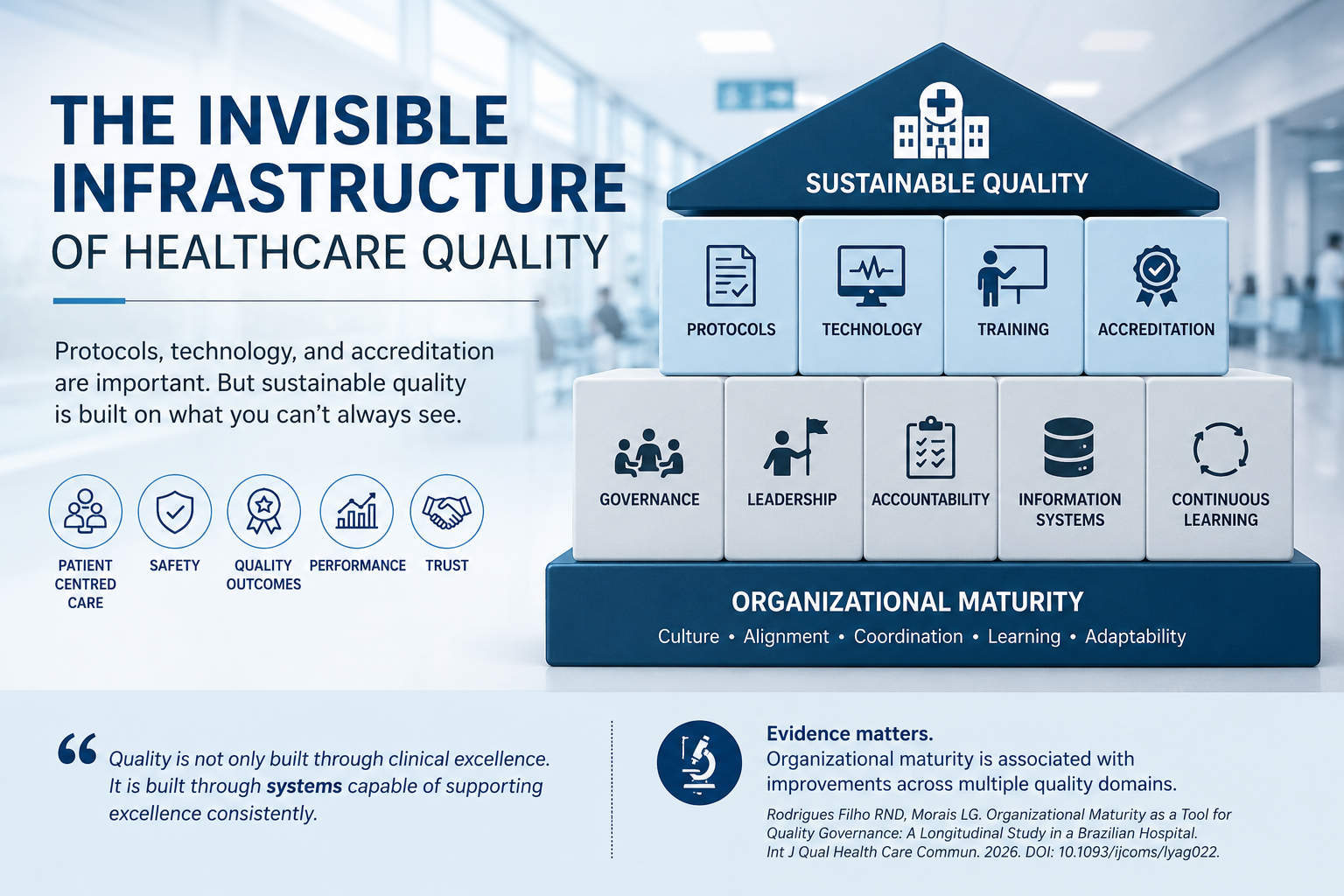
The invisible infrastructure of healthcare quality
Published in Mechanical Engineering and Business & Management
When discussing healthcare quality, most conversations focus on what is immediately visible: clinical protocols, patient safety initiatives, accreditation programs, digital technologies, and performance indicators.
These elements are undoubtedly important. However, they may represent only the visible layer of a much deeper organizational system.
What often determines whether quality initiatives succeed or fail is largely invisible.
Leadership structures.
Governance mechanisms.
Decision-making processes.
Organizational culture.
Accountability.
The ability to coordinate people, information, and resources toward a common objective.
Hospitals frequently implement the same evidence-based interventions yet achieve markedly different outcomes. This variation suggests that quality improvement is influenced not only by the interventions themselves but also by the organizational environment in which they are deployed.
Recent discussions in healthcare management have increasingly emphasized that sustainable improvement depends on organizational capability rather than isolated projects.
This perspective resonates with findings from our recently published longitudinal study, Organizational Maturity as a Tool for Quality Governance: A Longitudinal Study in a Brazilian Hospital, published in the International Journal for Quality in Health Care Communications.
Over four years, we observed progressive improvements in organizational maturity across multiple governance domains, accompanied by advances in institutional quality structures. Rather than highlighting a single intervention, the study suggested that coordinated governance mechanisms may create the conditions necessary for sustainable quality improvement.
This distinction is particularly relevant.
Protocols standardize practice.
Technology facilitates care.
Training develops competencies.
Accreditation establishes frameworks.
But governance integrates all these elements into a coherent organizational system.
Without governance, quality initiatives risk becoming isolated efforts that depend primarily on individual commitment rather than institutional capability.
The challenge becomes even greater in increasingly complex healthcare systems characterized by operational pressure, workforce shortages, digital transformation, financial constraints, and growing demands for patient safety and efficiency.
In such environments, fragmentation may represent one of the greatest barriers to quality.
Fragmented communication.
Fragmented accountability.
Fragmented priorities.
Fragmented decision-making.
Conversely, organizations capable of aligning leadership, operational intelligence, and continuous learning are more likely to sustain improvements over time.
Perhaps this explains why hospitals with similar resources often deliver remarkably different results.
The difference may not lie in the protocols they adopt.
It may lie in the invisible infrastructure that allows those protocols to function.
Quality is not only built through clinical excellence.
It is built through systems capable of supporting excellence consistently.
For healthcare leaders, this may be one of the most important lessons: sustainable quality is not simply implemented—it is governed.
Related research
Rodrigues Filho RND, Morais LG. Organizational Maturity as a Tool for Quality Governance: A Longitudinal Study in a Brazilian Hospital. International Journal for Quality in Health Care Communications. 2026. DOI: 10.1093/ijcoms/lyag022.
Follow the Topic
-
BMC Global and Public Health
An open access, transparent peer review journal publishing outstanding and influential research and opinion of broad interest to all professional communities involved in global and public health research, policy-making, implementation and delivery worldwide.
-
Health and Quality of Life Outcomes
This is an open access, peer-reviewed journal offering rapid publication and wide diffusion in the public domain of high-quality articles in the field of Health-Related Quality of Life (HRQOL).
-
Management International Review
Related Collections
With Collections, you can get published faster and increase your visibility.
Refining the EQ-HWB instrument: psychometric evidence and methodological advances
The EQ Health and Wellbeing (EQ-HWB) tool is a new, experimental instrument by the EuroQol Group designed to capture a broader range of outcomes beyond traditional health-related quality of life measures. Designed for use in patients, social care users and caregivers, the EQ-HWB has two versions: a long-form profile measure and a 9-item short form (EQ-HWB-9), which is a preference-based measure, suitable for the evaluation of health, public health and social care interventions. Since the publication of the EQ-HWB in 2022, several smaller refinements have been proposed to improve the instrument’s usability and performance. These include modifications to item order, wording, response levels and layout. This special collection at Health and Quality of Life Outcomes offers a timely opportunity to share scientific evidence on the impact of these modifications, contributing to the finalisation of the instrument. The collection will be of broad interest to the health outcomes research community, particularly those involved in the development and validation of measures for health and caregiving.
We invite submissions on a wide range of topics, including:
-Qualitative and quantitative psychometric testing of EQ-HWB and EQ-HWB-9 modifications across diverse settings, populations and languages, including general population samples, social care users, caregivers and patients with long-term conditions.
-Methodological studies comparing the psychometric performance of proposed EQ-HWB and EQ-HWB-9 modifications (e.g. item order, wording, response scales, layout).
-Empirical studies supporting the evidence base for the EQ-HWB and EQ-HWB-9 and informing future instrument development.
Please contact the special collection editors directly to determine whether your topic idea is suitable for the collection.
We welcome contributions from researchers, clinicians and methodologists working across all medical fields, as well as in health outcomes research, social care and psychometrics.
This Collection supports and amplifies research related to SDG 3, Good Health and Well-Being.
All submissions in this collection undergo the journal’s standard peer review process. Similarly, all manuscripts authored by a Guest Editor(s) will be handled by the Editor-in-Chief. As an open access publication, this journal levies an article processing fee (details here). We recognize that many key stakeholders may not have access to such resources and are committed to supporting participation in this issue wherever resources are a barrier. For more information about what support may be available, please visit OA funding and support, or email OAfundingpolicy@springernature.com or the Editor-in-Chief.
Publishing Model: Open Access
Deadline: Jun 30, 2026
Measuring HRQoL in Infants and Toddlers: Methodological and Psychometric Evidence from the EQ‑TIPS Development
There is growing interest in the measurement and valuation of health‑related quality of life (HRQoL) in infants and toddlers (0–47 months), a population for whom robust and developmentally appropriate outcome measures remain limited. This Collection aims to advance methodological, psychometric, and applied research on HRQoL instruments designed for early childhood, with a particular emphasis on caregiver‑reported outcomes and cross‑cultural applicability.
Topics of interest include, but are not limited to:
- Development and refinement of HRQoL descriptive systems for infants and toddlers
- Psychometric testing and validation across countries, health conditions, and settings
- Valuation studies and methodological approaches to preference elicitation
- Applications of HRQoL instruments in clinical trials, population health studies, and health technology assessment
The collection especially welcomes work related to emerging and revised instruments, such as the EuroQol Toddler and Infant Populations (EQ‑TIPS), and research that informs best practices for measuring quality of life in very young children.
This Collection supports and amplifies research related to SDG 3, Good Health and Well-Being.
All submissions in this collection undergo the journal’s standard peer review process. Similarly, all manuscripts authored by a Guest Editor(s) will be handled by the Editor-in-Chief. As an open access publication, this journal levies an article processing fee (details here). We recognize that many key stakeholders may not have access to such resources and are committed to supporting participation in this issue wherever resources are a barrier. For more information about what support may be available, please visit OA funding and support, or email OAfundingpolicy@springernature.com or the Editor-in-Chief.
Publishing Model: Open Access
Deadline: Feb 01, 2027
Please sign in or register for FREE
If you are a registered user on Research Communities by Springer Nature, please sign in