Terminal Calcium Fluorides: From Fundamental Studies to Selectivity and Catalysis
Published in Chemistry


Explore the Research

 Nature Publishing Group
Calcium catalysed nucleophilic fluorination
Nature - Calcium catalysed nucleophilic fluorination
The missing structure
Fluorine might be a small atom, but adding it to a molecule can drastically change its properties: a useful trick in developing new medicines and materials. However, inexpensive sources of fluoride ions, such as potassium fluoride, are often poorly soluble, making them difficult to use in chemical reactions. Even when fluoride does react, it can take unwanted routes, causing elimination reactions instead of the desired substitution.
We wondered whether calcium could help guide fluoride along the right path. Calcium is abundant, inexpensive and essential to our bodies, for example in our bones and teeth, yet no calcium-catalysed fluorination had previously been reported. One of the obstacles is that calcium and fluoride tend to form tightly associated structures, and eventually insoluble calcium fluoride (Figure 1) – a remarkably stable material found in nature as the mineral fluorspar and the major industrial source of fluorine. Related to this stability, molecular calcium-fluoride complexes also tend to hold on tightly to their fluoride, making its delivery to other molecules very challenging.
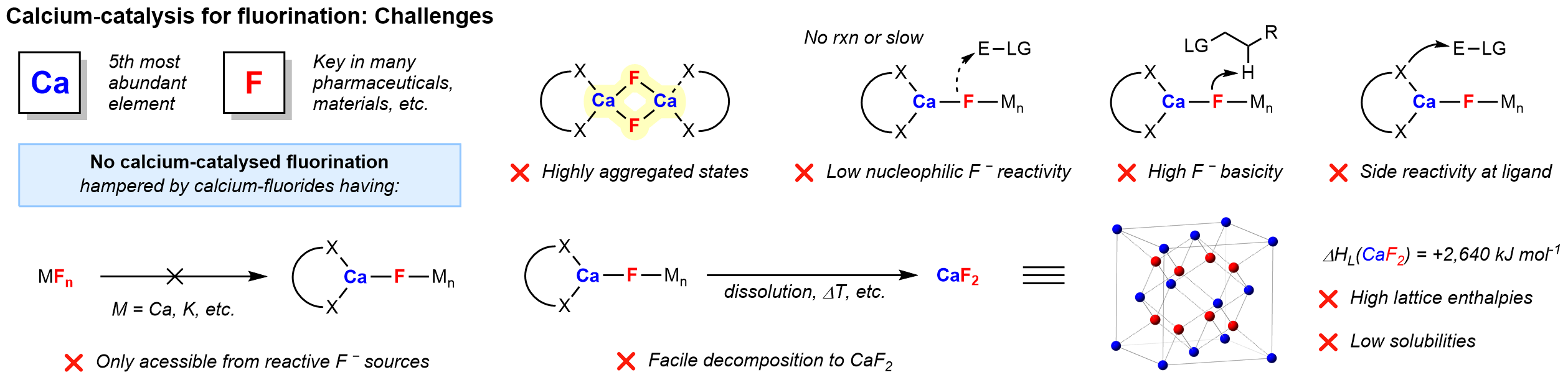
In our earlier work (Struijs et al. Nat. Chem. 2024 – https://www.nature.com/articles/s41557-024-01524-x), we significantly expanded the architectures in which calcium and fluoride could come together in discrete molecules, and demonstrated for the first time that fluoride could be transferred from such complexes. However, one structural motif – arguably the most interesting – was still missing: a terminal calcium fluoride, in which fluoride is attached to just one calcium centre, rather than held between multiple metals. We were particularly interested in this structure for two reasons. From a fundamental perspective, it would allow us to study the calcium-fluoride bond in its 'purest' form, without additional metal interactions. From a reactivity standpoint, we suspected that removing the additional interactions could make fluoride more readily available for transfer to other molecules, potentially even paving the way for calcium-catalysed fluorination.
One fluoride too many
With this in mind, I set out to synthesise this elusive species. After plenty of trial and error, I designed a ligand that could stabilise the calcium centre while leaving room for fluoride to bind. The key feature was a set of bulky yet flexible arms that stabilise the calcium but can move aside to accommodate incoming ions or molecules. When I introduced fluoride, using tetramethylammonium fluoride as the source, the first results were promising. Measurements in solution showed that calcium and fluoride indeed could come together in a 1:1 ratio – exactly what we were hoping for!
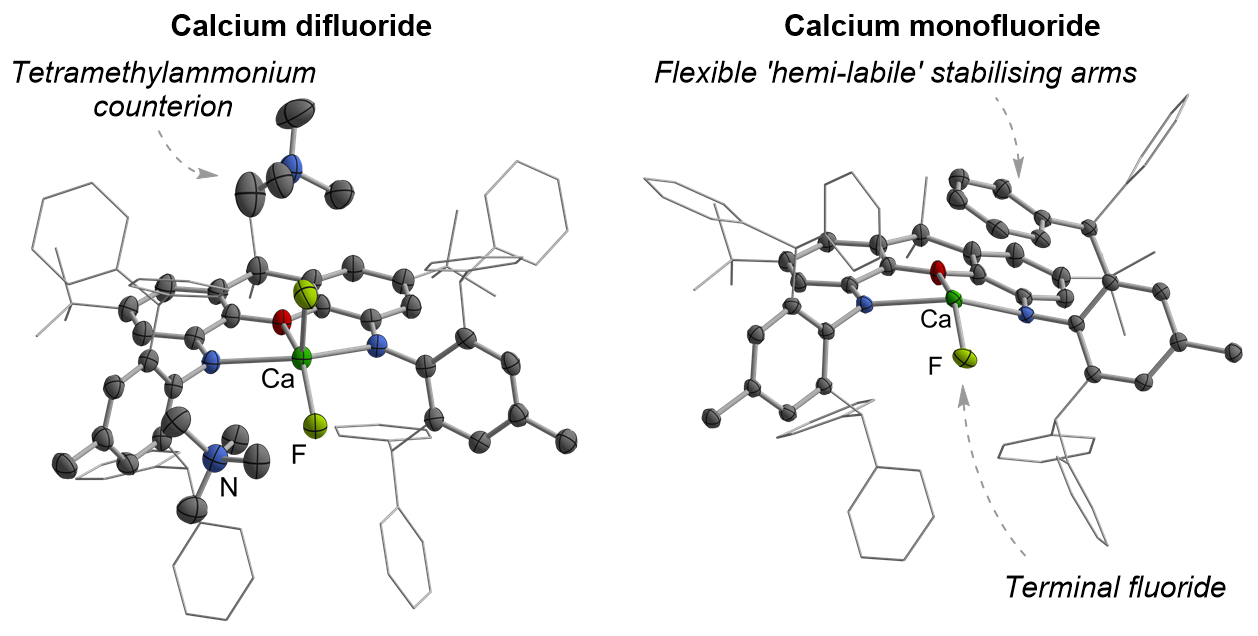
But where exactly was the fluoride located? Was it interacting with anything else? These questions could be answered by single-crystal X-ray diffraction, a technique that allows us to determine the three-dimensional arrangement of atoms in a molecule. The only catch is that you first need suitable crystals. When I finally managed to grow them, I was surprised to find not one, but two fluorides bound to calcium (Figure 2, left). Had I simply picked the wrong crystal? Further experiments revealed that this was no coincidence: although the monofluoride was favoured in solution, the molecules rearranged during crystallisation to form the difluoride.
While we had now discovered the first terminal calcium difluoride – an interesting structure in its own right – the elusive monofluoride was still missing. The fact that crystallisation favoured the difluoride pointed us towards changing the counterion, as the additional negatively charged fluoride necessarily comes with another positively charged counterion. Changing the size of this counterion could influence how the ions pack together in the crystal, like how oranges would stack differently alongside small marbles or larger ping-pong balls. You can imagine that it is easier to fit an extra marble (i.e. the small tetramethylammonium ion) into the spaces between oranges than an extra ping-pong ball.
The 'perfect ping-pong ball' turned out to be tetraphenylphosphonium. Introducing its fluoride salt to our calcium complex gave very similar behaviour in solution, but this time crystallisation yielded beautiful red crystals of our long-sought terminal calcium monofluoride! I still remember watching the first X-ray diffraction data come in, slowly revealing the structure we had set out to make (Figure 2, right). Seeing the fluoride bound to just one calcium centre, exactly as we had designed, was an amazing feeling.
Not all fluorides are equal
With the terminal calcium monofluoride finally in hand, we could turn to one of the questions that motivated its synthesis: would removing the additional interactions with other metals indeed make fluoride easier to deliver?
Encouragingly, our complex readily transferred fluoride to a range of molecules, forming new bonds between fluorine and carbon, phosphorus, silicon or sulfur. Even relatively unreactive molecules such as 1-bromopentane could be fluorinated, something that had proven particularly challenging with our earlier calcium-fluoride complexes.
But perhaps even more exciting was what didn't happen. In most reactions fluoride can act not only as a nucleophile, replacing another atom in a molecule, but also as a base, removing a proton and causing an unwanted elimination reaction that forms a carbon–carbon double bond. When we used a simple fluoride salt such as tetramethylammonium fluoride to fluorinate 1-bromopentane, both reactions occurred, with over 40% of the products arising from elimination. With our terminal calcium fluoride, however, we detected no elimination product (Figure 3, left). The calcium complex was thus doing more than simply delivering fluoride: it was actually controlling how fluoride reacted.
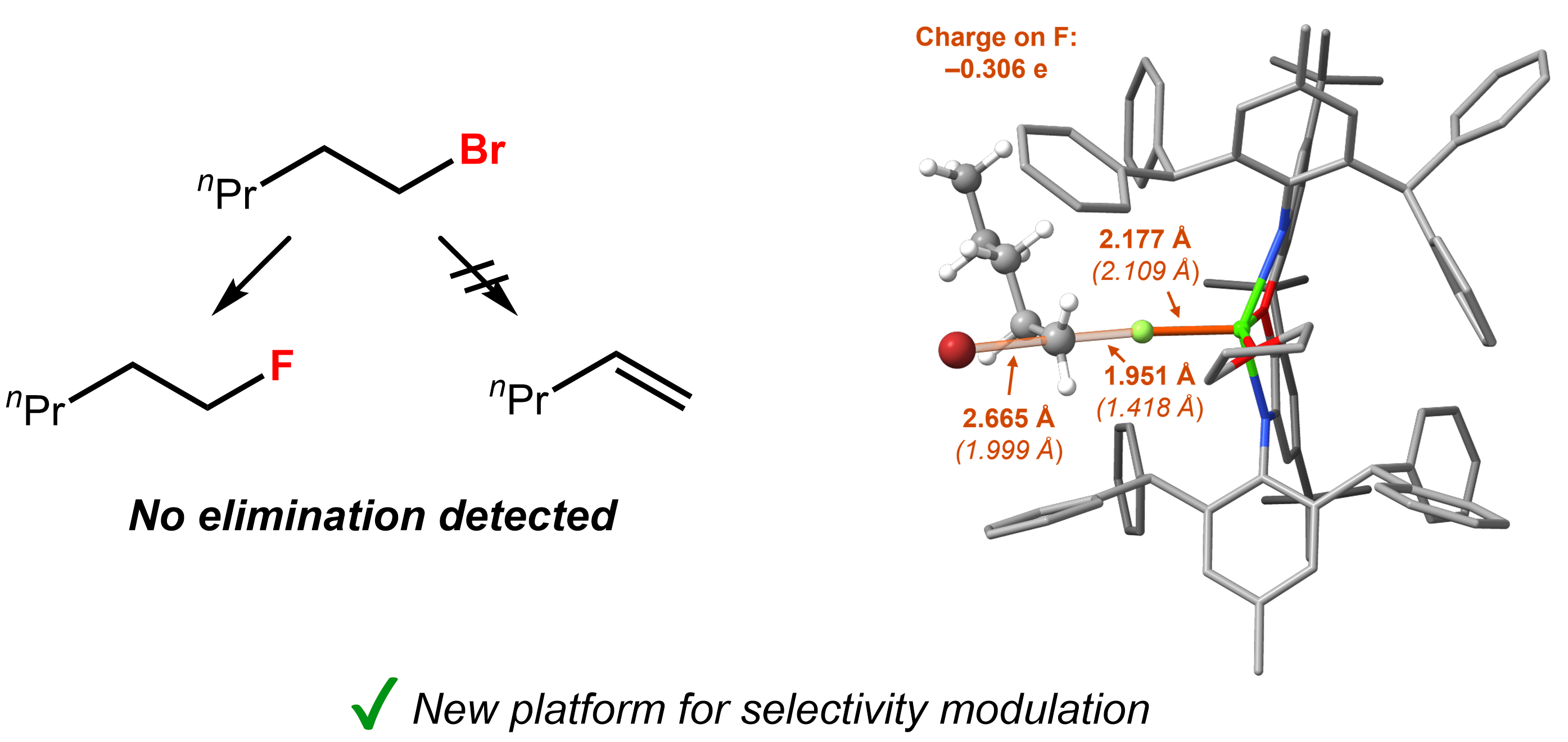
To understand this unusual selectivity, we turned to computational studies, performed by my friend and colleague Agamemnon Crumpton. These revealed that fluoride remains attached to calcium until very late in the reaction, meaning that the surrounding ligand and the calcium itself can still influence its behaviour (Figure 3, right). In particular, calcium reduces the negative charge on fluoride, which we believe makes it less prone to remove a proton, while the bulky framework appears to shield fluoride from the approach required for elimination, without preventing the desired substitution reaction.
Interestingly, although the individual calcium–fluoride bond in our terminal complex is actually stronger than in our previously reported structures, fluoride is more readily transferred. The key lies in the absence of additional interactions with other metals, which would otherwise hold on to fluoride and make its release more difficult. The question then became: could we take this one step further and make calcium deliver fluoride over and over again, in a catalytic cycle?
A fluoride shuttle
Delivering fluoride once is nice, but a catalyst must do it repeatedly. We wanted calcium to behave like a shuttle: collect fluoride from an inexpensive source, deliver it to an organic molecule, then return for another cycle.
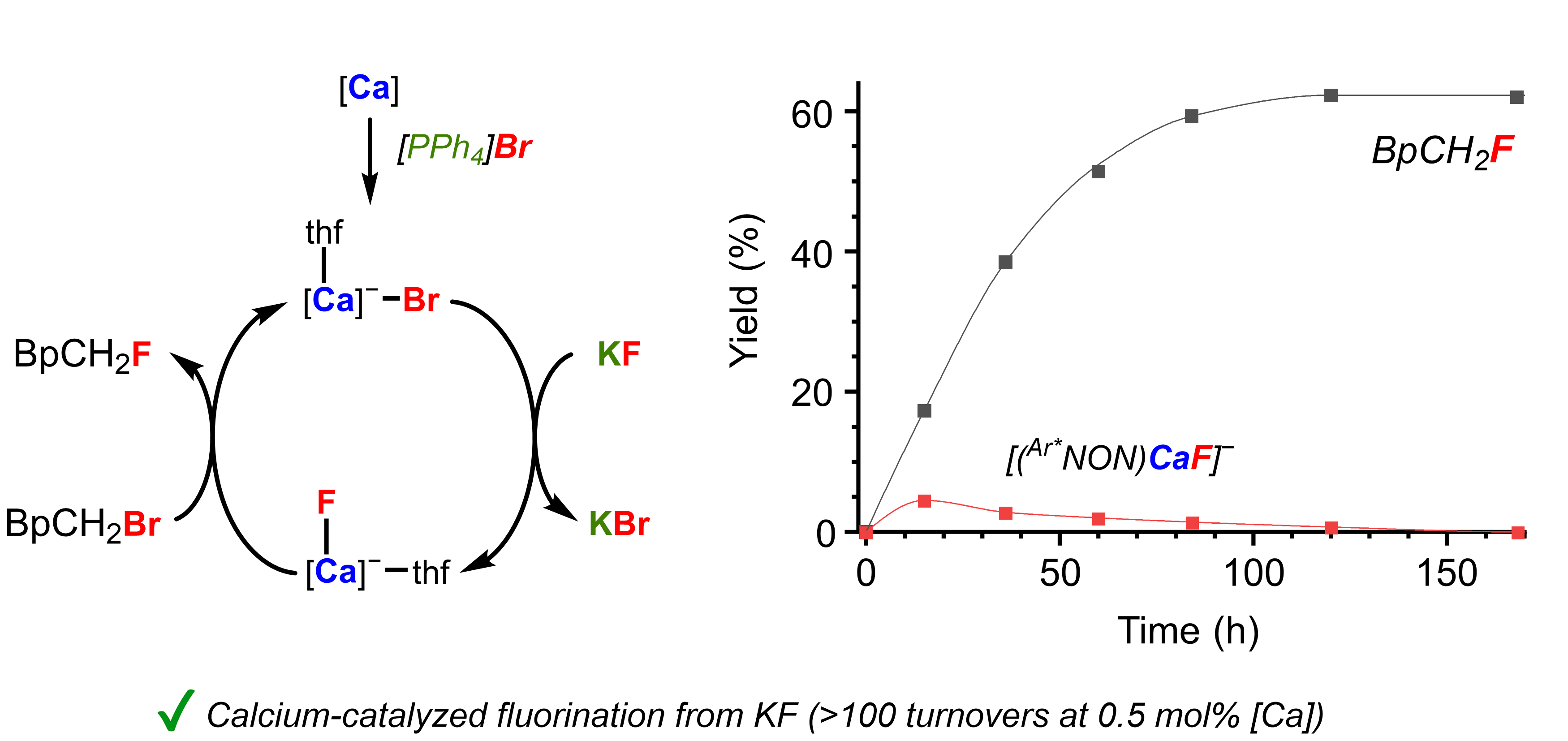
We turned to potassium fluoride as an inexpensive and readily available fluoride source. However, simply mixing it with our original calcium complex did not work: the calcium would not take up the fluoride. The solution was inspired by our tetraphenylphosphonium monofluoride complex: what if we first converted the calcium complex into its bromide counterpart? This complex, readily formed by simply adding tetraphenylphosphonium bromide to the reaction mixture, could then exchange its bromide for fluoride from potassium fluoride, generating our terminal calcium fluoride. Upon delivering fluoride to an organic molecule, the calcium complex picks up the displaced bromide, ready to repeat the cycle (Figure 4, left).
After switching to this system, we started seeing fluorinated product for the first time and not only that, eventually even in a catalytic fashion! Admittedly, the yield of this initial reaction was modest, but control reactions confirmed that calcium was essential for the transformation. Although developing this proof of concept into a ready-made manufacturing process was beyond the scope of this work, a change of substrate and a few adjustments to the reaction conditions allowed us to achieve a turnover number of over 100 at a catalyst loading of just 0.5 mol%, meaning that on average each calcium centre could deliver fluoride more than 100 times (Figure 4, right).
While there is still plenty of room for improvement, particularly in reaction rates and catalyst stability, these results demonstrate a fundamentally new way of using calcium in fluorination chemistry. What started as a curiosity about the ‘simplest’ possible calcium–fluoride interaction had ultimately led us to a new catalytic platform, with the added possibility of controlling the selectivity of fluoride delivery.
Article Information
Job J.C. Struijs, Agamemnon E. Crumpton, Véronique Gouverneur*, Simon Aldridge*. "Calcium catalysed nucleophilic fluorination", Nature, 2026.
https://www.nature.com/articles/s41586-026-11445-z
Follow the Topic
-
Nature
A weekly international journal publishing the finest peer-reviewed research in all fields of science and technology on the basis of its originality, importance, interdisciplinary interest, timeliness, accessibility, elegance and surprising conclusions.