The role of luck in creative career success
Published in Social Sciences
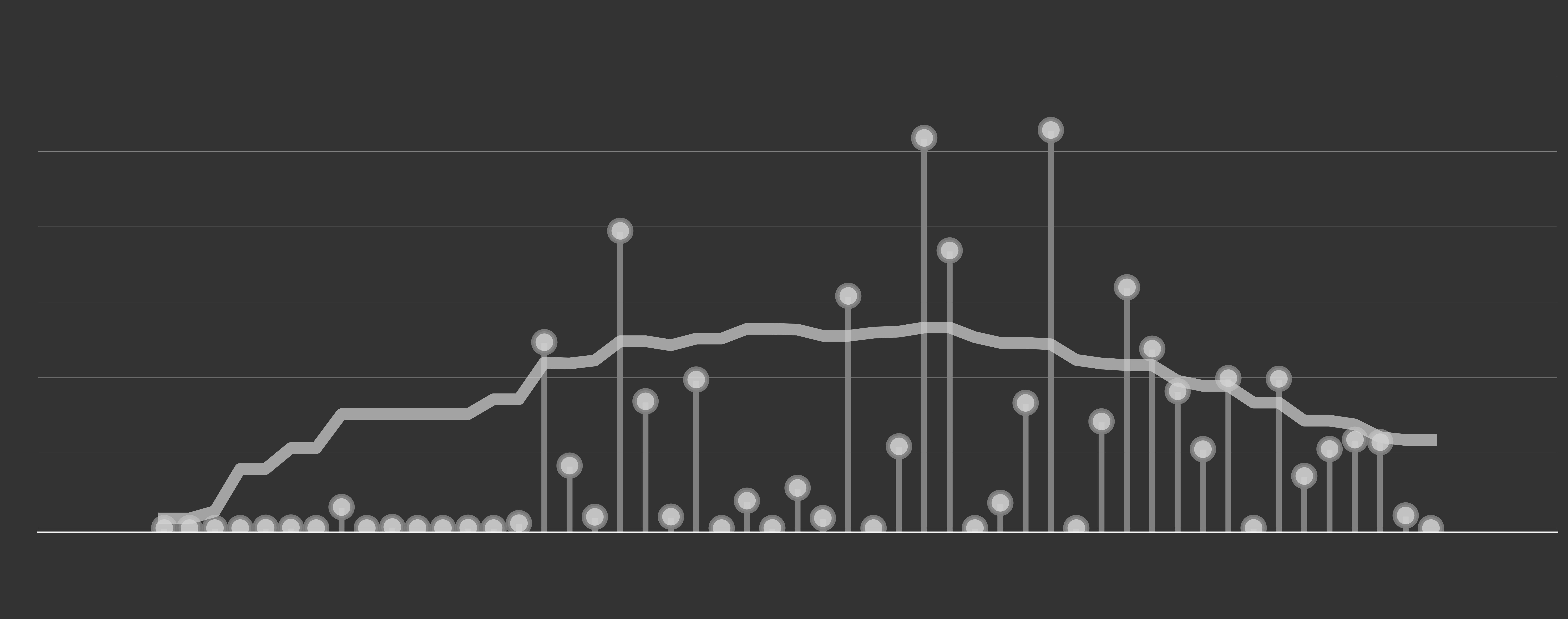





One of the crucial questions a movie producer, a scientist, or a musician, has to face during her career is: When will she produce her biggest hit? Can one predict when she will direct a blockbuster movie or make a fundamental discovery? Our research, with Roberta Sinatra and Federico Battiston, showed that this million-dollar question cannot be answered: the occurrence of the biggest hit is inherently random. This finding is also known as the random-impact-rule: Every creative product of an individual has the same chance to be the best, let it be the very first, or even the last piece of one's career. This finding is in line with Simonton, Sinatra et al., and Liu et al. as well.
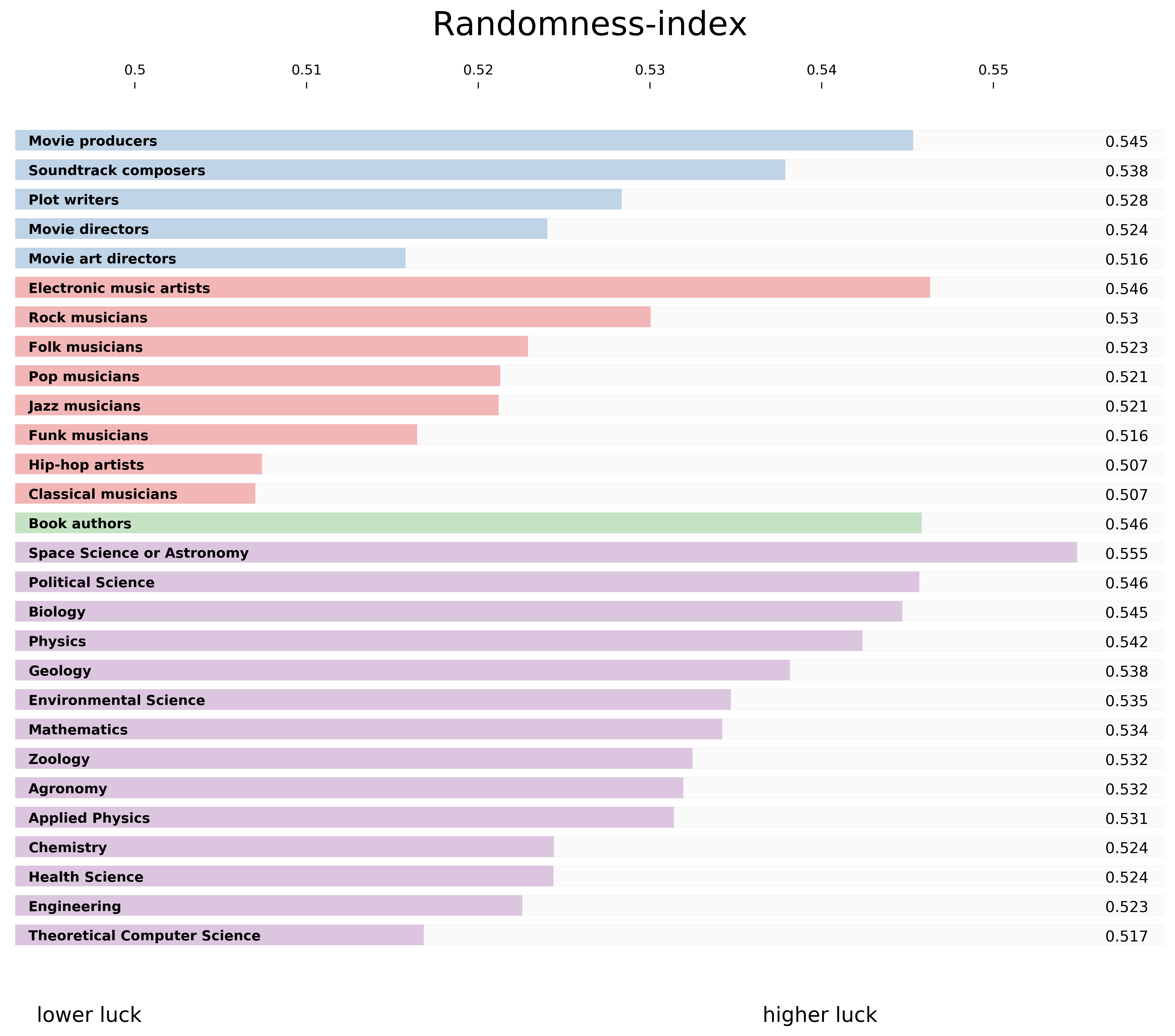
Apparently, luck is the main driving force behind the timing of the biggest hit. Then, the question arises: How does luck influence the magnitude of the hit? To answer this question we built on the random-impact-rule and on a formerly introduced modeling framework [rob], to decompose the impact of the individual products, such as books and movies, into two components: randomness and individual ability. We then compared the effect of these two components on impact across career 28 creative professions, ranging from movie directors to jazz musicians. Our findings, detailed in the second figure of our paper, uncover that randomness has a similar effect across creative domains and that its role is more pronounced than the role of the individual ability. In addition, our comparative analysis shows (Figure 1) that for instance, the musical fields most dominated by luck are electronic and rock music, while the least dominated one is classical music. For scientific disciplines, on the luck-end of the scale, we can find political science, contrasting to computer science which is the least exposed to luck.
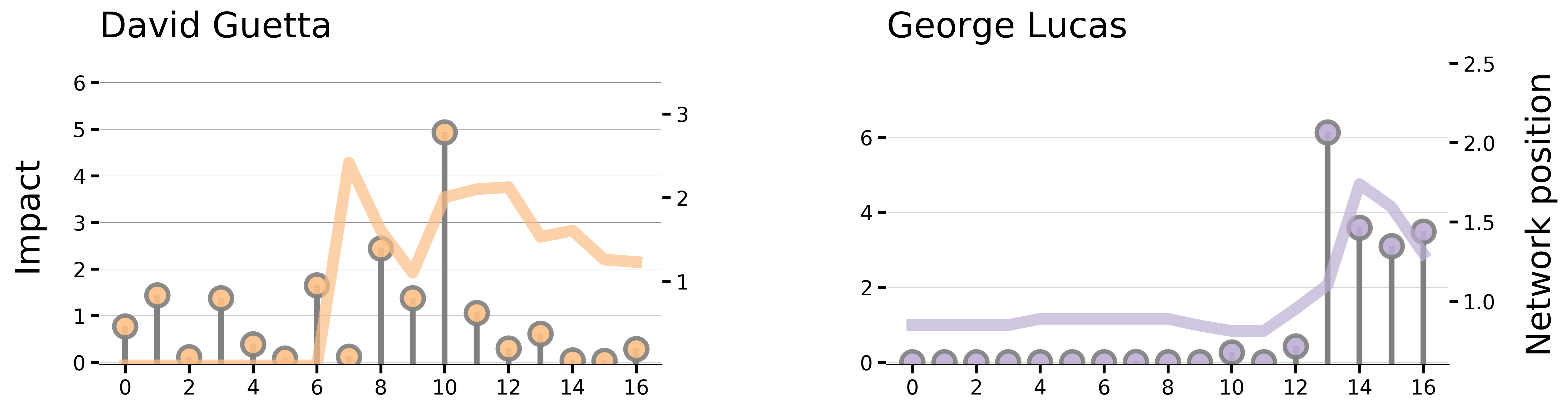
Finally, we investigated how the temporal changes in networking patterns may help to understand the occurrence of the big hit. Here our findings are twofold. First, we discovered that for creative individuals, two types of networking patterns exist. Namely, there are people who become central in their collaboration networks first, gaining access to connections and resources, and then produce their biggest hits. However, the opposite behavior exists as well: many produce their greatest piece first, any become central only afterward (Figure 2). Surprisingly, luck is still unavoidable: whether someone falls into the first or the second category happens at random.
Read more about this research here.

With a background in physics and biophysics, Milan earned his PhD in network and data science in 2020. He studied and researched at the Eötvös Loránd University and the Central European University in Budapest, at the Barabási Lab in Boston, and the Bell Labs in Cambridge. He was selected as Forbes 30u30 in 2020. He is an NFT sales contributor on SuperRare and Foundation, an alumni at Eötvös Collegium, and a regular columnist at Qubit and the Data Visualization Society. His first book titled DATA debuted with OpenBooks.
Milan is the current chief data scientist at Baoba. Previously, he was the chief data scientist and co-founder of Datapolis, a research affiliate at the Central European University, a research expert at the European Commission, and a senior data scientist at Maven7.
He was awarded the Scholarship of the Republic of Hungary three times, won multiple prizes at science competitions, and presented his work in peer-reviewed journals and conferences from Nature’s Scientific Reports to MIT.
His work has been featured in Nature Social Science Research, GQ, Times Higher Education, New Scientist, New York Times, TechXplore, The Economic Times, Fossbytes, Futurism, The Times, Towards Data Science,Phys.org, Nightingale, Gamestar, 99 Data Influencers to Follow 2023, the Miami Art Week, and more.
Follow the Topic
-
EPJ Data Science
This journal offers a publication platform to showcase the latest contributions to the study of techno-socio-economic systems, wherein the focus of the journal is on analyzing and synthesizing massive data sets to achieve new insights into societal phenomena and behavior.

Related Collections
With Collections, you can get published faster and increase your visibility.
Predicting fertility outcomes in PreFer data challenge and beyond: advances and limits
Fertility outcomes are among the key life outcomes shaping individual lives and societies. Different disciplines have extensively studied them, yet important gaps in our knowledge remain, illustrated by the difficulties in anticipating future fertility and its unexpected changes. This special collection explores prediction as a new approach to studying fertility behaviour. A prediction-focused approach offers several distinct opportunities: establishing benchmarks of predictive performance and trying to beat them can drive theoretical and methodological innovation; comparing predictive performance across outcomes and contexts can give insights into underlying mechanisms of fertility behaviour; tracking predictability over time can show how fertility behaviour evolves; improved predictions might enhance demographic forecasting.
This special collection aims to document current fertility predictability by leveraging advances in statistical learning and novel data sources, such as large-scale administrative data. Using fertility outcomes as an example, it also aims to provide broader insights into why life outcomes remain difficult to predict, demonstrate how prediction-focused approaches can advance life course research, and showcase novel computational social science methods.
This collection builds in part on the PreFer data challenge (Predicting Fertility in the Netherlands), in which teams predicted three-year fertility outcomes using Dutch survey and register data. However, we welcome contributions examining fertility prediction across diverse contexts, populations, and data sources.
Topics of interest include, but are not limited to:
- Predictability of different fertility outcomes across contexts
- Sources of unpredictability
- Foundation models for fertility prediction
- Use of administrative, digital trace, or linked multi-source data
- Predictability of fertility outcomes across demographic and socioeconomic groups
- Temporal trends in fertility predictability
- Model interpretation for understanding fertility behaviour
- Using predictive modelling to test theoretical mechanisms
- Applications to demographic forecasting
- Ethical considerations in fertility prediction
If you have questions about fit, please contact guest editors Gert Stulp (g.stulp@rug.nl) and Elizaveta Sivak (e.sivak@rug.nl).
Submission Information:
Authors should select the collection “Predicting fertility outcomes in PreFer data challenge and beyond: advances and limits” under the “Details” tab during the submission stage. All submissions will undergo the standard peer-review process of EPJ Data Science.
Publishing Model: Open Access
Deadline: Sep 30, 2026




Please sign in or register for FREE
If you are a registered user on Research Communities by Springer Nature, please sign in