The Story Behind "A Machine Learning Framework for Structural and Predictive Analysis of Intelligent Data Networks"
Published in Computational Sciences and Statistics
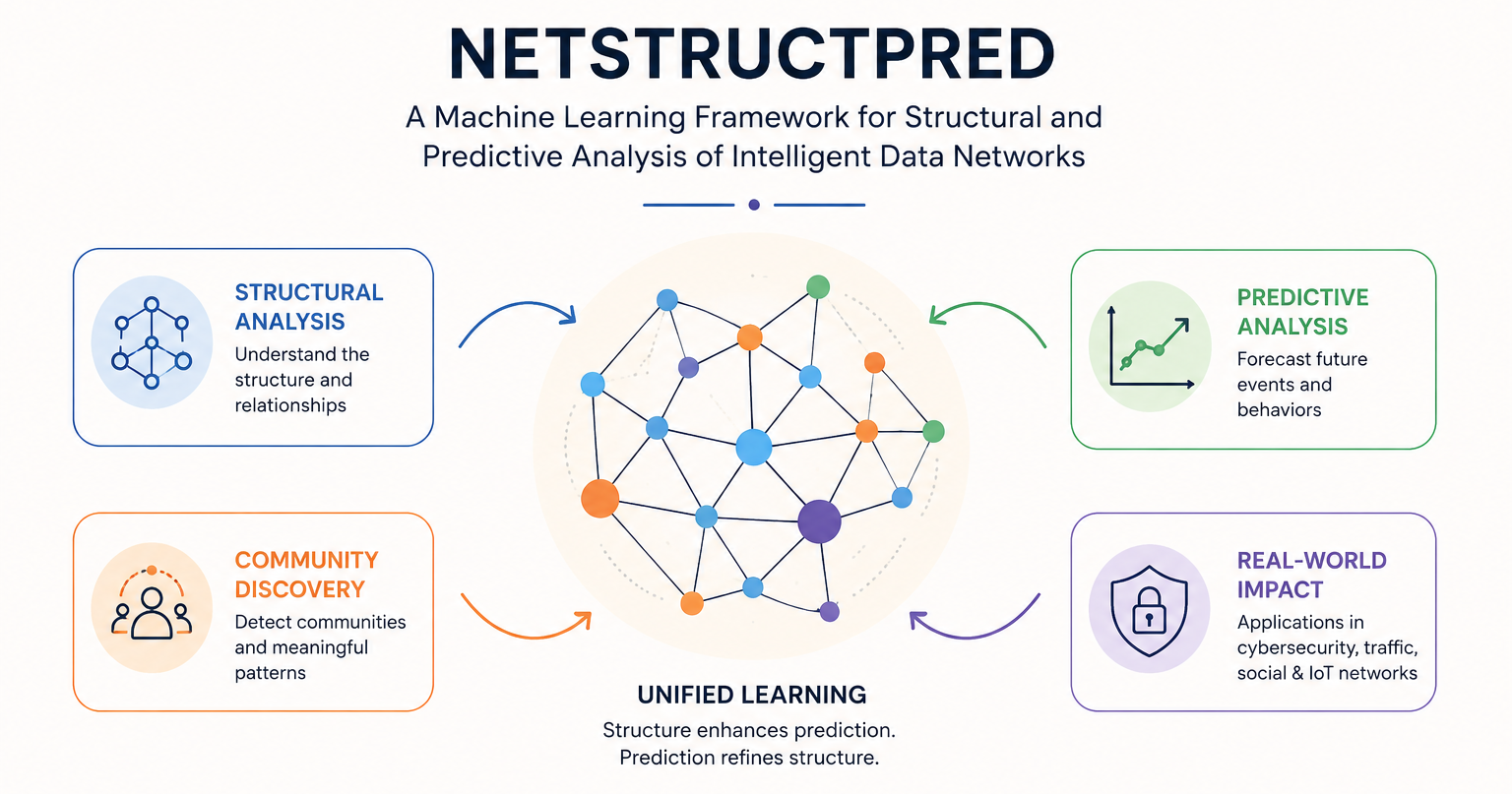



Every research paper begins long before the first word is written. It begins with a question that refuses to leave your mind. This paper was born from one such question that stayed with me through countless lectures, research discussions, and late nights spent reading the ever-growing body of literature on graph learning and intelligent networks. The question was simple, yet deeply unsettling: Why do we ask machines to understand the structure of a network separately from predicting its future, when nature itself never separates the two? That thought became the foundation of this work. The paper eventually proposed NETSTRUCTPRED, a unified machine learning framework capable of jointly learning structural understanding and predictive intelligence for dynamic, heterogeneous data networks.
The journey, however, was anything but straightforward.
Like many researchers, I began by reading hundreds of publications, hoping to find a framework that already connected these two worlds. I found remarkable work on Graph Neural Networks, temporal learning, heterogeneous graphs, anomaly detection, traffic prediction, and community discovery. Every model was impressive in its own right, yet they all seemed to live in separate universes. Some understood the architecture of a network but could not anticipate its future. Others predicted future events with remarkable accuracy but treated the network's structure as nothing more than a fixed input. I realized that we had built extraordinary tools, but they were solving isolated pieces of a much larger puzzle. That realization slowly transformed curiosity into determination.
I filled notebooks with sketches that would later evolve into the NETSTRUCTPRED architecture. One sentence appeared repeatedly across those pages:
"Structure should improve prediction, and prediction should improve structure."
At first, it sounded more like a philosophical statement than a machine learning objective. Yet every experiment gradually proved that this idea had scientific merit. The heterogeneous graph encoder emerged because real-world networks are rarely uniform. The temporal memory module became essential because networks remember their past. The transformer was introduced because historical events influence future behaviour across long time horizons. Finally, the cross-task feedback mechanism brought everything together, allowing structural understanding and predictive learning to reinforce one another rather than compete.
What surprised me most was that the hardest part was never writing code. Programming solves problems that are already understood; research begins where understanding ends. There were weeks when experiments failed without explanation. Architectures that looked elegant on paper collapsed during training. Loss functions that appeared mathematically beautiful produced unstable optimisation. Entire sections of the framework were discarded and redesigned. More than once, I questioned whether the original idea had been overly ambitious. Those moments never appear in the published manuscript, yet they represent the invisible chapters behind every successful publication.
Slowly, the data began to answer the questions that theory alone could not. We evaluated the framework across multiple domains, including academic collaboration networks, social platforms, transportation systems, and cybersecurity environments. Although these datasets represented entirely different worlds, they all revealed the same underlying truth: when structural intelligence and predictive intelligence learn together, both become stronger. The experiments were no longer merely validating an algorithm they were validating the central belief that inspired the research itself.
This paper also reminded me that research is never an individual achievement. Although authors' names appear on the first page, every meaningful publication is shaped by collaboration. I remain deeply grateful to my co-authors for their ideas, discussions, and willingness to challenge assumptions. Scientific progress depends not only on agreement but also on thoughtful disagreement. The peer-review process further strengthened the work. Every critical comment forced us to think more deeply, justify our decisions more rigorously, and refine the framework into something stronger than our original vision.
The day I received the acceptance notification from Scientific Reports was undoubtedly memorable. Yet, as I looked back on the journey, I realised that publication was never the true destination. It was simply a milestone along a much longer road. The greatest satisfaction came from knowing that we had addressed an important research gap by proposing a unified framework that integrates structural discovery and predictive modelling within a single learning architecture.
Looking back, I believe this paper taught me a lesson far beyond machine learning. Innovation rarely comes from asking, "How can I improve an existing model?" It comes from asking, "Why are we solving these problems separately in the first place?" Progress often begins by questioning assumptions that everyone else has quietly accepted.
If there is one message I hope young researchers take from this story, it is this: never chase publications; chase meaningful questions. Papers eventually become part of the literature, but good questions continue inspiring new generations of researchers. As Albert Einstein wisely said,
"The important thing is not to stop questioning. Curiosity has its own reason for existing."
Throughout this journey, I discovered another truth that has become my own guiding principle:
"Great research is not built on moments of brilliance; it is built on years of curiosity, persistence, and the courage to keep asking questions when answers seem impossibly far away."
This paper is not merely the story of an algorithm. It is the story of curiosity becoming conviction, of failures becoming lessons, and of one simple question evolving into a contribution that, I hope, encourages others to look at intelligent networks and perhaps research itself from a different perspective.
Regards
I am Dr. Sanjay Agal, an educator, researcher, and academic leader dedicated to advancing the frontiers of knowledge and shaping the future of engineering education. Currently, I serve as Professor and Head of the Department of Artificial Intelligence and Data Science at Parul University, Vadodara, India. My professional journey also includes serving as the Principal of Dr. V. R. Godhania College of Engineering & Technology, Porbandar an opportunity I was formally endorsed for by Gujarat Technological University (GTU) in 2023.
My career has been guided by a deep commitment to innovation-driven learning and impactful research. Over the years, I have authored sixteen books and published numerous research papers in reputed international journals. I have also secured several patents, reflecting my sustained efforts to bridge theoretical understanding with meaningful real world applications.
With a vision to inspire and empower the next generation of thinkers, innovators, and problem solvers, I strive to foster an environment where curiosity, creativity, and academic excellence thrive. Whether through teaching, research, or academic leadership, my mission remains the same: to contribute to a transformative educational ecosystem that benefits students, faculty, and society at large.
Follow the Topic
-
Scientific Reports
An open access journal publishing original research from across all areas of the natural sciences, psychology, medicine and engineering.

Related Collections
With Collections, you can get published faster and increase your visibility.
Cancer Prevention and Control
Publishing Model: Hybrid
Deadline: Feb 19, 2027
Healthy Aging
Publishing Model: Open Access
Deadline: Dec 31, 2026