The Test Begins When the AI Label Disappears
Published in Neuroscience, Computational Sciences, and Behavioural Sciences & Psychology




Suppose a person consults an AI-generated label before interpreting an uneasy feeling. The explanation seems plausible, so they accept it. After repeated consultations, the machine becomes their preferred source.
Has anything happened to the person's capacity for self-interpretation? The observation cannot tell us. The external label may simply be more informative. An intact internal signal can be given less weight for perfectly rational reasons.
That difficulty is the starting point of Delegated Precision, a Hypothesis and Theory article I published with Taehoon Park in Frontiers in Psychology on 4 November 2026. We ask a narrower question: under what learning conditions might repeated external interpretation change the use of internal evidence when the label is no longer available?
A counterexample before a new concept
The paper begins with a calculation that any credible account of AI dependence must survive. Imagine two independent observations of the same state, each with precision 1. In a simple equal-scale Gaussian model, the internal observation receives half the combined weight. Increase external precision to 9 while leaving internal precision at 1, and its relative weight falls to one-tenth.
Nothing has deteriorated inside the person. Remove the external observation, and the internal channel resumes its former role in this elementary model.
The distinction matters because reliance, subjective confidence, and sensory ability are frequently discussed as though one revealed the others. They do not. My earlier analysis of 351,734 relationship narratives had already required care in separating measurable properties of language from experienced emotion. Here the evidential boundary is different: preference for an external interpretation does not establish a lasting change in the reliability of internal evidence.
The learning history that might matter
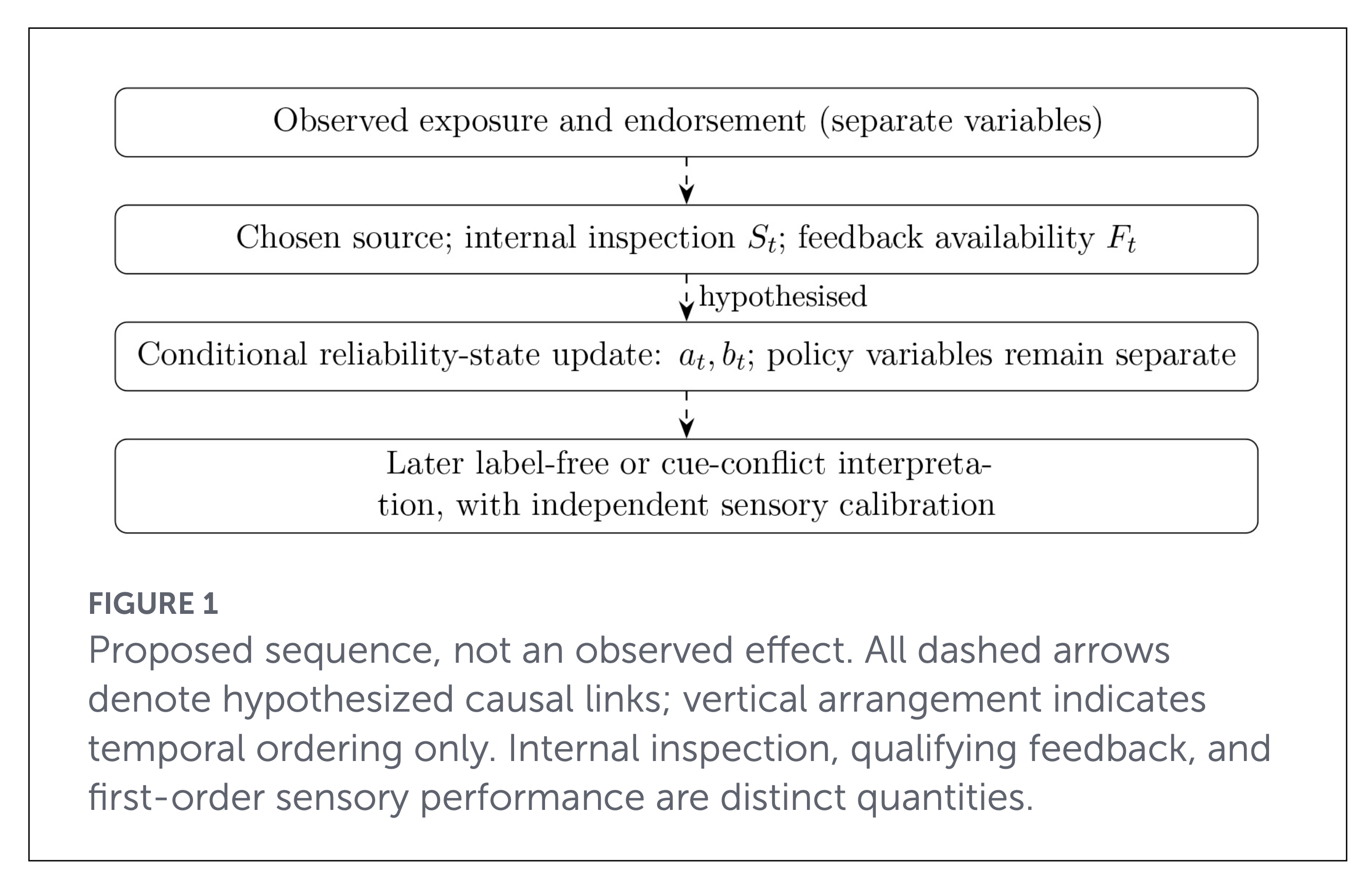
Our model separates events that everyday descriptions combine. A label may be presented, endorsed, or relied upon. The person may inspect an internal signal, and they may receive feedback that permits its reliability to be calibrated. None of these events necessarily entails the next. External advice can even encourage closer self-examination.
Calibration, in the minimal supervised rule, requires both internal inspection and qualifying task feedback. We then introduce a further assumption, explicitly open to falsification. If someone believes a signal's reliability can vary, periods without inspecting it may lead them to discount previously learned reliability information. A stationary Bayesian account, by contrast, need not change that belief in the absence of relevant observations.
We represent uncertainty about internal precision with a Gamma distribution. Under one bounded discounting rule, its mean is preserved while its concentration decreases. Integrating over that uncertainty gives the person's predictive observation model a Student-t likelihood. The underlying physical channel has not been made less accurate. The proposed change concerns what the learner believes about its reliability.
What the mathematics can, and cannot, establish
The resulting likelihood has a striking property. In a specified binary model, the log evidence available from an internal observation has a finite maximum against an opposing external label. In our worked example, ten episodes without internal inspection lower that maximum from about 2.41 to 2.06. An opposing label contributing roughly 2.20 units of log evidence can be overcome by some internal observations before that history, but not afterward under the specified deterministic decision rule.
These are illustrative model calculations, not measurements of human behaviour. Probabilistic choices do not become literally impossible. A second analytic result adds an essential complication: local evidence sensitivity can increase or decrease as uncertainty changes, depending on the parameters. There is no general theorem of psychological decline here.
The equations constrain what the theory is allowed to claim. They establish neither damaged sensation nor diminished emotional granularity, much less a change in conscious feeling.
The study that could make the theory unnecessary
Our proposed first experiment uses controlled bodily-signal discrimination, potentially respiratory resistance, because a physical stimulus can be verified without pretending to know the participant's private emotion. Generalizing from this proof of principle to ordinary affective experience would require separate validation.
The proposed design would compare externally supplied labels with self-generated labeling, reflective prompts, and a non-affective digital control. Actual label accuracy and displayed confidence would vary independently. Opportunities for internal inspection and qualifying feedback would also be manipulated separately. This matters more than simply counting how many times someone agreed with a machine.
After acquisition, cue-conflict trials would be followed by immediate and delayed tests without labels. These would assess calibrated internal-evidence use, while competing models account for prior learning, source-choice habits, reporting behaviour, and fixed robust integration. A later calibration phase would probe possible recovery.
A serious test must be capable of defeating our proposal. If external reliance increases and internal inspection declines, yet well-powered and identifiable cue-free assessments establish equivalent internal-evidence use across conditions, the hypothesized persistent transition is challenged. Even a positive result must outperform plausible alternatives. A familiar mechanism with fewer assumptions may explain the observations just as well.
The question left open
Two days after the paper appeared, I delivered a keynote at the Seoul Metropolitan Council on AI emotion interpretation and citizens' rights. There, I also publicly proposed Mental AI as a broader research programme examining the cognitive and affective-like functions of AI, their effects on human self-understanding, and the reciprocal changes arising from human–AI interaction.
Delegated Precision addresses one limited part of that programme: whether repeated external interpretation can alter the subsequent use of internal evidence. It does not establish such a change in humans, nor can it settle the institutional question of who should have authority over an AI-generated interpretation.
I take one lasting principle from this paper: when the apparent influence of an external interpreter increases, we should ask what, precisely, has changed. The source chosen? The attention given to internal signals? The learner's uncertainty? Or only the words used to report a feeling?
Delegated precision will earn its place as a distinct construct only if future evidence separates it from established explanations. The decisive observation comes after the label is gone.

Original research
Kim, R. S., & Park, T. (2026). Delegated precision: a predictive-processing hypothesis on external affective labeling and self-interpretation. Frontiers in Psychology, 17, 1904018. https://doi.org/10.3389/fpsyg.2026.1904018
Kim, R. S. (2026). Narrative-affect discrepancy as a regulated degree of freedom in 351,734 relationship narratives. PLOS ONE, 21(5), e0348715. https://doi.org/10.1371/journal.pone.0348715