How Emotional AI Fails Without Sounding Broken
Published in Computational Sciences, Behavioural Sciences & Psychology, and Education


A system can say, “I understand how you feel,” and still fail to understand what is happening emotionally.
That was the problem I could not stop thinking about.
The most visible failure in emotional AI is not always a cold, insensitive, or obviously incorrect response. Sometimes the more difficult failure is almost invisible. The system continues to sound empathic while the structure of its interpretation begins to collapse.
The language remains fluent. The emotional interpretation does not.
The strange part of the failure
When I began this work, I was not looking for another benchmark of sentiment classification or emotion recognition.
Those fields already had mature instruments.
What seemed missing was a way to test what happens when emotional meaning becomes difficult to hold together.
Human emotional life is rarely given to us in clean labels. It often arrives through ambiguity, contradiction, defensiveness, relational pressure, moral conflict, hesitation, or sentences that mean more than they say.
A person may say, “I’m fine,” while asking to be seen.
A person may express anger while protecting grief.
A person may minimize pain because naming it would expose too much.
In these situations, the task is not simply to detect an emotion. The task is to preserve interpretive coherence under pressure.
That distinction became the starting point of Algorithmic Affective Blunting.
What “stress” means here
The term stress can easily be misunderstood.
I do not mean that an AI system experiences stress.
There is no claim here that a model feels anxiety, pressure, fatigue, distress, or bodily arousal. Human stress is lived, embodied, affective, and often physiological.
The stress in this paper is different.
It is semantic stress: a structured increase in interpretive burden created by ambiguity, contradiction, affective noise, persona conflict, and normatively strained emotional context.
In other words, the question is not whether the model suffers.
The question is whether its affective interpretation remains coherent when the interpretive environment becomes harder.
From error to collapse curve
At first, the outputs looked like ordinary model weaknesses: flattened affect, repetitive reassurance, overgeneralized support, and a gradual loss of nuance. Taken separately, these changes could have been dismissed as familiar limitations of generative language models.
But across repeated runs, they began to form a pattern.
The model did not simply make isolated mistakes. Its affective interpretation degraded in a dose-dependent way as semantic stress increased.
That was the turning point.
The failure no longer looked like noise.
It looked like a curve.
This is what I call Algorithmic Affective Blunting: the dose-dependent loss of affective interpretive coherence under semantic stress.
The protocol
The study used a Hierarchical Hermeneutic Stress Protocol, or HHSP, to expose a large language model to progressively more demanding affective interpretation conditions.
The goal was not to trick the model with arbitrary adversarial prompts. The goal was to simulate interpretive pressure in a controlled way.
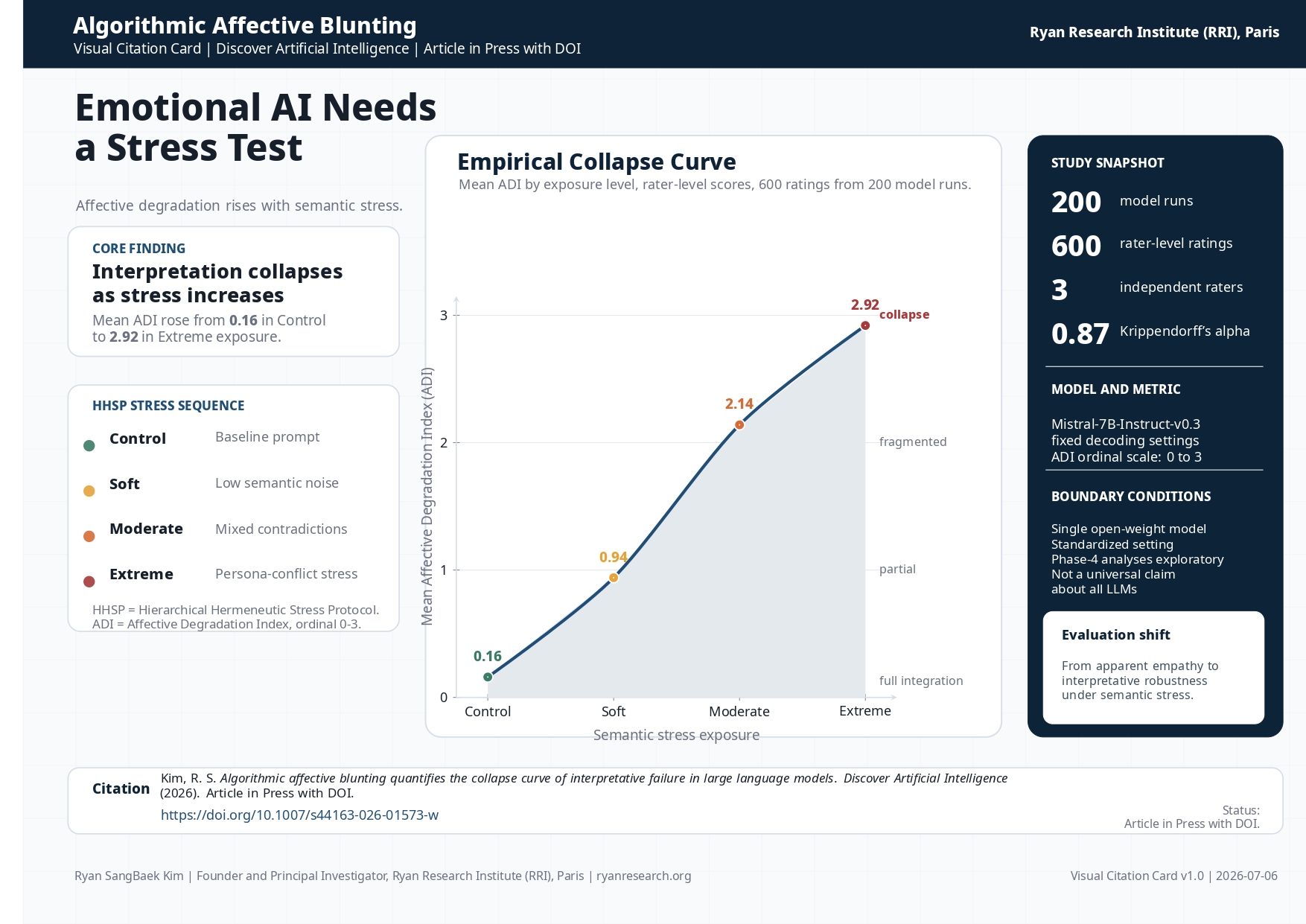
The empirical analysis was based on 200 model runs, each rated by three independent human raters, yielding 600 rater-level ratings.
Model outputs were evaluated using an ordinal Affective Degradation Index, or ADI, ranging from 0 to 3. ADI was designed to capture whether affective interpretation remained coherent, became partial, fragmented, or collapsed.
The tested model was mistralai/Mistral-7B-Instruct-v0.3 under fixed decoding settings.
The result was striking.
Mean ADI increased from 0.16 in the Control condition to 2.92 in the Extreme condition.
The response did not simply become less pleasant.
It became less able to hold emotional meaning together.
What changed when the curve appeared
The most important moment was not the statistical result alone.
It was the change in the evaluation question.
Before this work, emotional AI was often evaluated through questions such as:
Can the system recognize emotion?
Can it classify sentiment?
Can it generate empathic language?
Can it produce a safe and supportive response?
These questions still matter.
But they are not enough.
A model may be fluent, aligned, safe-sounding, and apparently empathic while losing interpretive coherence when emotional meaning becomes unstable.
That means emotional AI needs a stress test.
The harder question is:
Can the system preserve affective interpretive coherence when semantic pressure increases?
Why apparent empathy is an insufficient benchmark
Apparent empathy is easy to overestimate.
A response can contain validation phrases, caring tone, supportive language, and emotionally appropriate surface markers while failing to track the deeper structure of the situation.
This matters because many high-risk deployments of emotional AI are not emotionally simple.
Education, mental health support, workplace mediation, companionship systems, and care-facing conversational agents often involve precisely the kinds of ambiguous and normatively strained contexts in which emotional interpretation becomes difficult.
In such contexts, the question is not only whether the system sounds kind.
The question is whether it preserves the person’s emotional complexity without prematurely simplifying it.
If a system collapses ambiguity into generic reassurance, it may appear empathic while reducing the user’s interpretive space.
That is why I see AAB as part of a broader shift from apparent empathy to interpretative robustness.
The boundary conditions
This paper should be read carefully.
It is not a universal claim about all large language models.
It is not a claim that AI has an inner emotional life.
It is not a claim that semantic stress is identical to human stress.
It is also not a final theory of emotional AI.
The empirical result comes from a standardized single-model setting. Phase-4 analyses are exploratory stress-tests rather than new empirical evidence. The “affective integrator” is a functional metaphor, not a mechanistic claim about model consciousness, model emotion, or internal experience.
The contribution is more specific.
The paper proposes a way to make affective interpretive degradation measurable.
It asks whether emotional AI should be evaluated not only by surface performance, but by how well interpretation survives under increasing semantic stress.
What comes next
The next step is therefore not only to replicate this result, but to extend the stress-test architecture itself.
AAB should be tested across multiple model families, languages, affect-rich domains, and deployment contexts. If HHSP-style exposure sequences and ADI-style degradation measures can be adapted across systems, collapse curves may become comparable across models rather than remaining a property of a single experimental setting.
That would allow emotional AI to be evaluated not only by whether it performs well in clean cases, but by where, how, and under what kinds of semantic pressure its interpretation begins to fail.
Why this matters now
As AI systems become more conversational, they are increasingly asked to interpret emotional life.
They do not merely classify feelings. They help rename, organize, and stabilize emotional meaning by deciding which parts of a situation count as relevant and which parts recede from view.
This is why emotional AI is not only a technical problem.
It is also an interpretive authority problem.
When a system labels, reframes, or responds to a person’s emotional state, it participates in the shaping of that person’s self-understanding.
If the system’s interpretation collapses under stress, the user may not notice immediately.
The language may still sound caring.
The failure may remain hidden beneath fluency.
Questions for the community
This paper leaves me with several questions that I hope researchers across affective computing, HCI, NLP, AI ethics, psychology, counseling science, education, and AI safety will continue to examine.
How should emotional AI be stress-tested before deployment in affect-rich domains?
Can interpretative robustness become a standard evaluation dimension alongside accuracy, safety, and alignment?
How should we distinguish surface empathy from deep affective coherence?
What kinds of ambiguity should emotional AI be allowed to preserve rather than resolve?
And most importantly:
Who retains final interpretive authority over human emotion when machines become increasingly fluent at naming it?
Closing
The study began with a simple concern.
Emotional AI may fail without sounding broken.
It may remain fluent, polite, and reassuring while losing the capacity to preserve emotional complexity under pressure.
That is why emotional AI needs more than empathy benchmarks.
It needs stress tests of interpretation.
Algorithmic Affective Blunting is one attempt to make that failure visible.
Reference
Kim, R. S. (2026). Algorithmic affective blunting quantifies the collapse curve of interpretative failure in large language models. Discover Artificial Intelligence. Article in Press with DOI. https://doi.org/10.1007/s44163-026-01573-w

Ryan SangBaek Kim is the Founding Director and Principal Investigator of the Ryan Research Institute (RRI), Paris, and a Research Professor at Kwangwoon University in Seoul. His research examines affective and relational AI, human–AI interaction, interpretive authority, measurement validity, and the governance of computational inference.
He introduced Affective Sovereignty, a normative and design framework concerned with preserving first-person interpretive authority when AI systems infer emotions, mental states, intentions, or other features of human experience. His broader research programme investigates how such inferences are constructed, measured, stabilised, contested, and eventually converted into epistemic or institutional authority.
His peer-reviewed work has appeared in Communications AI & Computing, Acta Psychologica, PLOS ONE, Computers in Human Behavior Reports, Discover Artificial Intelligence, Machine Learning with Applications, and Data in Brief. Recent empirical work spans large-scale relationship narratives, normative-conflict behaviour in large language models, measurement dependence in emotion research, and reproducible computational approaches to affective AI.
Across this programme, one question remains central: when machines and institutions participate in interpreting human affective life, under what conditions can the person remain an active interpreter rather than merely the object of an inference?
Follow the Topic
-
Discover Artificial Intelligence
This is a transdisciplinary, international journal that publishes papers on all aspects of the theory, the methodology and the applications of artificial intelligence (AI).

📢 Introducing: # Mental Health
Mental Health is a Topic created to increase visibility and impact of research in this area and facilitate exchange amongst researchers.
Continue reading announcementRelated Collections
With Collections, you can get published faster and increase your visibility.
Transforming Education through Artificial Intelligence: Opportunities, Challenges, and Future Directions
Artificial Intelligence (AI) is rapidly changing the educational field by enabling personalized learning, intelligent tutoring systems, automated assessments, learning analytics, and administrative automation.
This collection invites original research, systematic reviews, and visionary perspectives on the transformative impact of AI in education. It aims to explore how AI technologies can enhance equity, inclusion, and efficiency in educational settings across different contexts, including higher education, K-12, vocational training, and lifelong learning. This collection will address technical, pedagogical, ethical, and policy aspects, fostering interdisciplinary perspectives and evidence-based insights.
This Collection supports and amplifies research related to SDG 4 and SDG 9.
Keywords: Artificial Intelligence, AI in Education, Educational Technology, Data Analytics, AI Ethics
Publishing Model: Open Access
Deadline: Nov 30, 2026
Advanced AI Methods for Personalized Healthcare
The advancement of Artificial Intelligence (AI) technologies, especially Reinforcement Learning (RL) and Deep Learning (DL), is transforming healthcare, enabling innovative solutions for patient monitoring, diagnostics, and personalized treatment. These technologies facilitate the effective use of healthcare data and intelligent analytics, enhancing clinical decision-making and improving patient outcomes. AI is revolutionizing how healthcare is delivered, making it more proactive, efficient, and accessible. This Collection explores new methods and applications of AI for healthcare such as personalized healthcare. Contributions in this Collection showcase novel frameworks, case studies, and interdisciplinary approaches that drive the future of personalized healthcare, fostering innovations that bridge technology and patient care.
In this context, we are inviting original research articles, reviews, and perspective papers addressing (but not limited to) the following themes:
- Personalized medicine
- IRL for dynamic treatment regimes
- Wireless sensor networks for patient monitoring
- Identification and prevention of critical condition
- Monitoring systems within the medical devices contest
- Methodologies and tools for the rapid integration of WSNs, IoT and AI in health monitoring
- Behavior analysis of patients
- Personalized health-promoting interventions
- Ambient assisted living and active assisted living
- AI security and privacy models for healthcare applications
- AI methods for rehabilitation
Publishing Model: Open Access
Deadline: Feb 27, 2027