Tiny Droplets, Big Chemistry: From H2O2 Detection to Interfacial Mechanistic Attribution
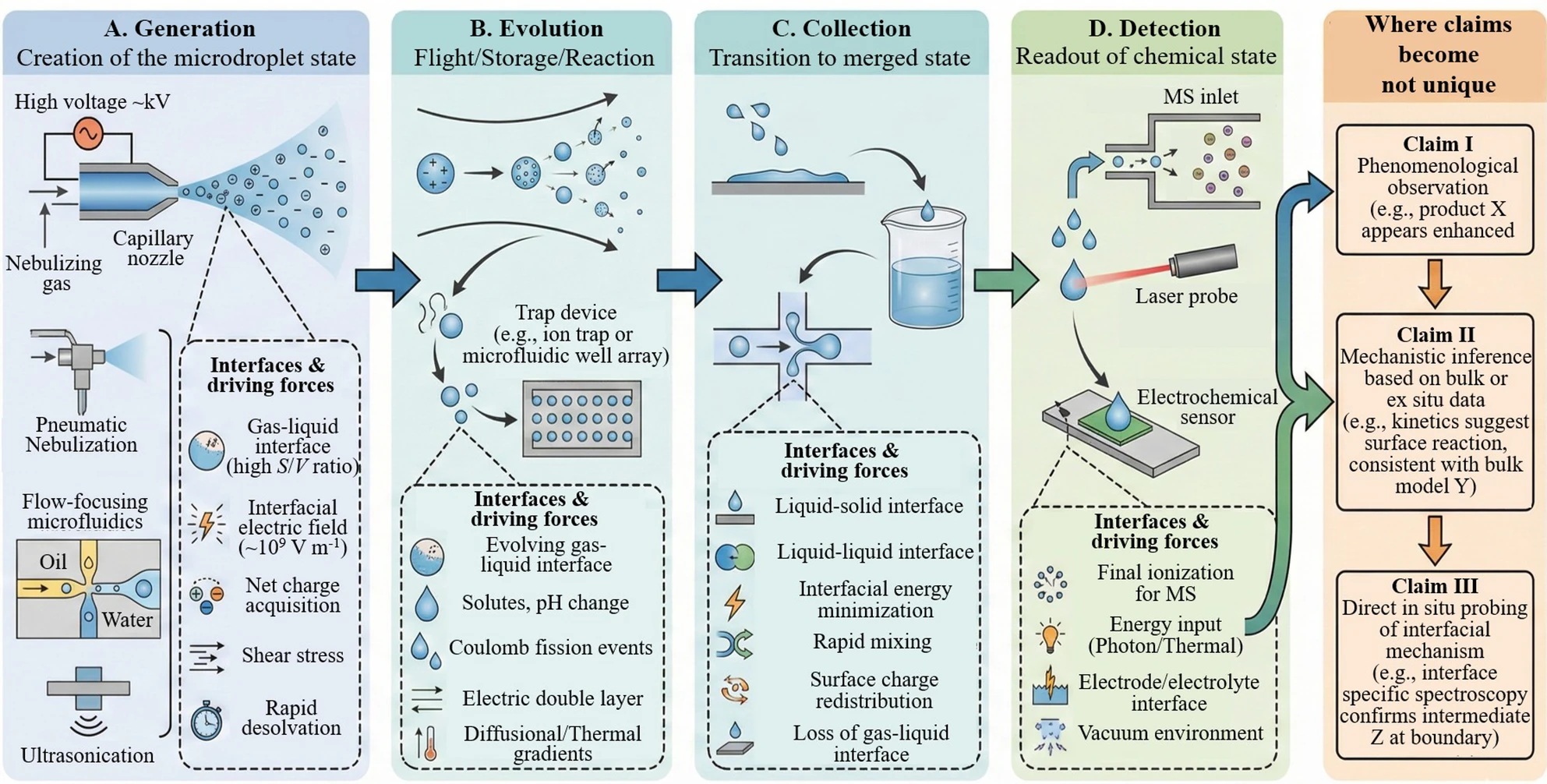


Catal has recently published an Analysis article entitled “Evidencing microdroplet H2O2 redox chemistry: from detection to mechanistic attribution” by researchers from Jiangsu University. The article reviews hydrogen peroxide (H2O2) and reactive oxygen species (ROS) formation in aqueous microdroplets, a rapidly developing area at the intersection of interfacial chemistry, atmospheric chemistry, electrochemistry, and oxidant synthesis.
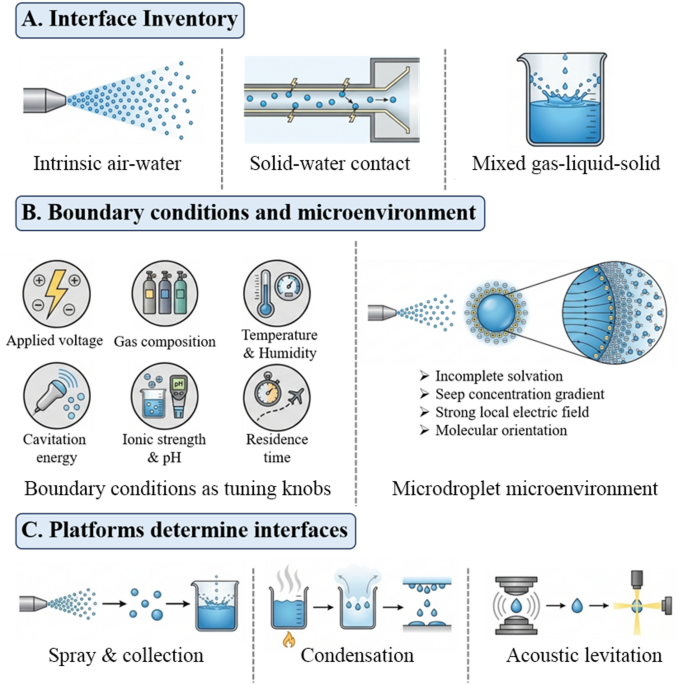
Micron-sized water droplets differ from bulk water. Because a large fraction of molecules reside near the gas–liquid interface, they experience incomplete solvation, steep concentration gradients, interfacial ion organization, charge separation, and strong local electric fields. These features make aqueous microdroplets chemically active environments that can support spontaneous redox processes and generate oxidants such as H2O2 and transient ROS without added molecular catalysts.
However, the field still faces an important mechanistic challenge. The central question is no longer simply whether H2O2 can be detected in microdroplet-derived samples. Instead, the key issue is how to rigorously determine when the oxidant is formed, where the reaction occurs, and which interface or mechanistic pathway is responsible. Droplets produced by spraying, condensation, ultrasonication, levitation, or emulsification can differ in solid contact, charge state, gas exposure, shear, cavitation, humidity, and residence time. As a result, similar H2O2 or ROS signals may arise from different operative interfaces and different boundary-condition regimes.
Key Insights
Microdroplet interfaces are chemically active, but mechanistic attribution requires rigor. Accumulated evidence supports the chemical competence of aqueous gas–liquid interfaces to generate H2O2 and ROS. At the same time, assigning a measured signal uniquely to a pristine air–water interface is a stronger mechanistic claim that requires stricter controls.
Experimental boundary conditions explain many apparent disagreements. Different droplet-generation methods introduce different levels of solid contact, imposed charge, gas-phase exposure, evaporation, and residence time. These factors can reshape both thermodynamic driving forces and kinetic product accumulation. Multiple mechanistic regimes can converge to the same H2O2 endpoint. O2-involved reduction, water/OH–-derived interfacial chemistry, solid-mediated redox processes, source-region chemistry, and post-collection reactions may all contribute under different conditions. The article therefore argues against forcing all observations into a single universal mechanism.
An evidence ladder helps prevent overinterpretation. The Analysis distinguishes three levels of evidence: detection, net production, and interfacial attribution. Detection establishes that an H2O2- or ROS-consistent signal is present; net production shows that the species accumulates during the droplet-processing window; interfacial attribution requires competing sources such as dissolved O2, wetted solids, source-region effects, collection artefacts, and post-collection reactions to be experimentally bounded. Endpoint measurements cannot by themselves reveal the reaction origin. Many H2O2 assays are performed after droplet collection. Such measurements integrate droplet generation, flight or residence, evaporation, deposition, collection, storage, and detection. They are valuable for quantification, but they cannot alone locate the formation site or identify the operative interface.
Electrostatics provides a powerful but model-dependent framework. Interfacial electric fields, charge separation, electrical double layers, and ion gradients can make microdroplets resemble confined microelectrochemical systems. However, electric field, surface potential, ζ-potential, net droplet charge, and field-sensitive spectroscopic shifts are not interchangeable quantities. The microelectrochemical-cell picture becomes most useful when electrostatic observables are linked to explicit model assumptions.
Standardized experimental reporting is essential. The article proposes that future studies should explicitly report and control droplet size distribution, generation mode, wetted materials, gas composition, dissolved-O2 protocol, humidity, temperature, residence time, collection conditions, time-to-assay, and orthogonal validation methods.
Significance of the Work
This Analysis provides a unified conceptual and methodological framework for microdroplet redox chemistry. Rather than treating conflicting results as simple contradictions, it shows that different studies may operate in different mechanistic regimes. Oxygen can serve as a reactant, a competing electron acceptor, or a kinetic factor affecting H2O2 accumulation and survival. Solid surfaces can shift the operative interface from air–water chemistry to solid–water or mixed gas–liquid–solid chemistry. Humidity, residence time, and collection procedures can further alter evaporation, gas uptake, radical lifetime, product stability, and downstream reactions.
By separating detection from net production and interfacial attribution, the article offers a practical language for evaluating the strength of experimental claims. This framework protects positive observations from being dismissed simply because the mechanism is unresolved, while also preventing endpoint detection from being overinterpreted as definitive proof of pristine air–water interfacial formation.
Looking forward, the authors emphasize the need to move primary readouts closer to the droplet event itself. Contact-minimized baseline experiments, explicit control of O2 and gas exposure, single-droplet or real-time kinetic measurements, and orthogonal validation of both stable products and transient intermediates will be critical for building a more reproducible and predictive understanding of microdroplet interfacial redox chemistry.
Authors and Affiliations
Tong Dong, Xiaoxue Song, Yuqiao Zhang, Miaomiao Chen, Jianming Zhang, Shun Li*, and Long Zhang*
Affiliations: Institute of Quantum and Sustainable Technology (IQST), School of Chemistry and Chemical Engineering, Jiangsu University, Zhenjiang, Jiangsu, China; School of Ecology and Environment, Jiangsu Province Engineering Research Center of Agricultural and Rural Pollution Prevention Technology and Equipment, Nantong, Jiangsu, China; Jiangsu Engineering Research Center of Environmental Functional Materials and Pollution Control, Nantong College of Science and Technology, Nantong, Jiangsu, China.
Corresponding authors: Shun Li (shun@ujs.edu.cn) and Long Zhang (longzhang@ujs.edu.cn).
How to Cite This Article
Dong, T.; Song, X.; Zhang, Y.; Chen, M.; Zhang, J.; Li, S.; Zhang, L. Evidencing microdroplet H₂O₂ redox chemistry: from detection to mechanistic attribution. Catal 2026, 2, 14. https://doi.org/10.1007/s44422-026-00028-8

Follow the Topic
-
Catal
Catal is an open access journal covering full spectrum of catalysis critical advances. From biocatalysts to heterogeneous catalysts, it integrates fundamental and applied sciences. Catal offers a primary platform for researchers and practitioners in the field.

Related Collections
With Collections, you can get published faster and increase your visibility.
National Catalysis Conference 2025
The 22nd National Catalysis Conference, held in December 2025 in Xiamen, China, stands as the largest national academic event in the field of catalysis, bringing together leading scientists from academia and industry to discuss frontier research and emerging technologies across catalytic science.
In collaboration with several internationally recognized researchers from Xiamen University - the main organizer of the conference - Catal will publish a Special Issue featuring selected contributions from the meeting. This joint effort ensures high academic standards and showcases the scientific breadth and excellence presented at the conference.
Potential topics include, but are not limited to:
• Catalytic materials
• Thermocatalysis
• Electrocatalysis
• Biomass and CO₂ conversion
• Industrial catalysis
• Theoretical and computational catalysis
Publishing Model: Open Access
Deadline: Dec 31, 2026
Porous Materials for Sustainable Green Catalysis
The advancement of our collective understanding in the field of porous materials for sustainable green catalysis is crucial as we face urgent environmental challenges and the need for sustainable energy solutions. The integration of porous materials into catalytic processes has opened new avenues for improving efficiency, selectivity and stability while minimizing waste. Significant advances have been made, including the development of zeolites, mesoporous materials, metal-organic frameworks (MOFs) and covalent organic frameworks (COFs), which have demonstrated remarkable catalytic performance in various reactions.
Future research holds immense potential, with speculations ranging from the design of novel porous materials with tailored properties to their application in industrial catalysis, biocatalysis, H2 production and carbon capture technologies. By continuing this research, we can drive progress toward achieving Sustainable Development Goals (SDGs), particularly in clean energy (SDG 7) and climate action (SDG 13), ultimately fostering a sustainable future for our planet.
We invite researchers to contribute to this special Collection by submitting research articles, brief communications, perspectives, reviews, and analyses.
Topics of interest include but are not limited to:
- Synthesis of porous materials
- Catalytic performance evaluation
- Green synthesis methods
- Application in environmental remediation
- CO2 conversion technologies
- Biocatalysis in porous matrices
- Design of multifunctional porous catalysts
- Mechanistic studies of catalysis
Publishing Model: Open Access
Deadline: Dec 31, 2026




Please sign in or register for FREE
If you are a registered user on Research Communities by Springer Nature, please sign in