How Amazonian Palms Quietly Outperform Trees Under Drought Stress
Published in Ecology & Evolution and Plant Science
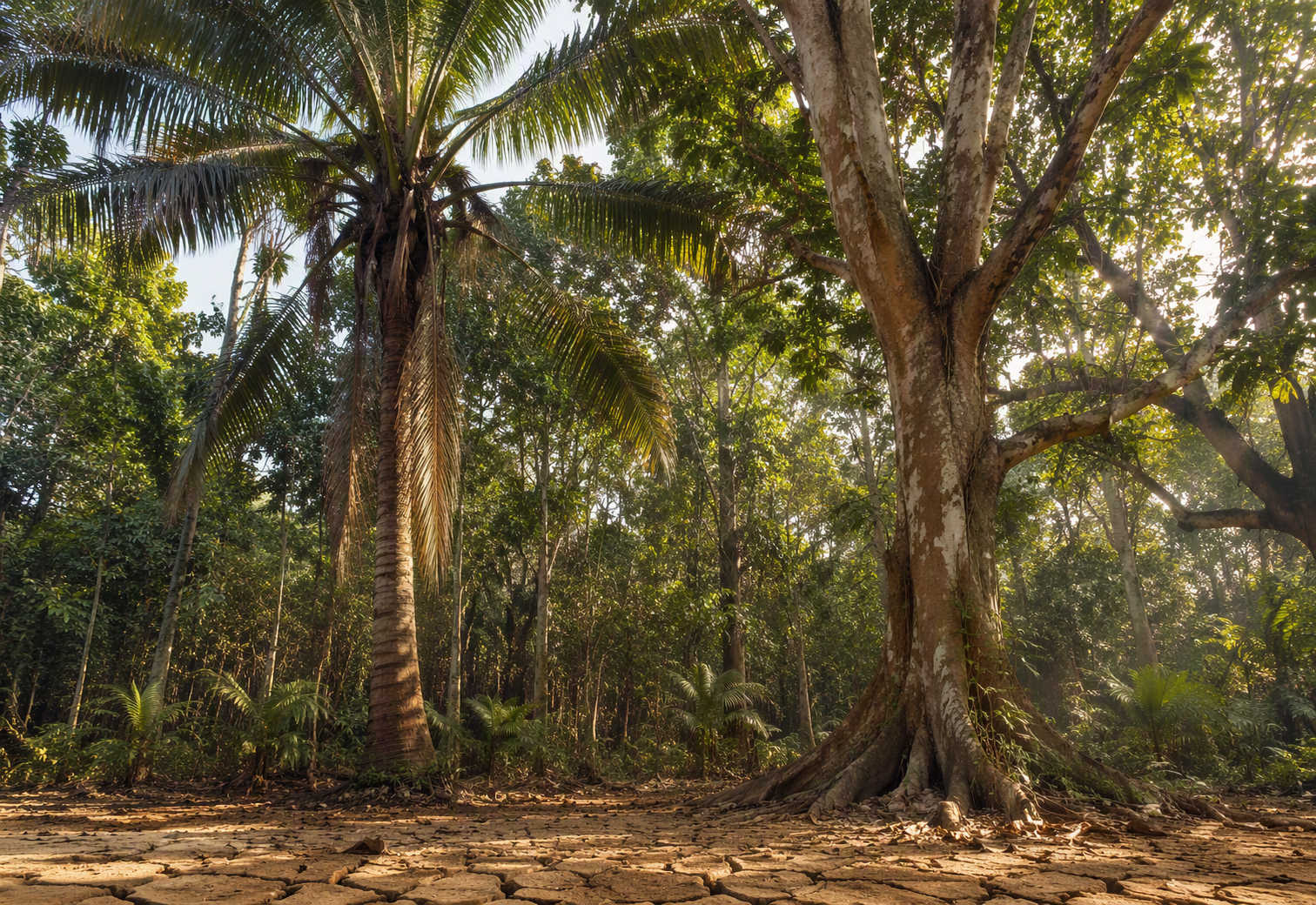



As climate extremes tighten their grip on tropical ecosystems, understanding how plants endure drought is no longer a niche pursuit—it’s central to the future of agriculture and forestry. A recent study published in Tropical Plant Biology explores this question in a striking way, comparing how Amazonian palms and dicotyledonous trees manage water within their stems. The research, led by corresponding author Dr. Lion R. Martius, peels back a hidden layer of plant physiology and reveals a story of resilience that could reshape how scientists think about plant survival strategies.
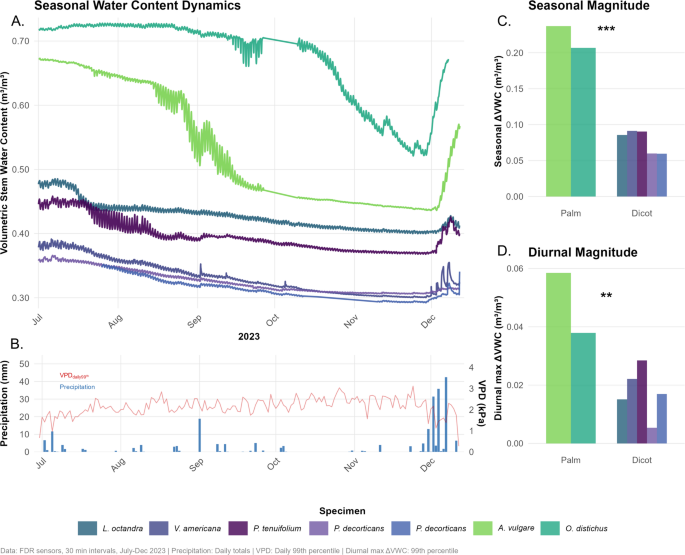
At the heart of the study is a deceptively simple question: how do plants store and use water when drought hits? To answer it, the team deployed frequency domain reflectometry (FDR) sensors—technology capable of continuously tracking stem water content in real time. This allowed them to follow the hydration dynamics of coexisting species in the eastern Amazon during the extreme 2023 drought, generating one of the first high-resolution datasets of its kind.
What they found was remarkable. Palms dramatically outperformed nearby dicot trees in their ability to store and mobilize water. Not only did they hold significantly more water within their stems, but they also released it more effectively on daily and seasonal timescales. This capacity appears to stem from a fundamental anatomical difference: while dicot trees restrict water storage to sapwood, palms—being monocots—can use nearly their entire stem volume as a living reservoir. The result is a hydraulic system that works less like a pipeline and more like a battery, buffering stress and sustaining function when external water becomes scarce.
Even more compelling is how palms behave under stress. The study shows that they maintain strong daily water discharge even at low hydration levels, while dicot trees begin to falter under similar conditions. This suggests fundamentally different survival strategies: trees become conservative, closing down water use to avoid damage, while palms continue operating—drawing on internal reserves to ride out the dry spell. For researchers working on crop resilience or agroforestry systems, these contrasting strategies open intriguing possibilities for selecting or engineering plants with improved drought tolerance.
The researchers also identified a critical soil moisture threshold—around 0.19 m³/m³—below which stem water content declines rapidly, signaling a likely disconnection from soil water supply. This insight has practical implications beyond the Amazon. For agricultural scientists, it underscores how threshold-based approaches could improve irrigation management or drought monitoring, especially in systems where plant water status is difficult to gauge directly.
Perhaps the most important takeaway is conceptual. Palms are often overlooked in plant physiology, yet they are among the most abundant and ecologically dominant species in Amazonian forests. By showing that they operate under a distinct hydraulic logic, this research challenges long-standing assumptions derived mostly from studies on dicot trees. For agriculture, forestry, and climate adaptation research, it’s a reminder that functional diversity matters—and that solutions to resilience may lie in traits we’ve barely begun to explore.
In a warming world, where drought is becoming the rule rather than the exception, this study invites researchers across disciplines to rethink how plants cope with water limitation. The lesson from Amazonian palms is clear: resilience is not just about surviving stress—it’s about how cleverly a plant can store, move, and spend its most precious resource.
Text and image were created with the assistance of AI.

Follow the Topic
-
Tropical Plant Biology
Tropical Plant Biology publishes research on tropical plant science, including development, physiology, evolution, phylogenomics, genetics, cellular and molecular biology, genomics, ecological genomics, and molecular breeding.





Please sign in or register for FREE
If you are a registered user on Research Communities by Springer Nature, please sign in